🧭 Compass Bearing Calculator
Convert bearings, calculate back bearings, find resultant headings & more — true, magnetic & grid
| Compass Point | Abbrev. | Bearing Range (°) | Center (°) |
|---|---|---|---|
| North | N | 348.75 – 360 / 0 – 11.25 | 000.0 |
| North-Northeast | NNE | 11.25 – 33.75 | 022.5 |
| Northeast | NE | 33.75 – 56.25 | 045.0 |
| East-Northeast | ENE | 56.25 – 78.75 | 067.5 |
| East | E | 78.75 – 101.25 | 090.0 |
| East-Southeast | ESE | 101.25 – 123.75 | 112.5 |
| Southeast | SE | 123.75 – 146.25 | 135.0 |
| South-Southeast | SSE | 146.25 – 168.75 | 157.5 |
| South | S | 168.75 – 191.25 | 180.0 |
| South-Southwest | SSW | 191.25 – 213.75 | 202.5 |
| Southwest | SW | 213.75 – 236.25 | 225.0 |
| West-Southwest | WSW | 236.25 – 258.75 | 247.5 |
| West | W | 258.75 – 281.25 | 270.0 |
| West-Northwest | WNW | 281.25 – 303.75 | 292.5 |
| Northwest | NW | 303.75 – 326.25 | 315.0 |
| North-Northwest | NNW | 326.25 – 348.75 | 337.5 |
| Region / State | Approx. Declination | Direction | Notes |
|---|---|---|---|
| Maine, NE Coast | –14° to –16° | West | High west declination |
| Florida | –5° to –7° | West | Moderate west |
| Texas | +3° to –3° | Near zero | Agonic line passes nearby |
| Colorado / Utah | +9° to +11° | East | Mountain states |
| California (S) | +11° to +13° | East | West Coast |
| Washington State | +15° to +17° | East | High east declination |
| Alaska (SE) | +18° to +22° | East | Very high east |
| UK / Ireland | –1° to +2° | Near zero | Low declination |
| Decimal Degrees | NATO Mils | Radians | Compass Point |
|---|---|---|---|
| 000° | 0000 mils | 0.0000 | North |
| 045° | 0800 mils | 0.7854 | NE |
| 090° | 1600 mils | 1.5708 | East |
| 135° | 2400 mils | 2.3562 | SE |
| 180° | 3200 mils | 3.1416 | South |
| 225° | 4000 mils | 3.9270 | SW |
| 270° | 4800 mils | 4.7124 | West |
| 315° | 5600 mils | 5.4978 | NW |
| 360° | 6400 mils | 6.2832 | North |
| Decimal Degrees | Degrees | Minutes | Seconds |
|---|---|---|---|
| 45.5° | 45° | 30' | 00" |
| 45.75° | 45° | 45' | 00" |
| 90.25° | 90° | 15' | 00" |
| 123.567° | 123° | 34' | 01.2" |
| 270.333° | 270° | 19' | 59.9" |
| 315.1° | 315° | 06' | 00" |
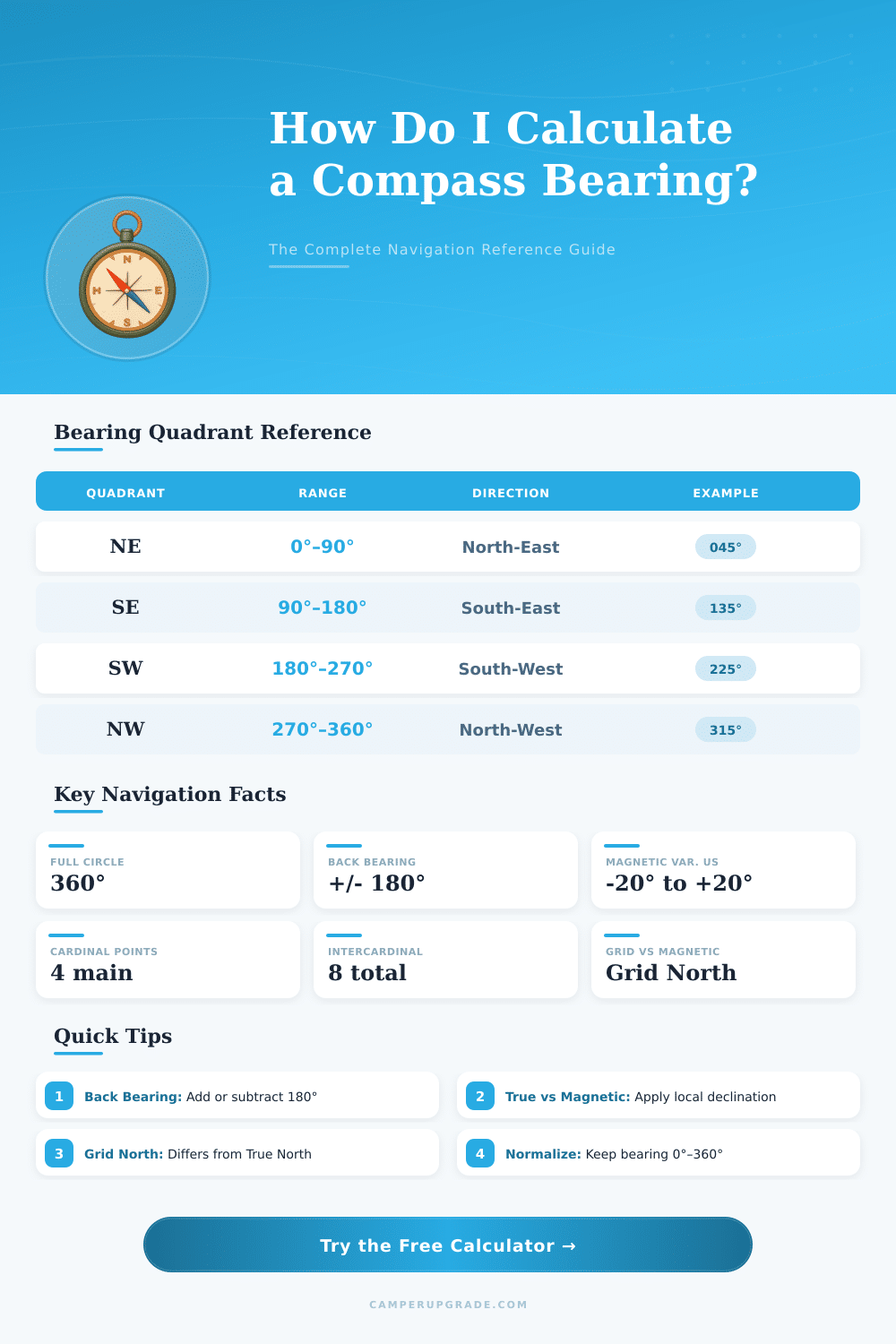
Compass Bearing shows the exact direction or angle, from that one can go. It depends on the present place, and because it works in a cycle the north matches 0 and 360 degrees. Compass Bearing estimates the angle clockwise between a spot and the real north on a Compass.
To find it, one counts the precise degree, how the chosen way turns from the north.
What Is a Compass Bearing?
The word “Bearing” simply means “direction.” The phrase “Compass Bearing and distance” came from army or hiking surroundings. It helps to exactly describe direction together with length. GPS devices work similarly.
That is the Compass direction of the current place to the intended spot, that explains, where that place or thing is.
There are various types of Bearings, that one must know in broad lines. One measures real Bearing clockwise from the geographic real north, which is the direction of the spin axis of the Earth. Compass Bearing is counted clockwise from the magnetic north, that a magnetic Compass shows.
Compass Bearing and magnetic Bearing are actually the same thing, because a Compass always shows to the magnetic north pole. Magnetic north diffres from real north. One estimates absolute Bearing by means of a Compass.
In navigation tools Bearings help to find the angle between an object’s direction and magnetic north. One can hold a small Compass to the eye to observe an object, for instance a lighthouse, and the Compass map shows the value. A Compass itself is a device for finding directions, with a circle and magnetic needle, that always shows north.
Bearings are always written by means of three figures. The Bearing of one object about another is the angle between the line binding them and the north line threw the first. For instance, from spot O one can note one direction as N30°E, another as N60°W, another as S70°E and another as S80°W.
While writing a Bearing, the note carries, from that line one measured and in that sense. For instance, if one starts from north and turns 42 degrees west to reach position B, the Compass Bearing of B will be N42°W.
To convert real Bearing into Compass Bearing, one can draw it on a NESW Compass, starting at north and turning clockwise. Bearings give a more precise way than simply saying “go east” or “west.” Declination shows the difference between real north from a chart and magnetic north. Magnetic north changes according to place and according to time, and the difference can besignificant in certain areas.
Keeping a Compass level, one gets a more precise reading. In theory, taking precise Bearings is a simple thing. It is enough to set the Compass, choose an object in the distance, that the arrow shows, and walk over there.
Later repeat. After setting a Bearing, the Compass shows, how the present way turns from it.