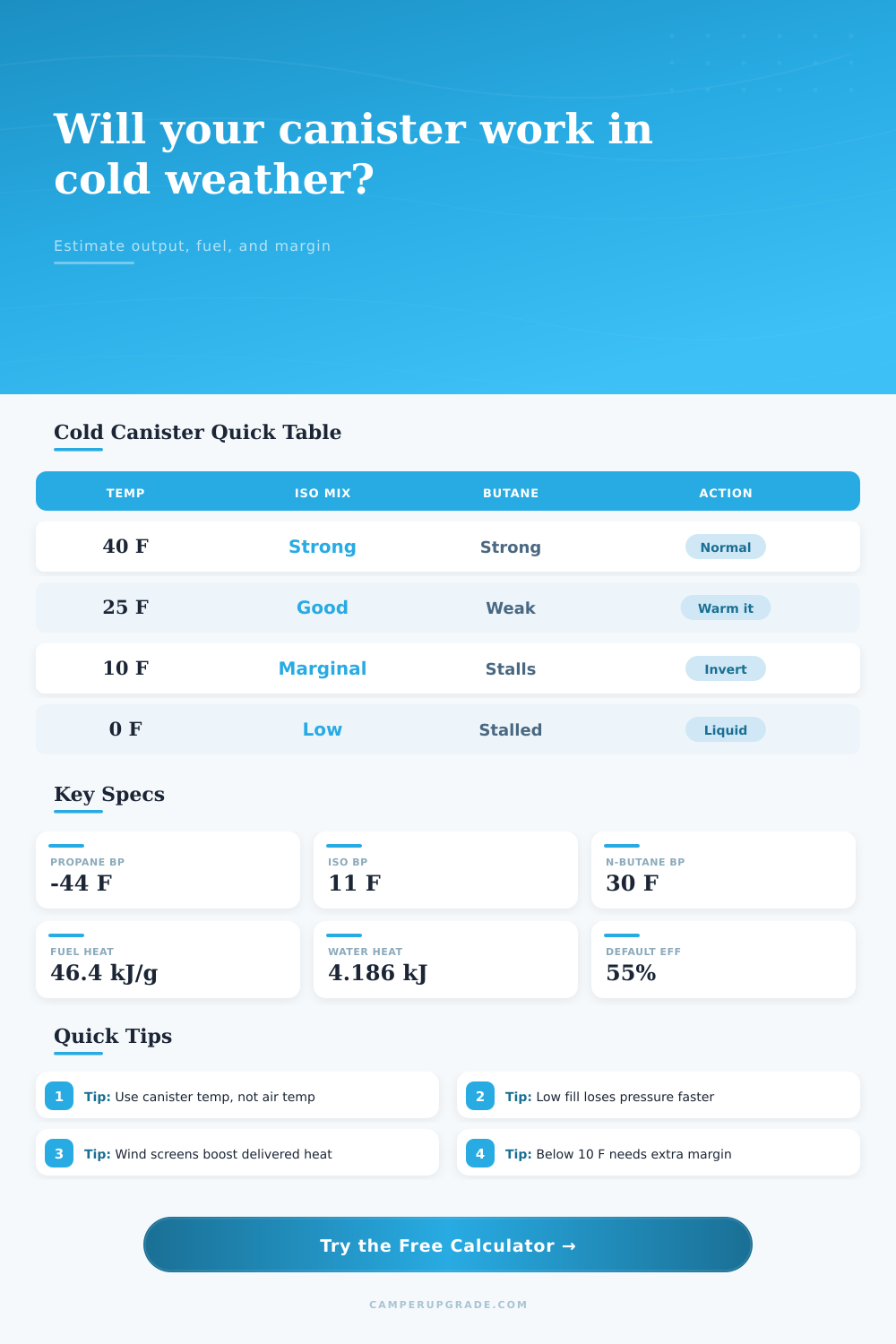
Cold Weather Canister Derating Calculator
Estimate pressure loss, delivered stove output, boil time, usable fuel, and canister margin from blend, temperature, fill level, wind, and water load.
⛽Named cold-camp presets
🌡Canister, stove, and water inputs
The derating model estimates vapor pressure behavior from propane, isobutane, and n-butane boiling points, then adjusts for fill level, cold soak, feed mode, wind, and heat transfer. Use stove manufacturer limits for final safety decisions.
Cold-weather derating result
⚙Fuel blend spec comparison grid
📊Fuel blend cold reference
| Fuel blend / model | Modeled composition | Cold behavior | Best calculator use |
|---|---|---|---|
| MSR IsoPro | 80% isobutane / 20% propane | Strong shoulder-season vapor pressure | Backpacking stove margin near freezing |
| Jetboil Jetpower | Iso-propane model, 80/20 baseline | High pressure with integrated pot systems | Fast-boil canister planning |
| Primus Power Gas | Isobutane / propane model | Good output below freezing when warmed | Uncertain spring-to-fall camp weather |
| Snow Peak GigaPower ProIso | Isobutane / propane model, 85/15 baseline | Stable pressure above the isobutane edge | Light alpine brew and meal loads |
| Butane-heavy mixed canister | n-butane / propane model | Falls off quickly below freezing | Mild camp checks and warning margins |
| Pure n-butane reference | 100% n-butane | Can stall at ordinary winter temps | Cold-soak fail point demonstration |
❄Temperature derating reference
| Canister temp | 80/20 iso-propane output | n-butane output | Planning action |
|---|---|---|---|
| 40°F / 4°C | Near normal with light derate | Usable but weaker | Use normal reserve |
| 25°F / -4°C | Noticeable output loss | Marginal vapor feed | Warm canister before lighting |
| 10°F / -12°C | Edge of upright use | Stalled | Use remote inverted or alternate fuel |
| 0°F / -18°C | Low pressure; propane fraction dominates | Stalled | Plan major extra margin |
| -10°F / -23°C | Very low without liquid feed | Stalled | Do not rely on upright vapor feed |
🔥Water heat load and fuel formulas
| Water task | Heat load formula | Fuel at 55% efficiency | Cold planning note |
|---|---|---|---|
| 0.5 L from 40°F to 203°F | 0.5 x 4.186 x 90.6°C | About 7.4 g before wind | Good single mug check |
| 1.0 L from 40°F to 203°F | 1.0 x 4.186 x 90.6°C | About 14.8 g before wind | Common meal batch |
| 1.5 L from 32°F to 203°F | 1.5 x 4.186 x 95°C | About 23.3 g before wind | Two-person dinner load |
| 1.0 L snow melt to boil | Melt 334 kJ/kg plus heat water | About 26 g before wind | Requires large reserve |
🧮Canister size and trip margin table
| Canister fuel size | Warm 1 L boils at 14.8 g | Cold 1 L boils at 19 g | Reserve note |
|---|---|---|---|
| 100 g | About 6.8 batches | About 5.3 batches | Overnight or backup size |
| 110 g | About 7.4 batches | About 5.8 batches | Small pot systems |
| 220 g | About 14.9 batches | About 11.6 batches | Two-person weekend base |
| 227 g / 8 oz | About 15.3 batches | About 11.9 batches | Common US backpacking size |
| 450 g | About 30.4 batches | About 23.7 batches | Basecamp and camper cooking |
📝Cold canister calculation tips
Your stove won’t work before dawn, which is often the coldest part of the day. When you need hot water for coffee, it won’t boil because contents of the canister no longer behave as a gas. Instead, they are starting to act more like a liquid. That’s what happens with that phase shift, so knowing how it works will keep you from freezing in your tent.
Most of us determine our cookset based off the air temperature, but that’s not the important number. What we want to know is what’s actualy happening to the temperature of canister itself. Even though the air might be really cold (if there’s wind), keeping the canister inside your jacket or sleeping bag keep it warmer. Because that’s the point: Vapor pressure isn’t determined by the weatherman’s prediction; it’s determined by fuel temp. So when you plug numbers into the calculator above, you’re modeling real life, not making guesses based on outdoor conditions. It’s that kind of simple but rigid chemistry.
Why Your Stove Stops Working in Cold Weather
Propane will work just about anywhere it gets cold enough, down to negative forty-four degrees Fahrenheit at its boiling point. N-Butane boils around thirty degrees, while isobutane boil around eleven. A winter blend is simply a mixture of those fuels so they keeps running until one reaches its boil-off point. Below that, the canister will cool past the boil-off point of the primary fuel, creating a large reduction of pressure inside the canister. Less fuel go through the regulator and you have no flame. This is not a failed regulator, but rather a physical limitation. Iso-propane lasts longer in winter conditions, whereas pure n-butane stall out sooner.
How full the canister is also play a role in how it performs. Even at constant temperatures, burning fuel reduces amount of air pressure in the headspace (the space above the liquid). Propane has a greater vapor pressure than butane and burns more quickly, which leave a weaker mixture. By the third or fourth meal, the remaining fuel will be chemically weaker then it was at breakfast. Remember to plan for this decline on your trip margin. A half-full canister isn’t the same thing as a full one.
All of this gets worse if there is any wind while you cook, since that will also remove heat from both the canister and the pot. Even with the most efficient stove system, windy exposure can reduces your efficiency by over 50%. Wind screens help maintain thermodynamic efficiency. Melting snow takes a lot of energy long before it reach a boiling point. All of this makes calculating boil time tricky.
That’s where the reference table comes in. While it certainly shows the behavior of various blends at different temperatures, that’s not what’s cool about it. What’s cool is that it will show the cumulative effect. Run the numbers for multiple days and cold starts/fill levels. Many times they come out tight, which is good since we’ll be using conservative plans when cooking in the wintertime. There isn’t room for guessing margins when they’re this tight.
Store your fuel warm if/when you can and bring even more than what the number calculator tells you should of bring. I don’t want to think about running out of fuel, that stuff is serious business and there aren’t any gas stations along the trail. Getting comfortabley with these factors makes it a doable routine rather than a hard situation. Now all those hot drinks won’t feel like a fight against your gear.