Clothing Layering Temperature Calculator
Estimate feels-like temperature, required clo, layer gap, and chill or overheating risk from weather, activity, exposure time, metabolism, and selected layers.
Layering estimate
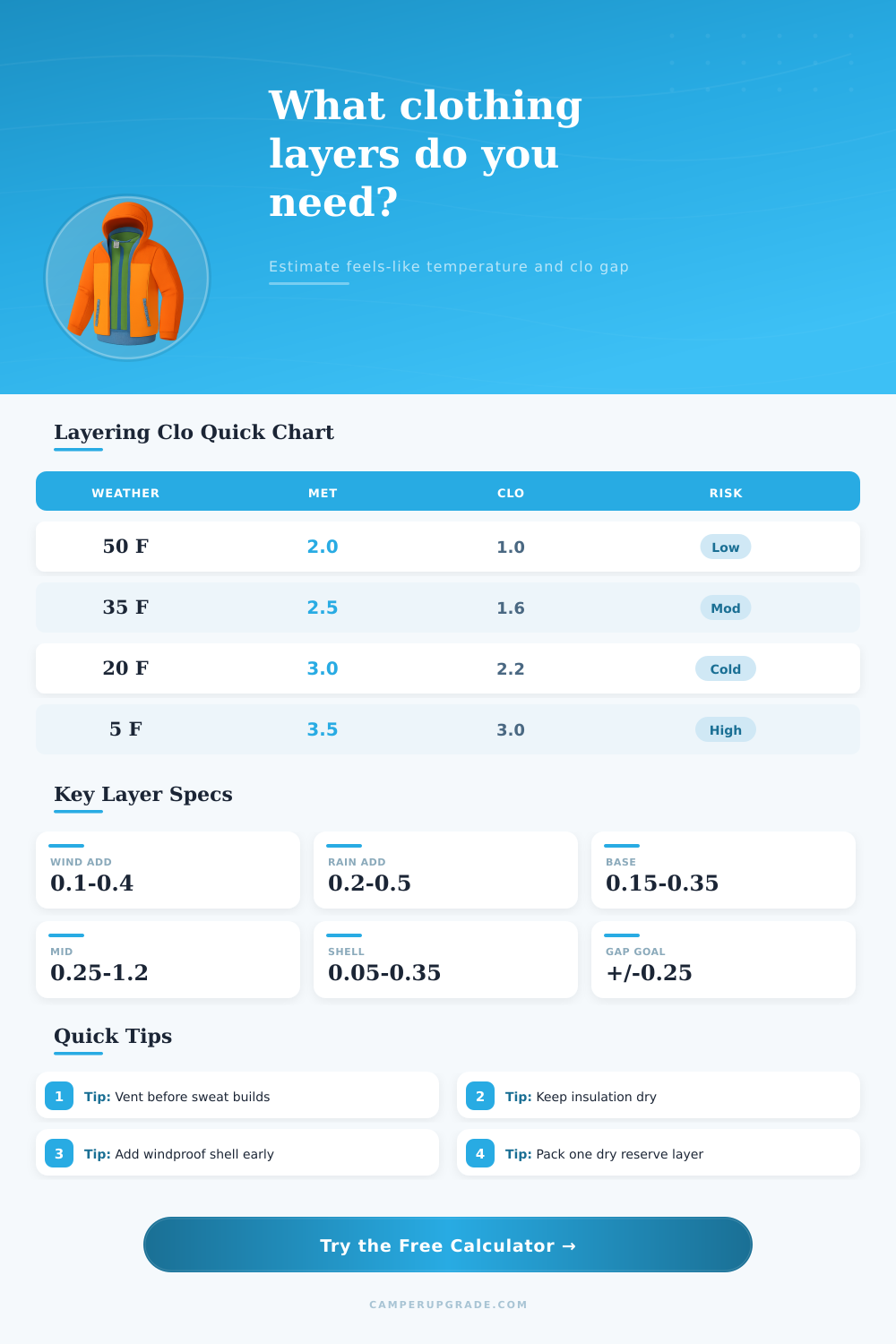
| Feels-like range | Rest / 1.2 MET | Walk / 2.5 MET | Hard move / 5 MET |
|---|---|---|---|
| 50°F to 60°F | 0.9 to 1.2 clo | 0.4 to 0.7 clo | 0.2 to 0.4 clo |
| 35°F to 50°F | 1.3 to 2.0 clo | 0.7 to 1.2 clo | 0.3 to 0.7 clo |
| 20°F to 35°F | 2.0 to 2.8 clo | 1.2 to 1.8 clo | 0.7 to 1.1 clo |
| 5°F to 20°F | 2.8 to 3.8 clo | 1.8 to 2.5 clo | 1.1 to 1.7 clo |
| Below 5°F | 3.8+ clo | 2.5+ clo | 1.7+ clo |
| Condition | Feels-like effect | Clo margin | Layer note |
|---|---|---|---|
| 5 to 10 mph wind | small drop | +0.05 to +0.15 | Light wind shirt helps |
| 10 to 20 mph wind | clear drop | +0.15 to +0.35 | Shell matters more |
| 20+ mph wind | large drop | +0.35 to +0.60 | Seal cuffs and hood |
| Steady rain | wet heat loss | +0.20 to +0.50 | Waterproof shell needed |
| Sleet / wet snow | strong wet chill | +0.35 to +0.70 | Protect loft from damp |
| Activity | Typical MET | Heat output | Layering bias |
|---|---|---|---|
| Sitting at camp | 1.0 to 1.5 | low | Add insulation early |
| Easy walking | 2.0 to 2.8 | moderate | Light mid layer |
| Backpacking | 3.0 to 4.5 | high | Vent often |
| Snowshoe / uphill | 4.5 to 6.5 | very high | Favor breathable layers |
| Belay or glassing | 1.2 to 1.8 | low again | Add puffy over shell |
| Setup | Approx clo | Best use | Watch item |
|---|---|---|---|
| Base plus wind shirt | 0.35 to 0.55 | Cool active movement | Low static warmth |
| Base plus fleece | 0.55 to 0.95 | Dry cool hiking | Wind cuts through |
| Base, fleece, rain shell | 0.80 to 1.25 | Wet shoulder season | Vent condensation |
| Base plus active insulation | 0.90 to 1.30 | Cold aerobic travel | May chill at stops |
| Base, down, hard shell | 1.30 to 1.80 | Cold breaks | Keep down dry |
| Heavy base and parka | 2.0 to 3.0+ | Static cold camp | Too warm for climbs |
Layering is the processes of wearing multiple clothing garments in order to manage the bodys temperature and moisture. For many people, it is difficult to decide which layer of clothing to wear at any given time due to the fact that the weather and there activities can change throughout the day. Should an individual choose the wrong layers to wear, they may become too cold or too hot.
If an individual become too hot, they will begin to sweat, which can make them feel cold once they stop moving. Thus, an individual must understand how to effective utilize a layering system to allow for adjustments to be made to their layers according to the changing environment in which they are present. There are three main type of layers that can be worn as part of an effective layering system: base layers, mid layers, and shell layers.
How to Layer Clothes to Stay Warm and Dry
Base layers are layers that are worn directly against the skin, and which help to manage moisture by move the sweat away from the skin. Mid layers are layers that the person wears over the base layers, and which help to trap the still air within their fibers to provide warmth to the body. Shell layers is the outermost layer of clothing that is worn over the mid layers to protect the body from the wind and water.
If the shell layers does not effectively prevent the wind from reaching the body, the body will lose warmth. Additionally, if the shell layers do not effectively prevent moisture from entering the body through the clothing, the moisture will lead to the body feeling cold due to the inability of the layers to provide warmth. The activity level of an individual is one of the major factors to consider in determining the types of layers that should be worn.
When an individual is actively performing vigorous activities, the body will naturally create heat through those activities. As a result of the body create heat, the individual should wear fewer layers while they are performing these activities. However, if the individual ceases those activities, the body will no longer be creating as much heat.
Thus, an individual will need to wear more layers to retain warmth when not performing any activities. An individual should be able to adjust their layers according to these changes in activity levels. Other factors that will impact an individual’s body temperature include the presence of wind and moisture, each of which can impact an individual’s layers differently.
For instance, if an individual’s layers does not effectively guard against the wind, the body may begin to lose warmth. Additionally, if the individual’s layers do not guard against moisture, moisture will enter the body through the layers, again causing the individual to feel cold due to the inability of the layers to retain warmth for the body. Individuals also have factors in relation to their bodies that can have an impact upon their temperature regulation.
For instance, some individuals have a higher metabolism then others. Individuals with high metabolisms will naturaly feel warm more easy than those with lower metabolisms. An individual’s metabolism can also change depending upon the amount of food that they have consumed or the amount of sleep that they have had.
Because each individual’s metabolism are slightly different, there is no “perfect” layering system. An individual should use a layering system that is flexible and allows for the addition or removal of layers according to the changes in their body temperature. An individual should not decide the layers of clothing that they will wear while on the move.
Instead, an individual should make adjustment to the layers that they wear while on the move. These adjustments can include the opening of the vents on the clothing, the removal of one of the mid layers, or the addition of a shell layer. By making small adjustments to the layers that an individual wears, an individual can prevent their body temperature from changing.
Additionally, an individual should also have a dry reserve layer in their individual travel pack in case the weather becomes more colder than what they experienced upon leaving the home. An individual should utilize a layering system as a means of managing their body temperature while on the move. By paying attention to their body while they are moving, an individual can determine if they are sweating or feeling cold.
Should an individual feel that they are sweating, they should remove one of their layers to avoid feeling wet. Should an individual feel cold, they should add one of their layers in order to feel warm to the body again. Thus, by utilizing the layers in such a way, an individual will be able to manage their body temperature despite the changes in the wind, the moisture around their bodies, or their activity levels.