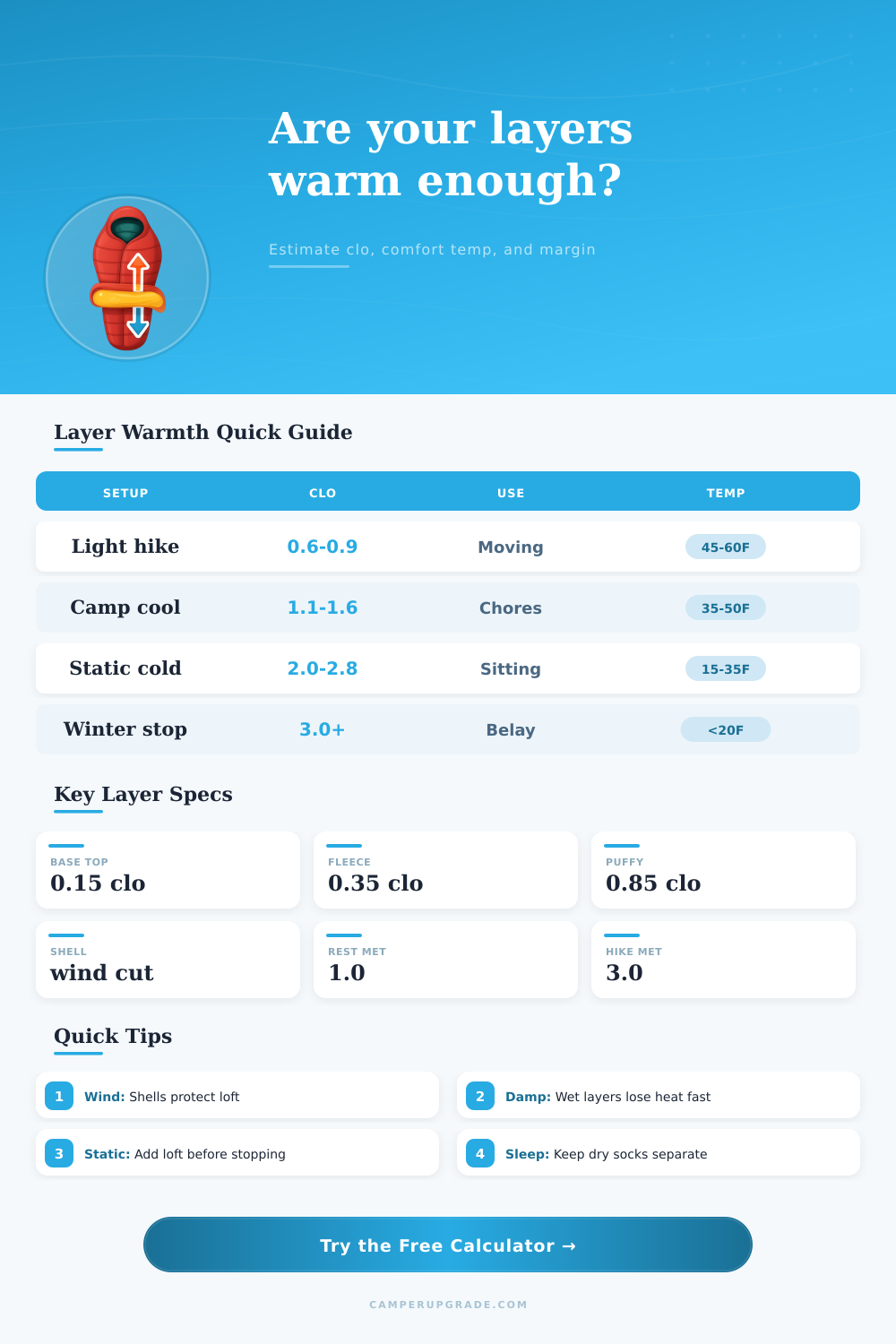
Clothing Insulation Temp Calculator
Estimate clothing clo value, effective warmth after wind and moisture, comfort floor temperature, and layer margin for hiking, camp chores, sleeping, belaying, and cold-weather stops.
This calculator uses common clo estimates for garments, MET activity multipliers, wind-chill adjustment below 50 F, shell protection, moisture loss, fit compression, shelter gain, and exposure reserve. It is a planning estimate, not a medical or survival guarantee.
| Layer item | Typical clo | Best use | Main limit |
|---|---|---|---|
| Light tee or sun shirt | 0.10 to 0.15 | Warm hiking | Little static warmth |
| Thermal base top | 0.18 to 0.38 | Moisture control | Weak in wind alone |
| Fleece or wool mid | 0.22 to 0.68 | Breathable warmth | Wind passes through |
| Down or synthetic puffy | 0.45 to 1.55 | Static warmth | Loft loss when wet |
| Shell layer | 0.05 to 0.18 | Wind and rain block | Can trap sweat |
| Activity | MET used | Layer effect | Watch for |
|---|---|---|---|
| Sleeping or lying still | 0.8 | Needs the most clothing reserve | Compression and damp socks |
| Sitting or belaying | 1.0 | Static comfort baseline | Hands and feet cooling |
| Camp chores | 1.6 | Moderate heat production | Sweaty base layers |
| Steady hiking | 2.7 | Less clo needed while moving | Stop-before-cold layer timing |
| Hard climbing or hauling | 4.0 | High heat production | Overheating then chilling |
| Condition | Adjustment | Why it matters | Field response |
|---|---|---|---|
| Dry and calm | Best case | Loft stays trapped | Use listed clo normally |
| Windy with no shell | Large loss | Warm air is stripped away | Add wind shirt or hard shell |
| Sweaty base | Medium loss | Evaporation cools skin | Vent before long stops |
| Damp or wet loft | High loss | Air pockets collapse | Change layers or add shell |
| Tent or vehicle shelter | Practical gain | Less wind and radiant loss | Still manage condensation |
| Common setup | Approx clo | Typical role | Layer note |
|---|---|---|---|
| Base top, pants, hat | 0.6 to 0.8 | Cool active travel | Add shell for wind |
| Base, fleece, pants, hat | 1.0 to 1.3 | Cool camp chores | Good shoulder-season start |
| Base, fleece, puffy, warm legs | 1.8 to 2.4 | Cold static camp | Protect puffy from moisture |
| Thermals, heavy puffy, insulated pants | 2.8 to 3.8 | Winter stops | Use mitts and face coverage |
| Sleep layers inside bag | 1.2 to 2.2 | Sleep-system boost | Avoid compressing loft |
A clothing insulation temperature calculator allow you to determine how much heat your clothing will retain. There is various factors to consider when using this clothing insulation temperature calculator, which allow you to determine if the clothing you are wearing will retain enough heat for your environment. The most important measurement of clothing insulation is the clo value.
Clo values represents the resistance of clothing to heat loss. Clothing with a clo value of 0.15 clo is thin, while clothing with a clo value of 1.5 clo or more are heavy. The total clo value of the clothing you wear will change due to factors such as wind, moisture, and compression.
How to Use a Clothing Insulation Calculator
Exposure to wind will result in the loss of warm air inside the clothing insulation. Moisture will collapse the air pockets in the insulation that retains your body heat. Finally, if your clothing gets compressed, such as when wearing it with a backpack, the insulation will lose it ability to retain heat.
Your activity level will change how warm your clothing feels. If you are active, your body will produces more heat. Thus, if you are hiking, for example, you will produce more heat then when you are not moving.
The clothing insulation temperature calculator use MET values (metabolic equivalent of movement) to represent the intensity of your activity level. The clothing insulation temperature calculator will indicate if the clothing is warm enough for when you are active but not enough for when you are resting. In this case, you will have to wear an additional layer of clothing to avoid losing heat when you are not move.
Finally, the amount of time you spend in your environment and the type of shelter you use will change how warm you feel in your clothing. The longer that you are exposed to cold temperatures, the more heat that your body will lose. Additionally, if your clothing becomes wet over time, your clothing will lose its insulating property.
On the other hand, if you are in shelter from the element like a vehicle or a forest edge, you will retain more body heat than if you are exposed to the elements. Many people makes mistakes with their clothing selection. Some people may create a clothing list based off the outdoor temperature while they are moving.
However, they do not account for the drop in their body temperature when they are not move. Others may create a clothing list that include a shell jacket for warmth but do not account for the fact that the shell jacket only protects the loft of insulation that is already in the clothing. The clothing insulation temperature calculator will help you to understand these factors because it will show how much insulation your clothing will lose when exposed to wind and moisture.
While the clothing insulation temperature calculator will provide a margin of safety with regard to your body temperature, this margin of safety are not a guarantee of warmth. If the margin of safety is large, you have room to adjust your clothing or to vent your clothing to avoid becoming too sweaty. However, if the margin of safety is narrow or negative, you need to add more insulation to your clothing or reduce your exposure to the outdoor elements.
Thus, by using a clothing insulation temperature calculator, you can make more better clothing decisions before you become cold.