🧗 Ideal Climbing Weight Calculator
Find your performance weight range for rock climbing based on your height, discipline, and body frame — focused on strength and performance, not aesthetics.
| Discipline | Elite Male BMI | Elite Female BMI | Recreational BMI | Notes |
|---|---|---|---|---|
| Bouldering | 19.5–21.5 | 18.5–20.5 | 21–24 | Highest power-to-weight demand |
| Sport Climbing | 20–22 | 19–21 | 21–24 | Balance of power and endurance |
| Trad / Multi-Pitch | 20.5–23 | 19.5–22 | 21–25 | Endurance focus, less weight premium |
| Alpine / Mountaineering | 21–24 | 20–23 | 22–26 | Pack weight matters; some reserve useful |
| Competition | 20–22 | 19–21 | 21–24 | Mixed bouldering and lead formats |
| BMI Range | Climber Category | Performance Implication | Recommendation |
|---|---|---|---|
| Below 18.5 | Underweight | Reduced strength, recovery risk | Consult a healthcare provider |
| 18.5–20 | Lean — elite range | Excellent power-to-weight, needs monitoring | Maintain with adequate nutrition |
| 20–22 | Optimal (male typical) | Strong power-to-weight ratio | Ideal zone for most disciplines |
| 19–21 | Optimal (female typical) | Strong power-to-weight ratio | Ideal zone for most disciplines |
| 22–24 | Recreational fit | Good general fitness, slight weight premium | Focus on strength training |
| 24–27 | Above optimal | Noticeable effect on dynamic moves | Gradual, sustainable approach |
| Above 27 | Significantly above optimal | Significant power-to-weight impact | Work with a coach and dietitian |
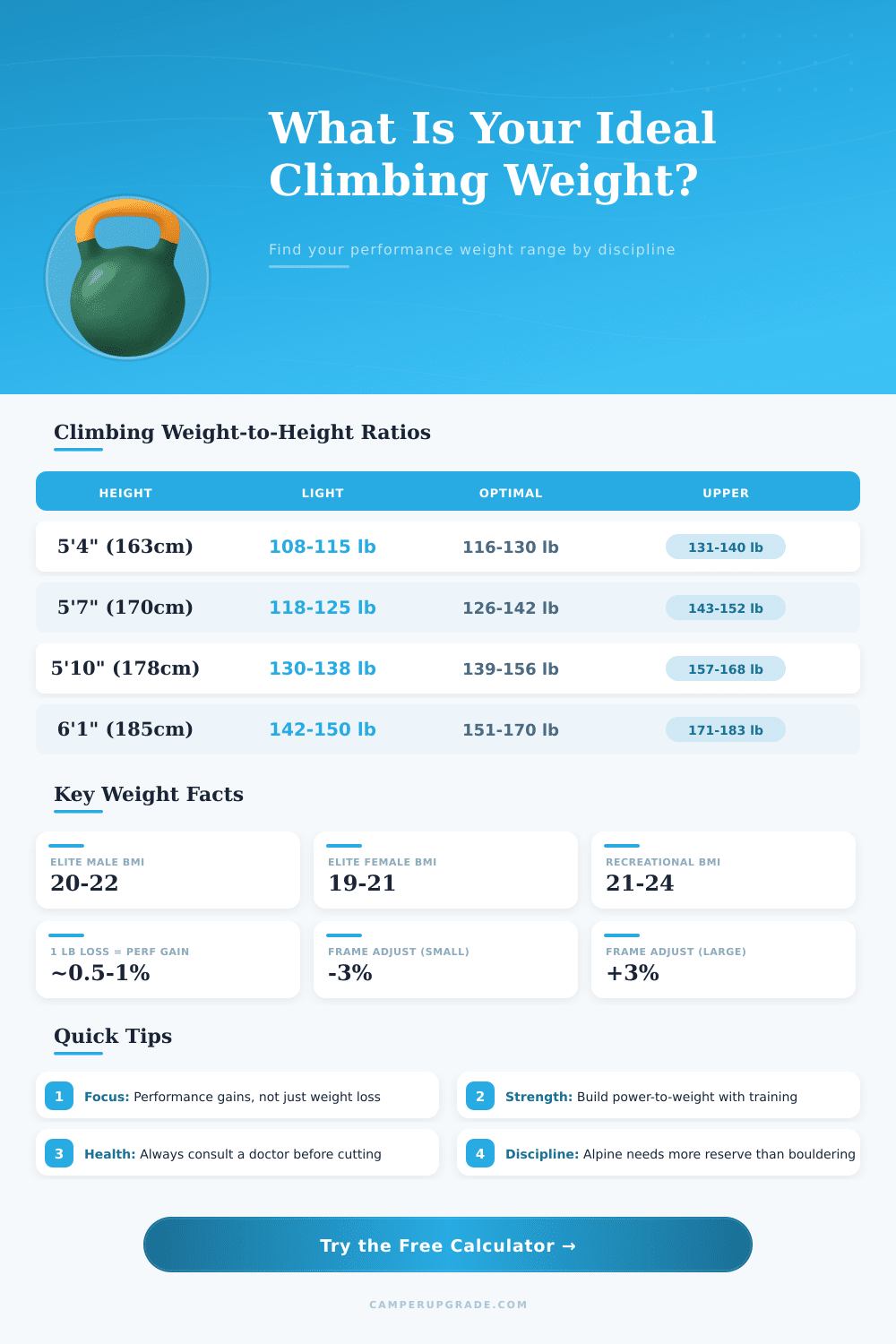
| Height | Light Range (lb / kg) | Optimal Range (lb / kg) | Upper Range (lb / kg) |
|---|---|---|---|
| 5'2" / 157cm | 100–108 / 45–49 | 109–124 / 49–56 | 125–134 / 57–61 |
| 5'4" / 163cm | 108–115 / 49–52 | 116–130 / 53–59 | 131–140 / 59–64 |
| 5'6" / 168cm | 114–122 / 52–55 | 123–138 / 56–63 | 139–149 / 63–68 |
| 5'8" / 173cm | 122–130 / 55–59 | 131–147 / 59–67 | 148–159 / 67–72 |
| 5'10" / 178cm | 130–138 / 59–63 | 139–156 / 63–71 | 157–168 / 71–76 |
| 6'0" / 183cm | 138–147 / 63–67 | 148–166 / 67–75 | 167–179 / 76–81 |
| 6'2" / 188cm | 147–156 / 67–71 | 157–176 / 71–80 | 177–190 / 80–86 |
| 6'4" / 193cm | 156–165 / 71–75 | 166–186 / 75–84 | 187–201 / 85–91 |
| Weight Change | Est. Performance Change | Grade Equivalent Impact | Notes |
|---|---|---|---|
| −5 lb / 2.3 kg | +1.5–2.5% | +0.5 sub-grade | Measurable on overhangs |
| −10 lb / 4.5 kg | +3–5% | +1 sub-grade | Significant dynamic improvement |
| −15 lb / 6.8 kg | +4.5–7% | +1–2 sub-grades | Major impact if from optimal zone |
| +5 lb / 2.3 kg | −1.5–2.5% | −0.5 sub-grade | Modest effect near optimal |
| +10 lb / 4.5 kg | −3–5% | −1 sub-grade | Noticeable on steep routes |
This calculator provides a general performance reference for rock climbers based on BMI and published research on elite climber body composition. It is not medical advice and should not be used as a target for weight loss or dieting without guidance from a qualified healthcare provider or registered dietitian.
Eating disorders are serious medical conditions. If you or someone you know is struggling with disordered eating, body image concerns, or unhealthy weight-control behaviors, please reach out to a healthcare professional. In the US, contact the National Eating Disorders Association (NEDA) helpline at 1-800-931-2237.
BMI is a limited metric and does not account for muscle mass, bone density, ethnicity, or individual health factors. Your climbing performance depends far more on technique, training consistency, and strength than on reaching any particular weight number.
Weight is a theme that commonly appears in the world of Climbing. The main idea is simple: Climbing is a constant struggle against gravity so the better the relation between force and Weight the more easily one can climb. Keeping the physical Weight low makes Climbing easier but that is only one factor.
Just as important are also flexibility force tehcniqe and good strategy on the way.
How Weight Affects Climbing
As is well known bouldering and sporting Climbing depend on the report between power and Weight. Climbers do a lot to improve that relation building finger strength and force of the upper body. Even so not everything deals only with physical fat.
Excessive muscular Weight also can affect the Climbing impact. So even if one is thin too much muscles can stop progress.
Also the type of Climbing mattered. Bouldering climbers usually are a bit bigger because bouldering is made of short intensive problems that use fast muscle fibers. Sporting climbers and those that do alpine Climbing usually are thinner because they need more stamina.
The training must match the style. Bouldering climbers should focus on high force with fewer repetitions while sporting climbers focus more on endurance or power-endurance training.
For amateur climbers one should first focus on building force and skill. If the technique is the weak spot being very thin will knot help. But if the stamina is the problem decrease of Weight can make a big difference.
Simple ways to control the physical fat are by means of DEXA scans or calipers for skin folds. There is also the old method of pinching the waist… If one can squeeze too much skin the best Weight is not reached.
An interesting way to think about that is this: do a pull-up and later do it again with ten pound Weight on your back. That gives a very clear answer about your Weight. When a climber loses fat the training burden drops similar to when one presses less Weight in bench press.
High and heavy climbers indeed can have an advantage on slab ways or low corners where strength is most important. But on sharp overhanging ways extra Weight becomes a real problem because less Weight stays on the feet. In top level contests one almost never sees heavy or thick masculine climbers.
Being thin and relatively light seems to be a need at thatlevel.
Even so Climbing during a calorie deficit can feel awful. Instead of obsessing about the scale better method is to swap bad food for healthy choices, for instance an apple instead of chocolate or a potato instead of crackers. Even gaining Weight can help if it is made of muscles and one learns to use that extra mass.
People absolutely can climb well even with extra Weight. The physical Weight is only one part of the puzzle.