🧗 Climbing Shoe Size Calculator
Find your perfect climbing shoe size based on style, foot shape & experience
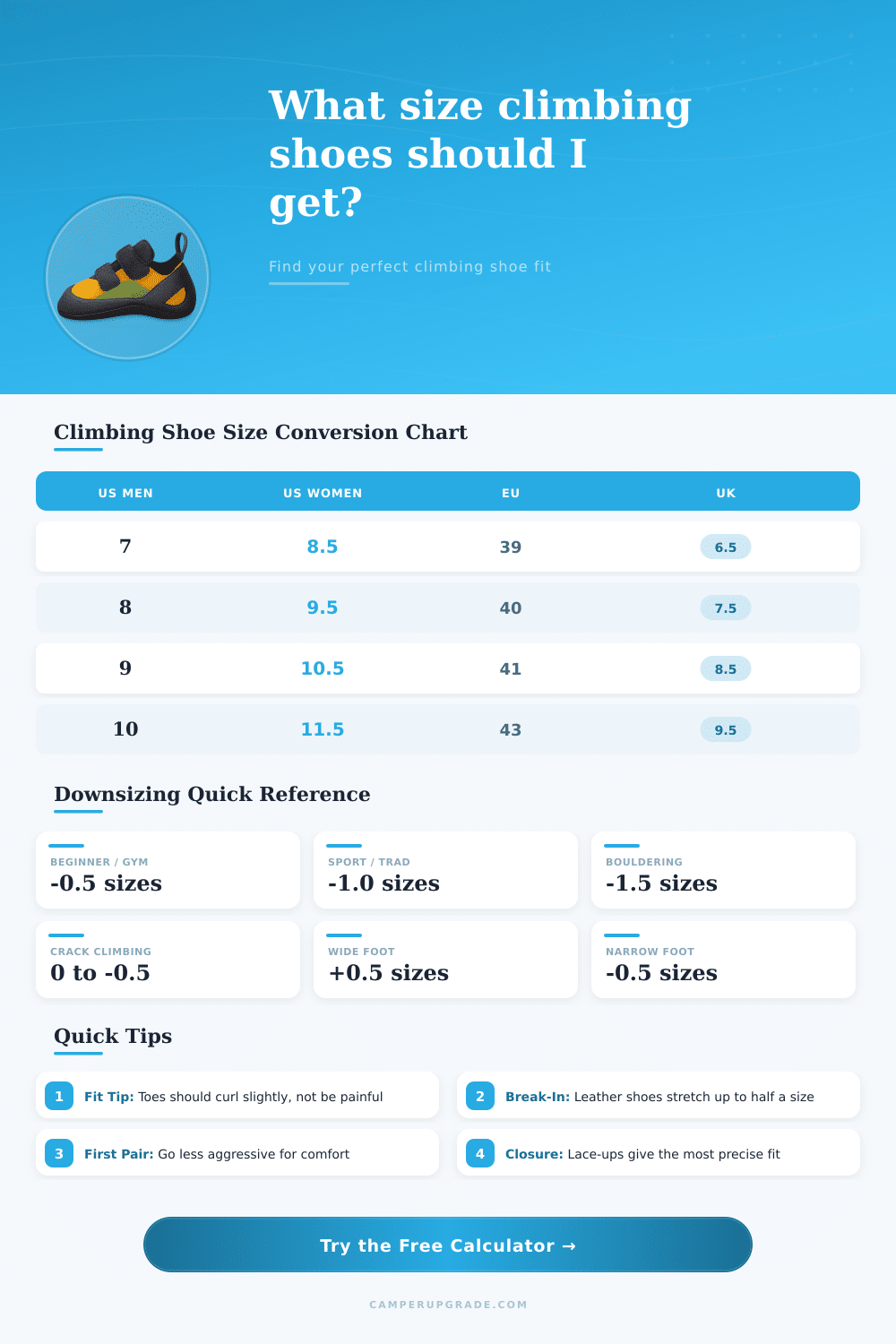
| US Men | US Women | EU | UK |
|---|---|---|---|
| 5 | 6.5 | 37 | 4.5 |
| 5.5 | 7 | 37.5 | 5 |
| 6 | 7.5 | 38 | 5.5 |
| 6.5 | 8 | 38.5 | 6 |
| 7 | 8.5 | 39 | 6.5 |
| 7.5 | 9 | 39.5 | 7 |
| 8 | 9.5 | 40 | 7.5 |
| 8.5 | 10 | 41 | 8 |
| 9 | 10.5 | 41.5 | 8.5 |
| 9.5 | 11 | 42 | 9 |
| 10 | 11.5 | 43 | 9.5 |
| 10.5 | 12 | 43.5 | 10 |
| 11 | 12.5 | 44 | 10.5 |
| 11.5 | 13 | 44.5 | 11 |
| 12 | 13.5 | 46 | 11.5 |
| 13 | 14.5 | 47 | 12.5 |
| Closure Type | Best For | Pros | Cons |
|---|---|---|---|
| Lace-up | All styles, crack climbing | Most precise fit, adjustable tension | Slower to put on/off |
| Velcro (1 or 2 strap) | Gym, sport, beginners | Quick on/off, easy adjust | Less micro-adjustment |
| Slipper (no closure) | Bouldering, gym warm-ups | Max sensitivity, lightweight | Less heel hold, sizing critical |
A climbing shoe is a special kind of shoe, designed specially for rock climbing. This type of shoe usually has a tight form a pointed front and sticky rubber on the bottom. The rubber extends to the heel and the toes of the foot, which helps for grip to the rock.
There are various grades of climbing shoe. They go from aggressive to neutral. To choose the right model, one must consider what style of climbing one does.
How to Choose a Climbing Shoe
For instance for bouldering or modern sport climbing, a model like the Scarpa Instinct VS answers well, because it bends and feels great, which is useful on steep ways. If some have a limited budget, the Unparallel UpMocc is friendly to the purse, because one can adapt it comfortably for crack routes or long multi-pitch-keys, or simply for bouldering and gymnastic clmibing.
Everything depends on the skill. A good climbing shoe should feel almost tight, without pinching and not with too much free space. No one can truly tell, whether a shoe answers to feet of another.
Many climbers insist on slightly curved toes and pressure in shoes, that is a bit too small, believing, that that helps them beat more difficult ways.
Some brands make shoes for different foot shapes. The 5.10 Anasazi VCS, for example, answer for broader feet. European brands like The Sportiva and Scarpa tend to have narrower shape with higher heel.
Currently some models come in low-volume versions for climbers with narrow heel and lower foot height and width. Major shoe makers present the current forms on there pages on the net, so that climbers find the right one and later buy something based on that model.
Rather than many climbing shoe with a bottom cut from one sheet of rubber, some brands apply moulded rubber soles. This delivers stronger hold, shape and comfort, with only short time to break in, so the shoe works well already from the box.
For newcomers the cheapest shoes commonly form the best start. More expensive or special models truly only are useful to expert climbers, that know how to use features like toe hooking. The Sportiva Tarantulace is popular among beginner shoes.
Too early upgrade does not have much sense. Right moment to improve is around V5-grade or when one reaches 5.12-ways.
Harder rubber usually is more lasting and works better for small feet. Softer rubber grips more strongly on rough surfaces, but wears out more quickly. Some shoes break in well during the time.
A right big, less aggressive, allround shoe with leather shell probably feels themost comfy for many climbers. Resources like online shoe guides and test labs also can help choose exactly the right pair according to brand, kind and grade of aggression.