🧗 Climbing Finger Strength Calculator
Assess your finger strength with the max hang test and find your climbing level relative to bodyweight.
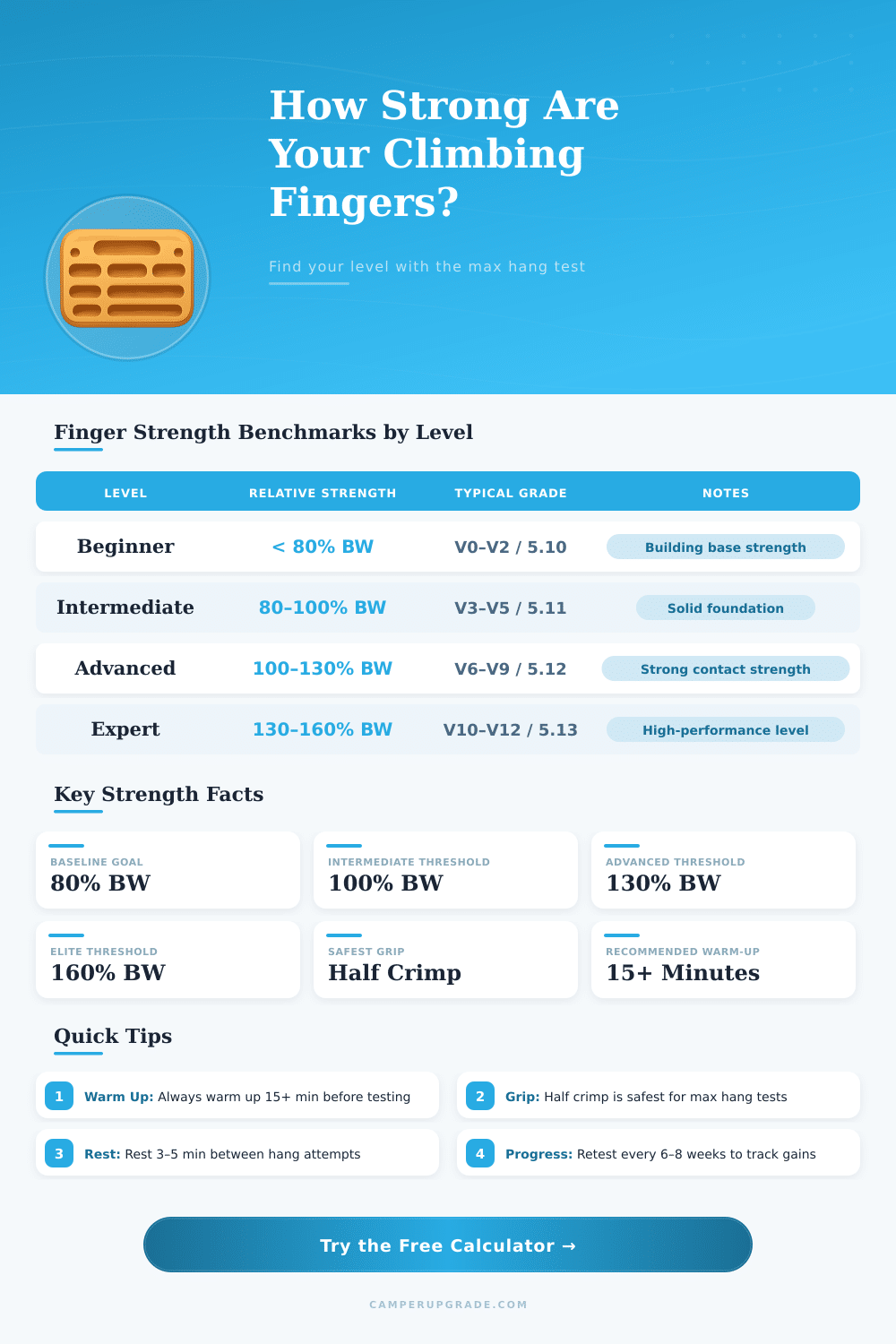
| Level | Relative Strength | Typical Grade (V / 5.x) | Notes |
|---|---|---|---|
| Beginner | < 80% BW | V0–V2 / 5.10 | Building foundational grip endurance |
| Intermediate | 80–100% BW | V3–V5 / 5.11 | Consistent on moderate overhangs |
| Advanced | 100–130% BW | V6–V9 / 5.12 | Strong on small holds and steep walls |
| Expert | 130–160% BW | V10–V12 / 5.13 | High-performance, competition-level |
| Elite | > 160% BW | V13+ / 5.14+ | World-class contact strength |
| Edge (mm) | Difficulty | Typical Use | Injury Risk |
|---|---|---|---|
| 25mm (Full) | Easiest | Warm-up, beginners | Low |
| 20mm | Moderate | General training, beginner assessment | Low–Moderate |
| 18mm | Moderate | Intermediate testing & training | Moderate |
| 15mm | Hard | Advanced strength testing | Moderate–High |
| 12mm | Very Hard | Expert-level training | High |
| 10mm | Extreme | Elite assessment only | Very High |
| Grip | Force Distribution | Injury Risk | Recommended Use |
|---|---|---|---|
| Half Crimp | Balanced across pulleys | Low–Moderate | Best for max hang testing; safest overall |
| Full Crimp | High load on A2 pulley | High | Performance testing only; not for beginners |
| Open Hand | Distributed; tendon-friendly | Low | Great for endurance; safer long-term |
| Pinch | Thumb flexors & extensors | Low–Moderate | Separate pinch strength testing |
Digital force is the most natural skill for climbing on rock. If a climber does not hold himself to a little handle, he simply will fall down. Although the feet can slip, strong hands help to stay set on the wall.
None can escape that truly. In vertical world digital force rules over all motion.
Finger Strength for Climbing
Even so, here is something encouraging. Fingers do not have muscles inside. The power that helps to keep a grip comes from muscles of the forearm, especially the deep and surface benders of the fingers.
Like this “digital force” is a bit foolishly named, because it means holding power, and even so it stays great training for climbers.
In climbing, fingers involve various typical forms. Full crimp happens when the second joint bends above the first. Half crimp lays the second joint level to the first.
Open hand leaves both joints bending below the first. Those variations matter, because handles in climbing reuqire different positions than simply closing a fist.
Good technique helps to reduce the need of digital power. Footwork, body position and movement all contribute. Yet, even with almost ideal method, part of the burden will load the fingers.
Usually they limit the whole activity.
Beginners risk, if they push digital force too soon, because that can create lasting wounds. During the first year in climbing, more progress comes from simple climbing and bouldering than from special training for fingers. Tendon skills grow slowly over time.
Building finger strength requires years, because tendons must grow themselves. Hurrying that or adding wait too early simply hurts.
Hangboards form the usual tool for training digital power. Stronger fingers allow to use even smaller grips, and those that once seemed impossible become controlled. A typical plan includes two to three sessions weekly, before climbing, with two to five sets of five to ten seconds, plus long pauses of three to five minutes between them.
Weightlifting offers another precise way to strengthen fingers, although it does not work the other muscles of the chain. Changing the digital training through techniques like deadlifts is useful, because sometimes progress comes only from new challenge in the exercises. Climbing itself stays the main way to build force specific for the sport.
Key to reaching higher levels is improving the ratio between finger strength and weight. One gets that by strengthening the fingers or by lowering the body weight. In bouldering, level commonly depends on how far digital power matches the weight of the body.
On the other hand, training full body force outside the hangboard helps to lower risk of wounds and create a solid base. Possibly, manyclimbers reach a limit, where only climbing no longer strengthens them.