Climbing Fall Clearance Calculator
Estimate how far a lead climber may travel in a fall, how much rope stretch contributes, and whether the entered ledge or ground clearance leaves margin.
🧭Scenario Presets
⚙️Fall Inputs
📊Fall-Clearance Spec Grid
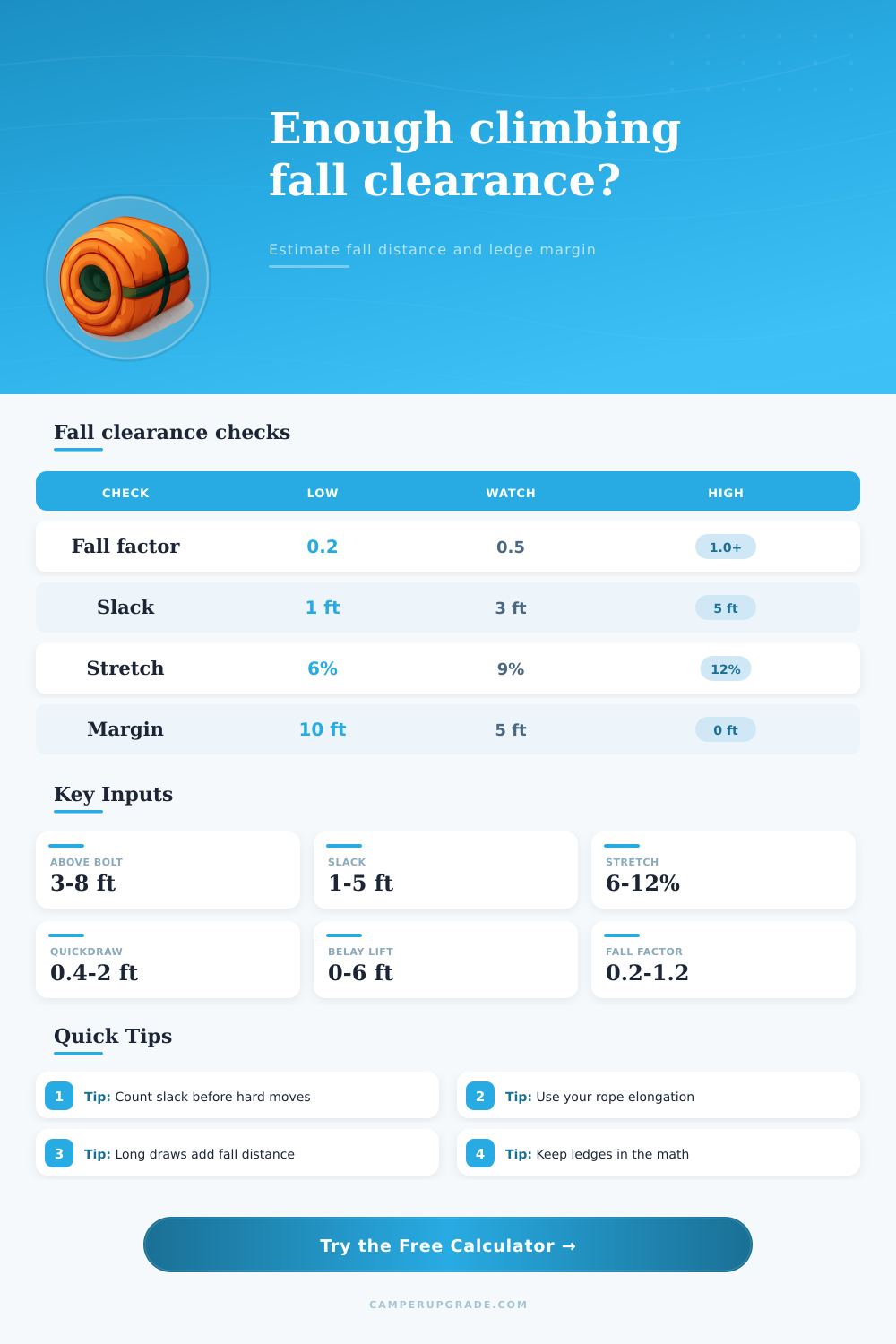
📐Fall Factor And Clearance Table
| Fall Factor Band | Typical Situation | Clearance Effect | Planning Response |
|---|---|---|---|
| 0.10 to 0.25 | Lots of rope out, small movement | Lower stretch per setup | Still count slack and belayer lift |
| 0.25 to 0.50 | Common sport lead fall | Moderate stretch contribution | Check ledges below the crux |
| 0.50 to 0.80 | Shorter rope or higher above bolt | Stretch can be meaningful | Reduce slack and assess stance |
| 0.80 to 1.20 | Near belay or short pitch section | High severity and travel risk | Treat as a no-fall zone if close |
| 1.20 to 2.00 | Very short rope in service | Severe; little rope absorbs energy | Avoid fall exposure near obstacles |
🧵Input Reference Table
| Input | What It Represents | Common Range | Why It Matters |
|---|---|---|---|
| Climber above bolt | Height from bolt to tie-in | 1 to 10 ft | Counts twice in a lead fall path |
| Belayer slack | Loose rope before catch | 0.5 to 5 ft | Adds directly to distance |
| Rope stretch | Elongation under load | 6% to 12% | Can add feet when rope length is high |
| Quickdraw length | Bolt to rope carabiner | 0.4 to 2 ft | Lowers the effective protection point |
| Belayer movement | Lift, slip, or device travel | 0 to 6 ft | Softens catch but increases travel |
| Ledge clearance | Available open space below | 10 to 80 ft | Determines final margin |
🧗Scenario Preset Table
| Preset | Above Bolt | Slack | Use Case |
|---|---|---|---|
| Gym bolt clip | 3 ft | 1.5 ft | Controlled indoor clip with open wall |
| Sport crux above bolt | 6 ft | 2.5 ft | Common redpoint fall near the crux |
| Low first bolt | 5 ft | 2 ft | Groundfall check early on route |
| Ledge traverse | 4 ft | 2 ft | Horizontal terrain above a ledge |
| Long alpine draw | 5 ft | 2.5 ft | Extended draw to reduce drag |
| Soft catch room | 7 ft | 3 ft | Steep terrain with space below |
| Short rope factor | 4 ft | 1 ft | Near belay with less rope active |
| Steep wall whip | 8 ft | 3 ft | Clean overhang with no ledges |
| Trad ledge check | 5 ft | 2 ft | Gear above a ledge or slab |
| Multipitch top belay | 3 ft | 1 ft | Short-rope stance management |
💡Clearance Tips
When a climber is performing a climb, the total distance that the climber can fall if a hold fail is something that they should consider. The total distance that the climber will fall isnt just the distance between the climber and the nearest bolts; that distance must be combined with the distance created by the stretch of the rope. The total distance that a climber will fall is important in that this distance will determine whether or not the climbers feet will land on a ledge or an obstacle on the route.
If the calculated total fall distance is equal to or exceeds the distance between the climber and the ledge, the climber will hit that ledge; using a fall distance calculator will allow a climber to determine this value without having to perform the calculations themselfs while climb. The first part of the calculation of fall distance is the distance of the climber above the bolt. The climber must double the distance above the bolt because they will fall to the bolt and then fall past the bolt.
How Far You Could Fall While Climbing
For instance, if the climber is three feet above the bolt, they will fall through six feet of distance before any other factor are considered. Other factors to consider in this initial distance measurement include the length of the quickdraw and the position of the tie-in point on that quickdraw. Quickdraws that are long or the tie-in point that is high on that quickdraw will add to the distance that the climber falls.
Finally, the distance can also be increased if the climbers belayer move upward during the fall; this will increase the amount of distance that the rope must fall and absorb the energy of the climbers fall. Each of these factor can be entered into the calculator to determine the impact that each has upon the distance that the climber will fall. Another factor that can increase the total distance that the climber will fall is the stretch of the climbing rope.
Many fall distance calculations underestimate the distance that the rope will stretch if the climber should fall. The distance that the rope stretch is based off the percent stretch of the rope; if a rope has an eight percent stretch, for instance, the rope will elongate eight percent of the distance between the climber and the belayer if the climber should fall. The fall factor for the rope is one measurement that can be used to calculate the amount of stretch in the rope; the amount that the rope will stretch is related to the fall factor of the rope.
The calculator can account for the stretch of the rope to help avoid memorizing the stretch of rope values that can exist with different fall factor. The final distance that must be calculated for the climber is the distance between the climbers fall and the distance to the ledge. The climber calculates the ledge clearance by taking the total distance that the climber will fall, and subtracting that value from the total distance between the climber and the ledge.
If the value of the ledge clearance is a positive number, then the climber will not land on the ledge during their fall. If the value is zero or a negative number, however, the climber will hit the ledge during their fall. This value can be displayed on the calculator to provide the climber with an indication of whether or not the move that they are to perform is a no-fall zone for the climber.
Many variables exist in real climbing routes that the fall distance calculator does not account for. For instance, the drag that can exist in the rope during a fall can change the way that the rope is loaded; if the climber performs a traverse during their route, the climber may swing into a wall rather than falling downwards. Finally, the rope may be wet or old, which may alter the stretch of that rope relative to the distance between the climber and the belayer.
These variables are not accounted for in the calculator, which is why the actual distance between the climber and the ledge may not correspond to the distance that the tool calculates. The fall distance calculator should of been used at the base of the climbing route prior to beginning the climb. If the calculated distance to the ledge is small, the climber may choose to either reduce the slack that is present in the rope (by shortening quickdraws, for instance), or extend the quickdraws that the climber uses.
Additionally, the climber may change their approach to the route if the distance that is calculated is too small for the distance to the ledge. While the calculator will not perform the climb itself for the climber, the calculator will remove the need for the climber to perform calculations of the fall distance while climbing the route.