Climbing Chalk Usage Per Session Calculator
Estimate loose chalk, chalk ball, block chalk, or liquid chalk use for a gym or outdoor session using session length, climb count, attempts, hand size, sweat, humidity, wall texture, and refill size.
📌Climbing Chalk Presets
⚙Session And Chalk Inputs
Use 1 for a personal bag or the group count for a shared bucket.
Count climbing time, warmups, projecting rests, and route turnover.
For circuits, count individual boulders or route burns.
Limit boulders and redpoint burns usually increase re-chalking.
Style changes how often climbers refresh chalk between burns.
Chalk balls meter less powder; loose chalk is faster but dustier.
A full hand dip scales with palm and finger surface area.
Sweat affects both powder amount and refresh frequency.
Moist air usually raises chalk demand and lowers session efficiency.
Rough holds remove more chalk from skin during each attempt.
Habit can change total use as much as the chalk format.
Enter your chalk ball refill, block, pouch, bucket, or liquid bottle size.
Buffer covers spills, shared dips, extra warmups, and chalk lost in the bag.
Session Chalk Estimate
📊Current Session Specs
📘Chalk Reference Tables
| Chalk format | Typical touch | Best use | Calculator effect |
|---|---|---|---|
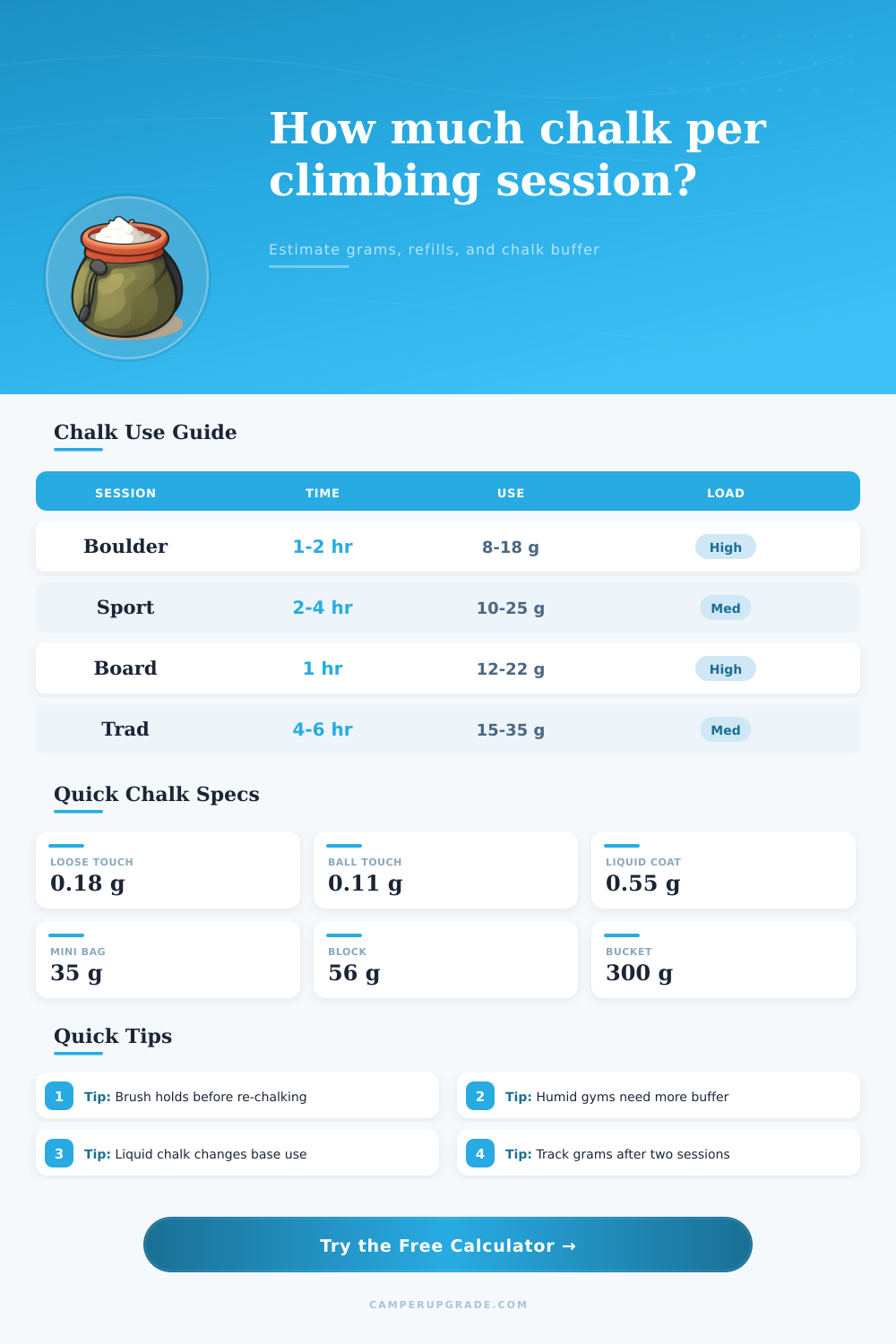
| Loose chalk | 0.14 to 0.24 g | Fast gym and bouldering dips | Baseline amount with moderate dust loss |
| Block chalk | 0.11 to 0.20 g | Crushed refills and compact bags | Slightly lower pickup than loose chalk |
| Chalk ball | 0.08 to 0.15 g | Gyms with dust control rules | Lower pickup and lower waste |
| Liquid chalk | 0.35 to 0.75 g | Base coat, comps, humid sessions | Higher base amount, fewer top-ups |
| Liquid plus loose | 0.12 to 0.20 g | Projecting in humid air | Adds base coat, lowers repeat powder |
| Session type | Common length | Chalk events | Expected range |
|---|---|---|---|
| Easy boulder circuit | 1 to 2 hours | 20 to 45 touches | 5 to 14 g per climber |
| Limit bouldering | 1.5 to 3 hours | 35 to 80 touches | 10 to 28 g per climber |
| Sport redpointing | 2 to 4 hours | 25 to 65 touches | 9 to 25 g per climber |
| Training board | 45 to 90 minutes | 30 to 70 touches | 9 to 23 g per climber |
| Trad or multipitch day | 4 to 8 hours | 45 to 120 touches | 15 to 40 g per climber |
| Condition | Amount change | Top-up change | Planning note |
|---|---|---|---|
| Dry skin and dry air | Down 10% to 25% | Fewer refreshes | Chalk ball or light touch may be enough |
| Normal indoor gym | Baseline | Baseline | Use session logs to tune the per-touch amount |
| Humid gym | Up 15% to 30% | More refreshes | Add buffer and consider liquid base coat |
| Damp outdoor holds | Up 25% to 45% | Much more frequent | Brush holds and keep chalk sealed between burns |
| Cold dry rock | Down 5% to 15% | Fewer refreshes | Over-chalking can make friction feel worse |
| Container size | Equivalent ounces | Typical role | Sessions at 15 g |
|---|---|---|---|
| 35 g mini pouch | 1.2 oz | Emergency refill or travel bag | About 2 sessions |
| 56 g chalk block | 2.0 oz | Single block crushed into bag | About 3 sessions |
| 100 g refill | 3.5 oz | Small gym pouch or chalk ball refill | About 6 sessions |
| 200 g pouch | 7.1 oz | Shared gym bag refill | About 13 sessions |
| 300 g bucket | 10.6 oz | Training group or frequent climber | About 20 sessions |
🧭Chalk Planning Notes
The next thing you know, you’re starting a boulder problem that you’ve attempted six times before. You’re not feeling confident; your fingers aren’t quite sticky enough, and your sweat hasn’t done the trick. So you grab some chalk. It’s white, and it looks magical, it makes your hands stick again.
But chalk isn’t magic; in fact, it’s finite. It’s something you can run out of. Something that relies off physics, humidity, and our own waste habits. If you’d like to know how much you use, if you want to pack for a crag trip, or understand why your gym bag might be empty by Tuesday night, then read on.
How to Use Chalk Smartly
After you input your climate conditions and number of climbs, simply select how long your session was and it’ll calculate the rest (see calculator above). No more guesswork as to how many grams you should of take. Not sure what the coefficient of friction between your skin cells and magnesium carbonate is? Neither does anyone else. All you have to know is what influences your consumption.
Turns out the most common factor isn’t climbing at all; instead, it’s the amount of attempts at each problem. If you send the project on the first attempt, you use almost no chalk. On the other hand, if you spend 3 hours trying to project the same line, you’ve burned through a whole block. To handle this, the tool ask for your average attempts per climb, which is a more sensible metric different than total problems climbed.
The chalk format also means that what you place on the ground and how you pack it has changed. While loose chalk is faster at application, it’s awful at containment. Dipping both hands fully into a bag of chalk result in half going on your body and the other half on the floor or back into bucket. Chalk balls meter out less product with each touch. So not only do they cut down on the dust cloud that many indoor facilities are strictly regulating these days, but they’ll conserve your stash, too.
Liquid chalk works differently because it creates a chemical barrier rather than adding bulk friction immediately. That makes it feel heavier on the skin, but stay on the skin longer after application. In more humid areas, liquid will also require fewer constant top-ups; look at reference table on the page to see how a liquid base coat can make this happen.
There’s one variable that significantly decreases the effectiveness of any chalk: humidity. If you’re climbing in dry air, then your hands will be relatively controllable; they’ll sweat but evaporate the moisture rapidly. Introduce some water into the equation and now you need two or three times the powder to get the same level of stickiness on your skin. That’s why a rainy trad day needs more of a buffer than an air-conditioned gym boulder session. To account for this, the calculator allow you to choose humidity levels, which will scale up the estimated usage to match what happens in real life (not ideal conditions).
For example, many climbers over-chalk. They do it not because they need to, but because that’s what they’re used to doing. Even if their hands aren’t wet, they’ll dip them before each rest. It’s a waste of product. It can even lead to less friction because it builds up a slick coating between your skin and the hold. Often just brushing off the hold will do more than applying more chalk. That’s why there’s an application habit field on the calculator. Enter how much chalk you currently use to coat your hands, such as a heavy or balanced amount.
Balanced?), then it tells you how much money you might be able to save with a switch. The other factor in your plan is size of your container. A tiny mini pouch will run out quickly and requires constant filling, which breaks up your flow. Bigger buckets lasts for a while but are cumbersome to lug around outside. If you get a bucket that matches how much chalk you think you’ll need per session then you won’t have any anxiety about running out halfway through a route. It’s such an easy logistical issue that most climbers don’t realize until they’re standing at the bottom of a route with their hands empty.
For a couple of trips, weigh out your bag in the morning and again at night (you can put it on a kitchen scale). Then see how well the calculator matches up with reality. Tweak the settings, humidity or sweat level; for as long as necessary so they match, then use it for trip planning from there. It’ll become a confidence booster and no longer a guess.
Magnesium carbonate, also known as chalk, is totally interchangeable, plentiful and affordable. Treating it like a finite resource, however, makes you a smarter climber. Without the extra powder clogging up your hands, you can hone in on your technique. The idea isn’t to save your chalk; it’s to conserve it intelligently. With some thoughtful forethought, perhaps your next send will hinge less on supply and more on skillful care.