Chlorine Dioxide Dose Calculator
Estimate camper water treatment from batch volume, product format, target dose, temperature, turbidity, organic demand, contact time, and residual check goals.
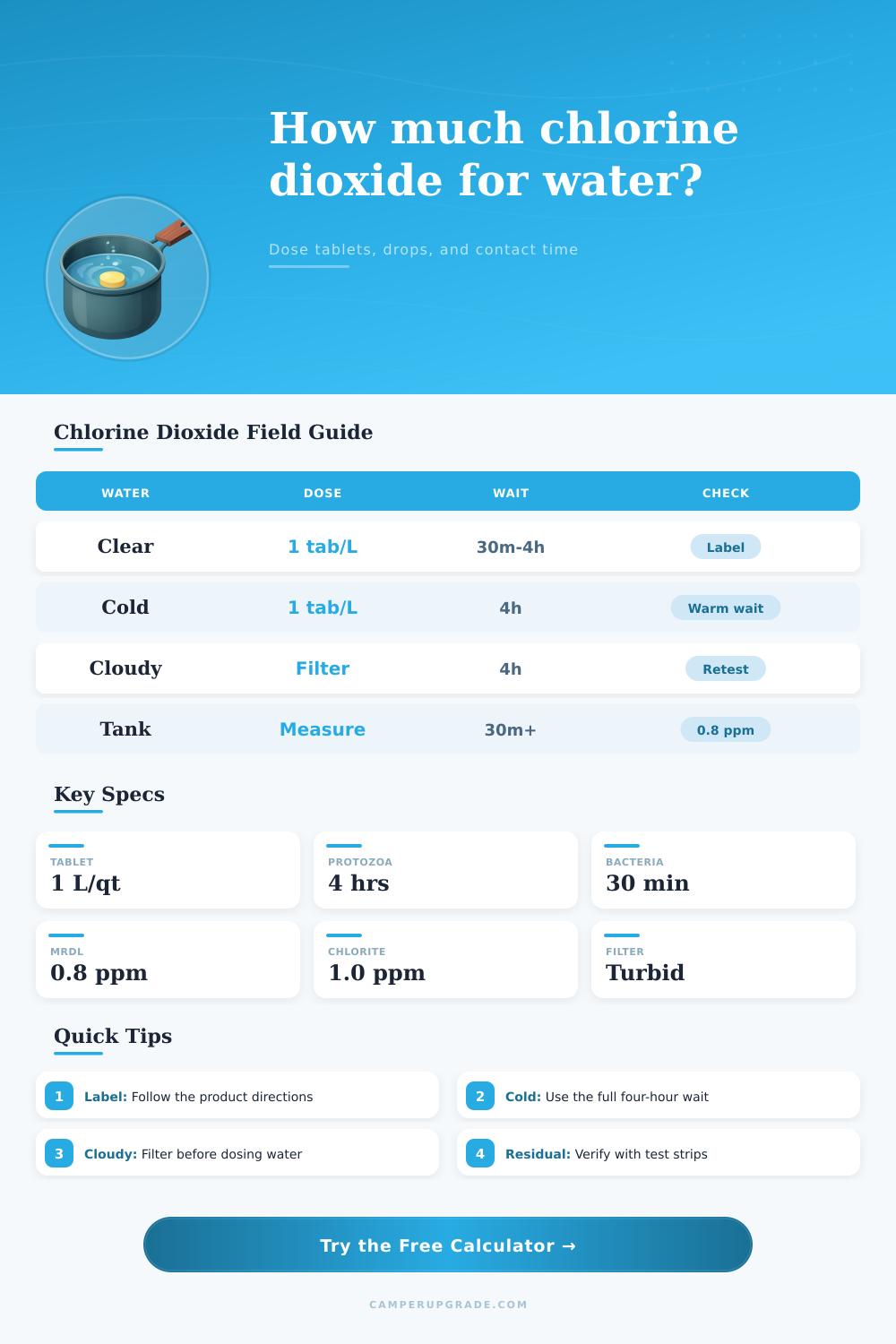
Dose planning by water condition
| Water condition | Calculator demand factor | Field action before dosing | Planning caution |
|---|---|---|---|
| Clear spring or tap-fill container | 1.00 | Dose by label and mix well. | Still wait the label time when protozoa may be present. |
| Slight color, tannin, or lake taste | 1.15 | Allow sediment to settle if possible. | Demand can reduce residual; test if storing. |
| Cloudy after settling | 1.35 | Prefilter through cloth or a real filter first. | Particles can shield organisms from disinfectant. |
| Turbid or high organic water | 1.65 | Filter, use a cleaner source, or boil if available. | Chemical dosing alone is poor planning for dirty water. |
Contact time planning
| Goal | Typical field wait | Best water condition | Why the calculator may extend it |
|---|---|---|---|
| Bacteria and virus reduction | 30 minutes | Clear water above 20°C / 68°F | Cold water slows reaction rates. |
| Cool clear water | 60 to 120 minutes | 10°C to 20°C / 50°F to 68°F | Extra time helps compensate for temperature. |
| Protozoa and cyst label use | 4 hours | Clear water dosed exactly by product label | Many tablet labels use 4 hours for maximum efficacy. |
| RV tank residual check | 30 minutes or label | Known clean tank water | Residual must be measured, not assumed. |
Batch volume conversions for label tablets
| Container | Liters | Label tablets at 1 L each | Label tablets at 1 qt each |
|---|---|---|---|
| 1 liter bottle | 1.00 L | 1 tablet | 2 tablets if following quart-only rounding |
| 1 US quart canteen | 0.95 L | 1 tablet | 1 tablet |
| 1 US gallon jug | 3.79 L | 4 tablets | 4 tablets |
| 5 US gallon camp cube | 18.93 L | 19 tablets | 20 tablets |
Disinfectant limit and verification notes
| Reference point | Value | Applies to | Calculator use |
|---|---|---|---|
| Chlorine dioxide MRDL | 0.8 mg/L as ClO₂ | Public drinking water residual limit | Flags estimated residual above this level. |
| Chlorite MCL | 1.0 mg/L | Disinfection by-product limit | Warns against repeated high custom dosing. |
| Emergency tablets | Follow product label | Backcountry and emergency treatment | Uses tablet count rounding rather than partial tablets. |
| Residual test strips | Product-specific range | Tank or stored water checks | Needed for any real pass/fail decision. |
With a pack full of gear and a water bottle in hand, you approach a tranquil alpine lake and find yourself asking: just because it looks clean doesn’t mean it’s safe to drink. That’s when chemistry meets survival instincts, and the dose makes the poison. Get the dose wrong, and you’ll have a very unpleasant few days on the trail; get it right, and you can hike home in good health.
Because chlorine dioxide treats a wider range of pathogens, including those pesky Giardia cysts that won’t die easily… Than do old-school bleach tablets, it has emerged as one of the favorites for backcountry trekkers. But while simple boiling is straightforward and obvious, the use of chemicals demand a little more thinking ahead… Specifically about volume, temperature, and time.
Why Dose Matters for Safe Water
After that, you just enter amount of water, and the size of your container (above), and let the calculator do all the work for you. There is no need to guess at how many tablets will dissolve completly in your solution. People take the math part of it as simple arithmetic, one tablet = one liter, full stop. No matter what.
That’s where people goes wrong. Because organic materials such as silt or tannin from leaves consume disinfectants without killing any bacteria at all. In other words, if your water is cloudy when settled, then you need a higher dose or a longer wait time to ensure nothing survive. The calculator takes that into account with its demand factor, which it calculates based off your choice of filtering or dosing raw creek water directly.
Just as important, however, is temperature, specifically how it affects how fast the chemical work. A half-hour soak at 20 C may require four hours if you’re trying to kill something in cold water. This is a fact. That’s why so many products has max times listed on their labels instead of min.
The chart on the page spells this out very well, tying desired contact times to various water temperatures. Pick your situation, such as warm early spring water. Want to play it safe with protozoa in cold waters?) and the system will do the rest. Which is to say: Face the music: Patience can be your best friend in the bag after all.
Now on a bigger scale, such as with family jugs or RV tanks, it’s not about health right now; but rather the safety of storing water. That’s where what’s left over comes into play. How much will be leftover after the initial kill phase? Enough that there won’t be a chance of recontaminaton when transported or used down the road? And how do you know if you’re safe? Well, test strips are no longer optional (you can’t smell or visually identify a safe dose accurately).
Finally, remember the EPA has set max residuals for public systems that help reduce byproduct chemicals such as chlorite; though the field allows for more flexibility, using a sensible dose helps ensure no funky tastes and possible health problems from over-exposure. A common error made by many backpackers is thinking “more is better” when it comes to chemicals. In truth, too much chemical will taste so bad that even the most parched hiker won’t be able to drink the water.
A little goes a long way, especially if you need your body to be hydrated so you stay energized! The calculator determines this balance by estimating how much residue will be left based on your initial dose and the expected demand. Maybe you use a higher estimate, and then you decide to dilute it a bit or let it sit for more time.
All this comes back to the point that wilderness water treatment isn’t about being perfect; it is about managing risks. There’s no way any out-in-the-field method can be completely sterile, but if you follow instructions on the package and account for your environment, you’ll have yourself some pretty darn good water that won’t make you sick. It doesn’t matter whether you go for ease-of-use or accuracy… Either way, you’re just trying to eliminate the question mark hanging over what you put in your mouth.
Fill up your bottle, let it sit the appropriate amount of time and go ahead and drink it with the knowledge that you not only trusted the source but also understood the science behind it. And ultimately, that’s why all that additional time at the water’s edge is so worthwhile.