Cherry Firewood BTU Calculator
Size a cherry stack by dimensions, moisture, and stove demand. See how sweet cherry heat changes when the pile is looser, tighter, wetter, or more seasoned.
🍒Cherry Presets
⚙️Calculator Inputs
A tighter stack gives more wood per cubic foot.
Black cherry is the baseline; orchard wood tends to run a touch denser.
Choose a common split depth or switch to a custom depth.
Shorter cherry splits tend to pack a little tighter.
Seasoned cherry often lands near 15-20% MC.
This trims the gross wood heat to usable room heat.
Use your stove demand to estimate burn hours.
Leaves a planning cushion for rough stacking or cold snaps.
🌲Cherry Species Reference
| Cherry type | BTU per cord | Dry weight | Burn character |
|---|---|---|---|
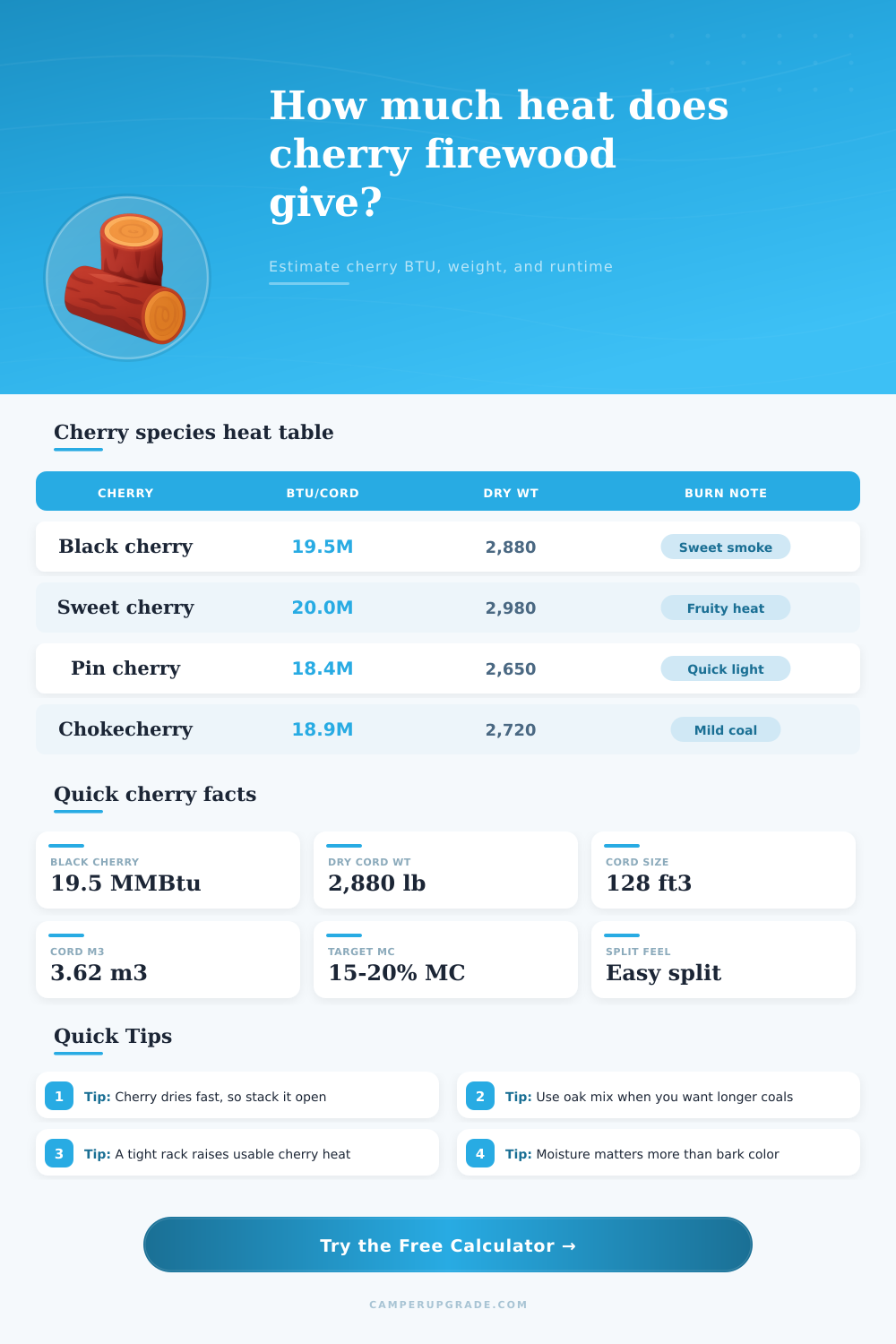
| Black cherry | 19.5 million | 2,880 lb | Sweet smoke, medium heat |
| Sweet cherry | 20.0 million | 2,980 lb | Dense orchard cut, bright flame |
| Pin cherry | 18.4 million | 2,650 lb | Lighter, quick-light shoulder wood |
| Chokecherry | 18.9 million | 2,720 lb | Fragrant, easy to like in blends |
📦Coverage by Stack Depth
| Depth | Sq ft per cord | m2 per cord | Why it matters |
|---|---|---|---|
| 12 in | 128.0 | 11.9 | Long, shallow rack |
| 16 in | 96.0 | 8.9 | Classic face-cord depth |
| 18 in | 85.3 | 7.9 | Common split length stack |
| 24 in | 64.0 | 5.9 | Deep row, fewer lineal feet |
🔥Moisture Adjustment Table
| MC | Heat factor | Weight gain | Use note |
|---|---|---|---|
| 15% | 1.02 | -4% | Very dry, sharp start |
| 20% | 1.00 | 0% | Seasoned target zone |
| 30% | 0.88 | +10% | Still drying, less punch |
| 40% | 0.76 | +18% | Green wood, plan low |
📏Common Cherry Stack Examples
| Stack | Size | Cord fraction | Black cherry BTU |
|---|---|---|---|
| Porch rack | 4 x 4 x 8 | 1.00 cord | 19.5 million |
| Half cord row | 4 x 4 x 4 | 0.50 cord | 9.8 million |
| Split tote bin | 2 x 4 x 8 | 0.50 cord | 9.8 million |
| Long shallow row | 3 x 4 x 8 | 0.75 cord | 14.6 million |
📊Cherry vs Common Woods
Cherry
Sweet, friendly heat with a quick start and enough coal to carry an evening fire.
Red Oak
Holds a deeper coal bed, but it does not give cherry's airy, fruity first flame.
Sugar Maple
Reliable and clean, but cherry is usually nicer when you want fragrance and fast light.
White Ash
Great starter heat. Cherry stays a little more aromatic and a touch more lively in the flame.
💡Practical Cherry Tips
Tip: Cherry racks up fast when the splits are kept off the ground and open to moving air.
Tip: Mix cherry with oak or maple if you want the scent up front and the coals to last longer.
Cherry firewood is a type of firewood that people uses for heating in the winter and for cooking fires. The heat energy that cherry firewood burn off is measured in BTUs. Black cherry firewood contains approximately 19.5 million BTUs per cord, while sweet cherry firewood contain approximately 20 million BTUs per cord.
The moisture content of the firewood can affect the heat energy that cherry firewood releases. If the cherry firewood is too wet, the heat energy will be used to evaporate the water in the firewood rather than to heat the room. If the moisture content of cherry firewood reach 30%, a person will lose 12% of the heat energy of the firewood.
How to Dry, Store, and Use Cherry Firewood
In order to avoid losing heat energy from the firewood, it is necessary to store cherry firewood in such a way that the moisture content of the firewood remains lowly. Cherry firewood tends to dry more easy than other types of firewood due to the way that the grain of the wood tends to split apart cleanly. To dry cherry firewood properly, the firewood should be stacked off the ground with a air gap between the rows of firewood.
Many people makes mistakes when trying to dry cherry firewood, such as covering the firewood too tight or burying the firewood under tarps. By covering the cherry firewood too tight, the firewood is unable to access the breeze that is necessary to dry the cherry firewood properly. Once dried properly, cherry firewood will be easy to split into 16-inch length.
Additionally, cherry firewood can also be split into 12-inch lengths, as well. Because 12-inch lengths of cherry firewood will pack more close together than 16-inch lengths, 12-inch lengths will provide more BTUs per cubic foot of firewood. The way that people stack cherry firewood will impact the total amount of firewood that can be stored.
Firewood that is stored in neat piles will be denser than firewood that is stored in loose piles. If cherry firewood is stored in a loose truck toss, a person will lose 18% of the volume of firewood that could theoreticly be stored in neat stacks. Because cherry firewood contains air pockets and bark, the wood will be denser when stored in a snug, neat stack.
Additionally, some stoves will be less efficient than others at providing heat from the cherry firewood. For instance, a standard stove insert may only use 75% of the heat that is released from the burning cherry firewood, meaning that 25% of the heat will exit the chimney. By using a stove that has a tight gasket and catalytic burner, though, the efficiency can be increased so that the stove will use 80% of the heat, and 20% will exit the chimney.
Cherry firewood come in different varieties, each of which may have different uses. Pin cherry is a type of cherry firewood that may be used as kindling for starting fires. Chokecherry is another type of cherry firewood, and it has a mild scent, so it is often blended with other types of firewood.
For instance, cherry firewood can be blended with oak and maple firewood. In these blends, the oak will burn to provide long-lasting coals, while the cherry firewood will burn to provide a pleasant scent to the fire. When measuring cherry firewood, there are a few mistakes that people should of avoid.
For instance, many people use the term “face cords” to describe the number of cords of cherry firewood that are in a pile. This term refers to firewood that may have gaps between the logs in the firewood pile, so the volume of firewood is less than expected. A moisture meter can be used to measure the moisture content of the cherry firewood to ensure that the firewood is dry; a moisture meter will provide a more accurate measurement than guessing the moisture content.
Additionally, dry cherry firewood will make a crisp cracking sound when it is split, while wet cherry firewood will make a soggy thudding sound. Finally, to ensure that the scent and the heat of the cherry firewood is strongest throughout the heating season, people should make sure that the firewood is seasoned and dry prior to use.