Charcoal Amount Calculator
Estimate briquettes, lump charcoal, reload amounts, heat duration, and chimney loads from grill diameter, cook temperature, cook time, weather, lid use, food mass, and reload interval.
Charcoal amount estimate
| Charcoal type | Chimney weight | Burn character | Best planning use |
|---|---|---|---|
| Standard briquettes | About 5.0 lb full chimney | Predictable, steady bed | General grilling and kettle barbecue |
| Dense premium briquettes | About 5.5 lb full chimney | Longer steady heat | Low and slow cooks with fewer refuels |
| Natural briquettes | About 4.8 lb full chimney | Clean burn, slightly faster | Medium grilling and shorter barbecue |
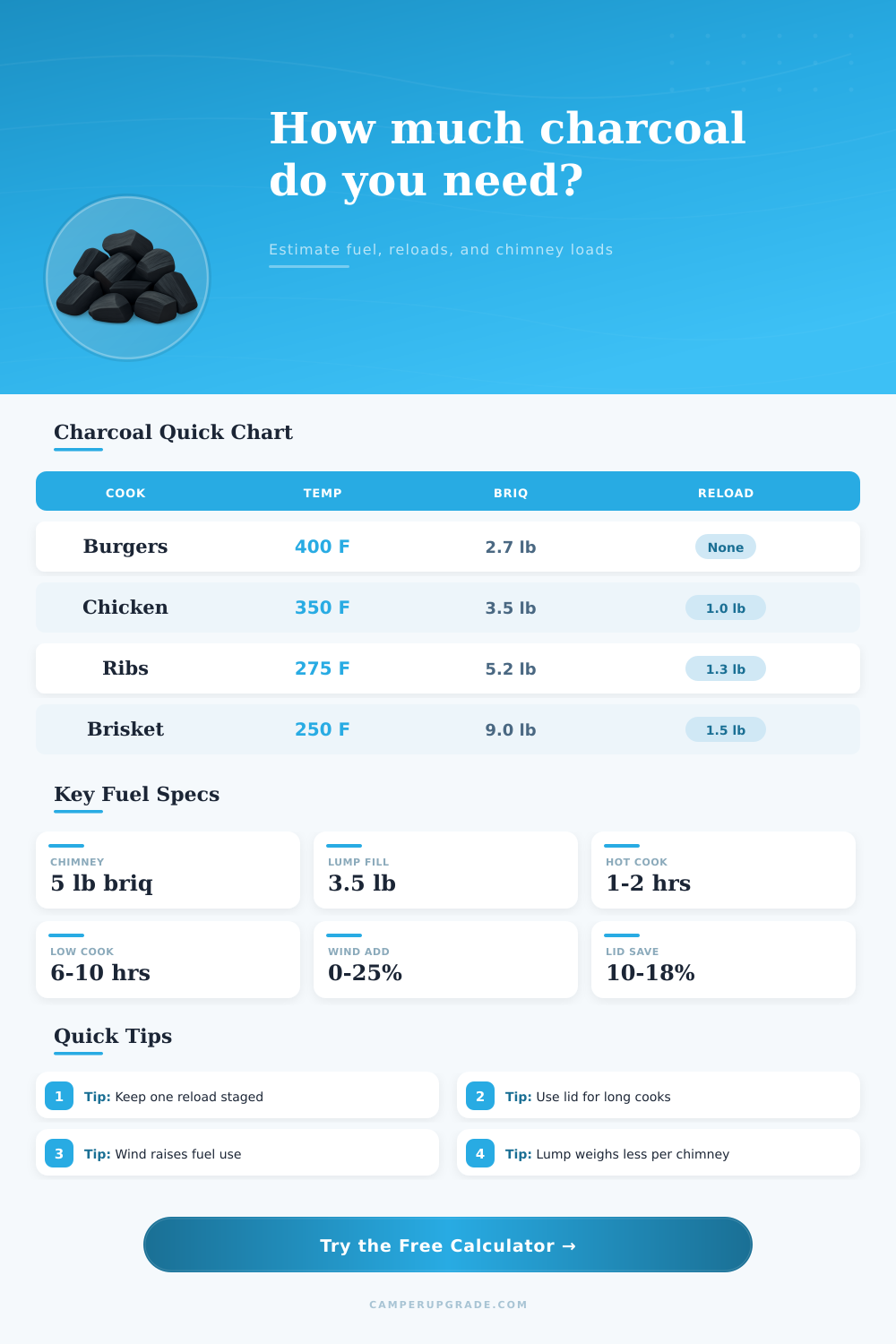
| Hardwood lump charcoal | About 3.5 lb full chimney | Fast response, uneven pieces | Hot grilling, kamado cooking, searing |
| Large-piece lump charcoal | About 3.8 lb full chimney | Longer lump burn | Kamado barbecue and extended roasts |
| Coconut shell briquettes | About 5.2 lb full chimney | Dense and slow burning | Long steady cooks where available |
| Cook temperature | Typical use | Fuel behavior | Reload cue |
|---|---|---|---|
| 225°F | Smoking and long barbecue | Small controlled fire, long burn | Add small reloads before temp sags |
| 250°F | Brisket, pork, ribs | Steady low heat with vent control | Reload every 2 to 4 hours if needed |
| 275°F | Ribs and faster barbecue | Moderate fuel draw | Watch ash buildup and grate temperature |
| 325°F | Roasts and whole poultry | Medium-hot bed with faster recovery | Reload after the first visible dip |
| 350°F | Chicken pieces and sausages | Balanced grilling heat | Usually one reload for longer sessions |
| 400°F | Burgers, chops, vegetables | Hot active fire | Short cook; reload only for batches |
| 450°F | Steaks and high heat sear | High burn rate | Use a fresh hot chimney if extending |
| 500°F | Very hot searing | Maximum airflow and fast fuel use | Plan short windows of intense heat |
| Condition | Fuel adjustment | What it means | Practical setting |
|---|---|---|---|
| Calm and sheltered | Baseline | Normal burn rate | Use the calculator result as-is |
| Light breeze | Add about 6% | Small heat loss and extra airflow | Keep vents controlled |
| Moderate wind | Add about 14% | Fuel burns faster and heat escapes | Shield the grill and stage fuel |
| Strong wind | Add about 25% | Open grills lose heat quickly | Use a lid, wind block, or shorter batches |
| Lid open | Add about 18% | Radiant heat loss is high | Best for quick searing only |
| Lid closed | Reduce about 10% | Heat cycles through the cooker | Best default for longer cooks |
| Tight kettle or kamado | Reduce about 18% | Vents meter oxygen efficiently | Useful for low and slow control |
| Preset | Grill and temp | Time and food | Starting approach |
|---|---|---|---|
| Weeknight burgers | 22 in at 400°F | 0.75 hr, 4 lb food | One hot direct bed |
| Hot steak sear | 22 in at 500°F | 0.5 hr, 3 lb food | Concentrated full chimney |
| Chicken pieces | 22 in at 350°F | 1.5 hr, 6 lb food | Two-zone fire with lid |
| Kettle ribs | 22 in at 275°F | 5 hr, 8 lb food | Banked coals and timed reloads |
| Pork shoulder | 22 in at 250°F | 9 hr, 9 lb food | Low fire with repeat reloads |
| Low brisket | 26 in at 250°F | 12 hr, 13 lb food | Large cooker, steady refuel plan |
| Fish and vegetables | 18 in at 325°F | 0.75 hr, 3 lb food | Small covered fire |
| Party wings | 26 in at 400°F | 2 hr, 12 lb food | Hot two-zone batch cooking |
| Camp Dutch oven | 14 in at 350°F | 2.5 hr, 7 lb food | Briquette-style steady heat |
Determining the amount of charcoal that your grill needs involve considering several different variable. The amount of charcoal you use will determine the heat of your fire and the success of the meal that you cook on the grill. Using too little charcoal will cause your fire to lose heat when your meat require heat.
Using too much charcoal will create a alot of ashes and waste charcoal. Many cook use trial and error to determine the correct amount of charcoal to use. By understanding the variables that affects the amount of charcoal that your grill consumes, you can avoid the trial and error process when using your grill.
How Much Charcoal to Use on Your Grill
The size of the grill is one of the variable. The larger the grill, the more charcoal you will need to maintain the temperature of the grill. The smaller the grill, the less charcoal that will be required for maintain heat.
Therefore, you must take into consideration the size of the grill that you will use. The target temperature of the grill is another of the variables that will affect the amount of charcoal that are consumed. Cooking at a low temperature will cause the charcoal to be consumed slow.
However, cooking at a high temperature will cause the charcoal to be consumed faster. A calculator will help determine the proper amount of charcoal that is required for you’re desired temperature. The calculator can process the size of the grill and the target temperature to determine the amount of charcoal that your grill will consume.
The other variables for charcoal consumption are the environmental factor. If your grill is exposed to wind, it will consume the charcoal at a faster rate. Cold weather will also make your grill consume more charcoal to maintain the target temperature.
Therefore, you must use more charcoal when it is windy and in the cold weather. Another factor is the position of the lid of the grill. An open grill will allow heat to escape from the grill.
An open grill will use up charcoal at a faster rate then a grill whose lid is closed. By keeping the lid of the grill closed, you will retain the heat of the grill. Retaining the heat of the grill will allow you to maintain the temperature of the grill and use up less charcoal.
By keeping the lid of the grill closed you will save charcoal. The other factor to consider is the mass of the food that is being cooked. Cooking a small amount of food will cause little change to the temperature of the grill.
However, cooking a large amount of food will pull heat away from the grill. To compensate for the decrease in the temperature of the grill caused by a large mass of food, you will have to use extra charcoal to heat the food to the desired temperature. Therefore, large masses of food use up more charcoal than small masses of food.
The type of charcoal you use will change how your fire burns. Standard briquettes burn at a steady rate. Standard briquettes are also easier to pack into the chimney of your grill.
Lump charcoal will light faster than standard briquettes. However, lump charcoal can be irregular in shape, causing it to burn at an uneven rate. Therefore, you must choose the type of charcoal that will allow your fire to burn at the rate you require for the food that you are cooking.
Another factor to consider when using charcoal on the grill is the timing of your charcoal reloads. Adding charcoal to a grill that is already very hot will waste the heat of the grill. However, if you add charcoal to the grill too late in the cooking process, the temperature of the food will drop.
By observing the length of time that your first load of charcoal lasts, you can plan your charcoal reloads. Planning your charcoal reloads will allow you to maintain a steady temperature while cooking. Another variable to consider is the change in the weather.
A sudden gust of wind can remove the lid of the grill and cause a loss of heat from the grill. Cold weather will also make your grill consume more charcoal. You should prepare a reserve of lit charcoal to be used in case you have to cook for longer than two hour.
Reference tables will help you to understand how temperature and weather affect the charcoal that you use on the grill. These tables are not strict rules but provide the starting point for using the charcoal calculator. The tables will help you understand the effect that each variable will have on your charcoal use.
Some cooks use the incorrect amount of charcoal. For example, some cooks will say that since twelve pounds of charcoal was used for the last cook, using twelve pounds will ensure success with this cook, as. This is a mistake since the amount of charcoal that is used may change based off the size of the grill, the target temperature, and the weather.
Therefore, cooks must not treat charcoal as a fixed number but adjust the amount of charcoal that is used based on the variables. If cooks took the time to plan the amount of charcoal to use on the grill, they would reduce the stress of cooking. By planning the amount of charcoal that will be used, cooks will know the amount of charcoal that will be needed for the first load.
They will also know when to add the charcoal and how much extra charcoal may be needed due to the weather. Finally, cooks must learn to read the fire while it burns. A calculation will allow cooks to determine the starting point for the amount of charcoal to use.
However, cooks must learn to read the fire and adjust the amount of charcoal that is used based on the success of the cook to achieve a successful result.