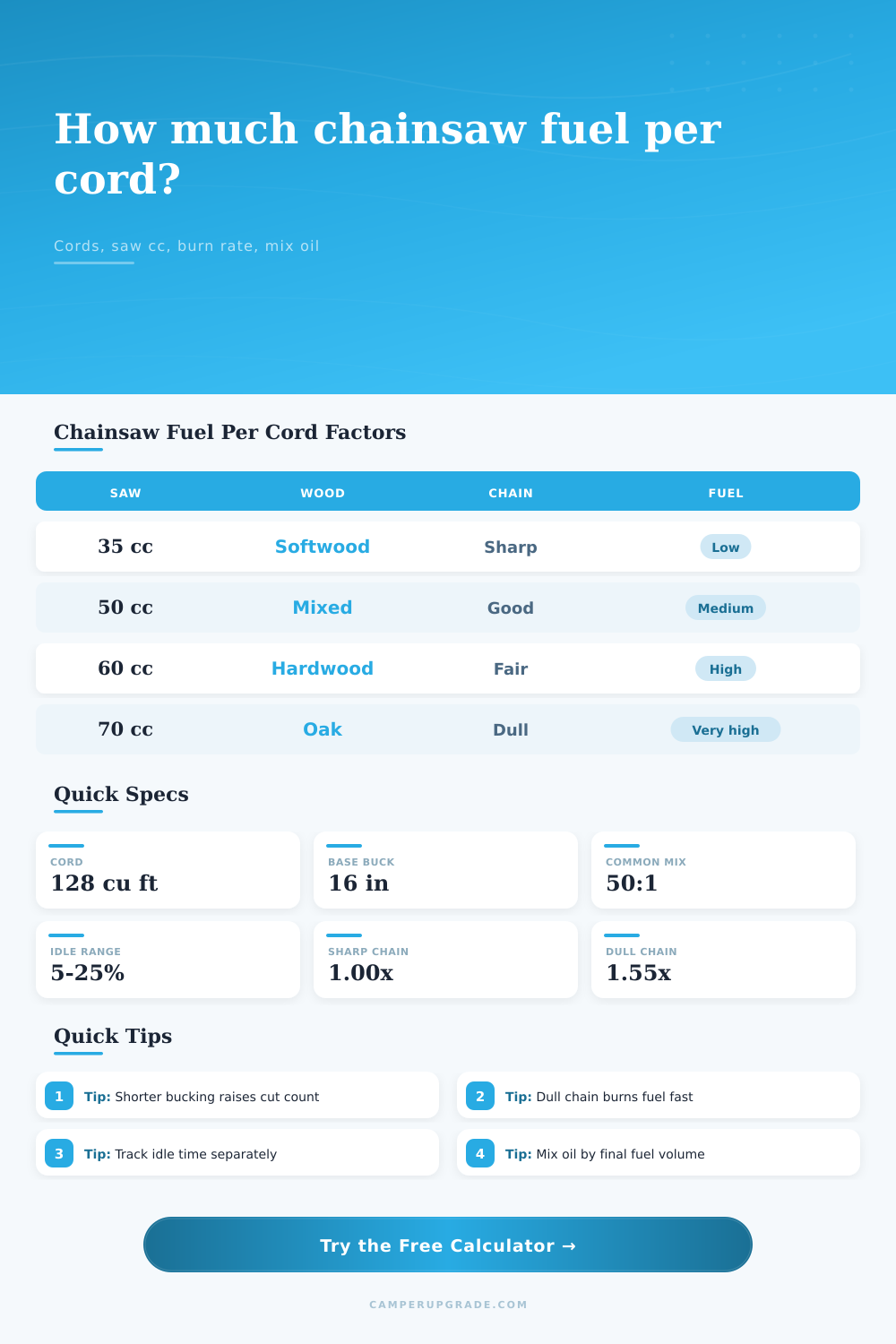
Chainsaw Fuel Per Cord Calculator
Estimate fuel mix, straight gasoline, two-stroke oil, runtime, idle loss, cut count, and gallons or liters per cord from saw size, burn rate, wood hardness, chain condition, and buck length.
Cutting breakdown
| Saw size | Typical work | Burn range | Planning note |
|---|---|---|---|
| 30 to 40 cc | Limbing, small camp rounds, softwood piles. | 0.15 to 0.30 gal/hr | Low fuel use, but slower cord production in larger hardwood. |
| 45 to 55 cc | General firewood, mixed hardwood, 16 inch bucking. | 0.28 to 0.50 gal/hr | Common one-saw range for a steady homeowner cutting day. |
| 60 to 70 cc | Large hardwood rounds, faster bucking, longer bars. | 0.45 to 0.75 gal/hr | Higher hourly burn can still use less fuel per cord when productivity rises. |
| 75 cc plus | Oversize stems, milling-style work, heavy bars. | 0.65 to 1.10 gal/hr | Use real measured burn for long bars or full-throttle hardwood cuts. |
| Wood condition | Factor | Examples | How it changes fuel |
|---|---|---|---|
| Soft, dry, clean | 0.85x | Pine, fir, clean cedar. | Often faster than the entered base rate. |
| Average mixed firewood | 1.00x | Mixed hardwood and softwood in normal bark. | Uses the base cut rate as entered. |
| Dense hardwood | 1.18x | Ash, maple, beech, many dry hardwood rounds. | Adds runtime because chip load and feed speed drop. |
| Very hard or dirty | 1.35x to 1.65x | Oak, hickory, locust, frozen or storm wood. | Can turn a normal fuel plan into a spare-can day. |
| Buck length | Length factor | Approx cuts per cord | Fuel planning effect |
|---|---|---|---|
| 12 in | 1.33x | 130 to 190 | More handling and crosscuts for small stove fireboxes. |
| 16 in | 1.00x | 95 to 145 | Common reference length for firewood estimates. |
| 20 in | 0.80x | 75 to 115 | Fewer cuts, but larger rounds may slow handling. |
| 24 in | 0.67x | 65 to 95 | Lower cut count when the stove or boiler accepts long wood. |
| Mix ratio | Oil per gallon | Oil per liter | Common use |
|---|---|---|---|
| 32:1 | 4.0 fl oz | 31 ml | Older equipment or specific high-oil instructions. |
| 40:1 | 3.2 fl oz | 25 ml | Many older saws and utility two-stroke tools. |
| 50:1 | 2.6 fl oz | 20 ml | Common modern chainsaw mix ratio. |
| 80:1 | 1.6 fl oz | 13 ml | Only when the oil and saw instructions allow it. |
But there’s one particular situation where you run out of gas before completing a cord of oak: It’s cold, your arms are sore, you’re exhausted, and automobile is three miles distant. Why? Because rather than using math, we purchase our fuel by intuition. Grab a five-gallon bucket and go to work.
But here’s the lesson: Fuel consumption is a rate problem. In order to know how far you’ll get, you must first know how fast it burns. That’s what calculator above does. It crunches the numbers on wood type, saw size, and everything else.
How to Save Fuel When Cutting Wood
Big isn’t always bad for gas: While small homeowner unit may consume fewer gallons an hour, it often uses more fuel per cord than a big pro saw (assuming they’re both running full throttle). Why? Because latter cuts quicker. Less time spent trying to muscle it through tough grain, less time idling.
You plug in your real-time cut rate and burn rate into the tool. If you’ve got a slow-moving 50cc sipper, the calculator will tell you its per-cord cost is greater then that of a 70cc screamer that rips through equal amounts of wood twice as fast. Efficiency in this sense has to do with speed.
The harder the wood, it will affect the fuel equation more. Frozen hickory is hard work; pine saws like butter (dry). The software takes that into account based off what’s called a “hardness factor” on the base rate. When you’re bucking green hardwood in January, it’s the battle of both moisture and density. The wetter chips plugs up the bar and slow down the cut. The bar spins longer, burning more gas.
A dull chain makes issue worse. A biting chain gets job done; a grinding chain creates nothing but heat and sound…not progress. Always consider condition of your file.
A big portion of your budget will be killed by idle time. Walking, stacking and repositioning takes way longer than cutting does in most cases. Wasting 20 minutes rolling a fat log is like wasting fuel. That’s what the idle percentage input captures. It makes you admit that sitting there costs money. Be honest with it. Muddy conditions, tired days mean your idle time increases so should your fuel budget.
The oil must be mixed propery. If there isn’t enough, it will melt your rings. If you have too much oil, it fouls up the plugs. The calculator divides the total amount of fuel by the ratio to determine how much oil and gas are being added. The typical ratio for most new saws is 50:1 but some old ones operates at 32:1 or 40:1. Running the wrong ratio is a great way to kill an engine slowly. I recommend having a separate pump bottle for mixing your own. Trusting eye-balling a gas can would of get you in trouble.
A longer buck length is better than you think. Twelve inch stove wood pieces take more crosscutting then do sixteens. And that means more starts and stops. More bar clearance, more start rope wear. You use more fuel for the same cord if you are making shorter lengths. Inefficiency is cost of convenience.
Be ready for the unexpected. Because storm cleanup wood is typically littered with mud, dirt or metal debris, it can cause your chains to dull faster and cut slower. Leave extra room for a reserve. Better off arriving back home with half a tank than running out in driveway.
Math provides the starting point. Experience provides the cushion of safety.
Bring some extra gas. File frequentley. Consider the weight of that cord.