🌳 Cedar Firewood BTU Calculator
Estimate usable heat from cedar cords, moisture, split size, and stove efficiency with realistic stacked-wood math.
| Condition | BTU/Cord | Weight | Note |
|---|---|---|---|
| Green cedar | 18.9 MMBtu | 5,050 lb | Wet core |
| Mid season | 20.4 MMBtu | 4,600 lb | Better burn |
| Seasoned | 22.3 MMBtu | 4,200 lb | Best value |
| Dry split | 22.8 MMBtu | 4,050 lb | Fast start |
| Measure | Cord Eq. | Stack Ft3 | Use |
|---|---|---|---|
| Full cord | 1.00 | 128 | Base unit |
| Face 16 | 0.33 | 42.7 | Short wall |
| Face 18 | 0.38 | 48.0 | Common rack |
| Face 24 | 0.50 | 64.0 | Deep rack |
| Moisture | Factor | Split | Burn note |
|---|---|---|---|
| 12% | 1.05 | Small | Very dry |
| 18% | 1.01 | Medium | Ready |
| 24% | 0.93 | Large | Wet edge |
| 30% | 0.84 | Rounds | Hard start |
| Task | BTU/hr | Hours | Note |
|---|---|---|---|
| Small cabin | 8,000 | 8-12 | Easy load |
| Main heat | 12,000 | 6-10 | Typical stove |
| Cold snap | 16,000 | 4-8 | Hard burn |
| Night bank | 20,000 | 3-6 | Deep coal |
Measure moisture on a fresh split, not the outside shell.
Use the lower BTU result for cold weather planning.
Cedar is a type of wood that is used for burning in fire. Cedar is used to provide heat for cabin and other structures. Cedar burn quickly, but due to the oils in cedar, it has more less energy density than other woods like oak.
You must account for the type of cedar and the density of the cedar when calculating the amount of heat that a pile of cedar wood will provide. There are different types of cedar that can be found. Each type of cedar contain a different amount of British Thermal Units, or BTUs.
How Much Heat Does Cedar Wood Give?
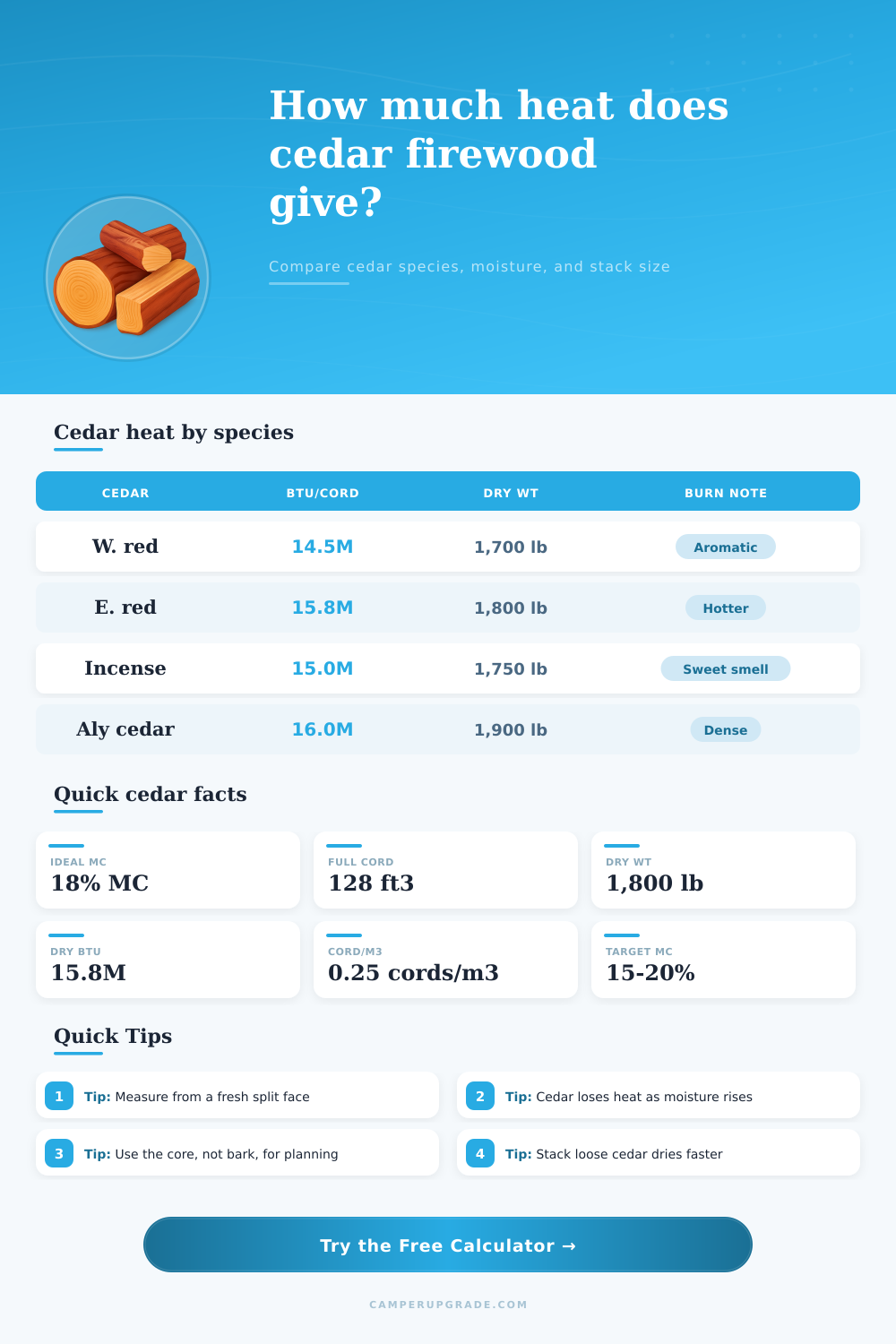
Western red cedar can provide 14.5 million BTUs per cord when the cedar is dry. However, eastern red cedar can provide 15.8 million BTUs per cord because the grains of the wood is tighter. Incense cedar will produce a medium amount of BTUs when burned.
Finally, Alaska yellow cedar can produce nearly 16 million BTUs because it is a denser form of cedar. A cord of wood is not 128 cubic feet of cedar wood. A face cord of wood that is 16 inches in depth is only one-third of a cord.
Therefore, make sure that you do not confuse the two measurement. Another factor that will impact the amount of heat that the cedar provide is its moisture content. Freshly cut cedar can contain 50% of its weight as water.
When burned in a fire, the stove will have to boil the water out of the cedar before it can provide heat to the structure. If cedar is seasoned to 18% moisture content, it will provide more energy than cedar that contain 50% moisture content. To season cedar, cut it into small pieces and place the cedar under a tarp in a location that is breezy for twelve months.
If the moisture content is 24%, the BTUs will decrease by 7%. The lower the moisture content of the cedar, the more BTUs the cedar will produce when burned. Another factor that will impact the amount of heat that the cedar provides is its size and the way it is stacked.
Small splits of cedar will dry faster than round cedar log. Additionally, small splits of cedar will ignite more easy. The bark on cedar contains very little energy.
Therefore, if there is a high percentage of bark in the cedar wood that you are to burn, the BTUs will be correspondingly lower. If you want the cedar to dry quickly, you should stack it in a loose fashion. However, cedar should be stored in a tight fashion in the winter months to conserve the wood.
Finally, the efficiency of the heating appliance will also impact the amount of heat that you will recieve from burning cedar. For instance, a moddern stove can reach 75% to 85% efficiency while an open fire pit may only reach 50% efficiency in the amount of heat it can produce. Cedar should not be used as the only fuel source for deep winter months.
However, cedar is an excellent fuel source for starting fires because of the ease with which it will ignite. Additionally, during shoulder seasons, cedar is a helpful type of wood for starting fires. However, for long lasting fires, mix cedar with denser types of woods like maple.
The maple will burn steadiness while the cedar will start the fire. Do not purchase cedar wood that is green by weight. Green cedar will weigh more due to the water content in the wood.
However, when cedar is dry, it will produce more heat per pound than green cedar. When burning cedar wood, you must take into consideration your specific heating setup. For instance, a firepit will have a lower efficiency than a boiler setup.
Therefore, the boiler will produce more heat and allow for the cedar wood to last longer. Find the BTU output that is necessary for your space. Use the tools that are available to calculate the number of hour that your cedar wood will provide.
Additionally, make sure that you clean the flues of your fireplace or heater. The resin in the cedar wood will build up over time and reduce the efficiency of your fire. If you can measure the moisture content in the cedar and account for the type of cedar that you are using, you can accuratelyly predict the amount of heat that the cedar will provide when burned.