Caving Carbide Fuel Calculator
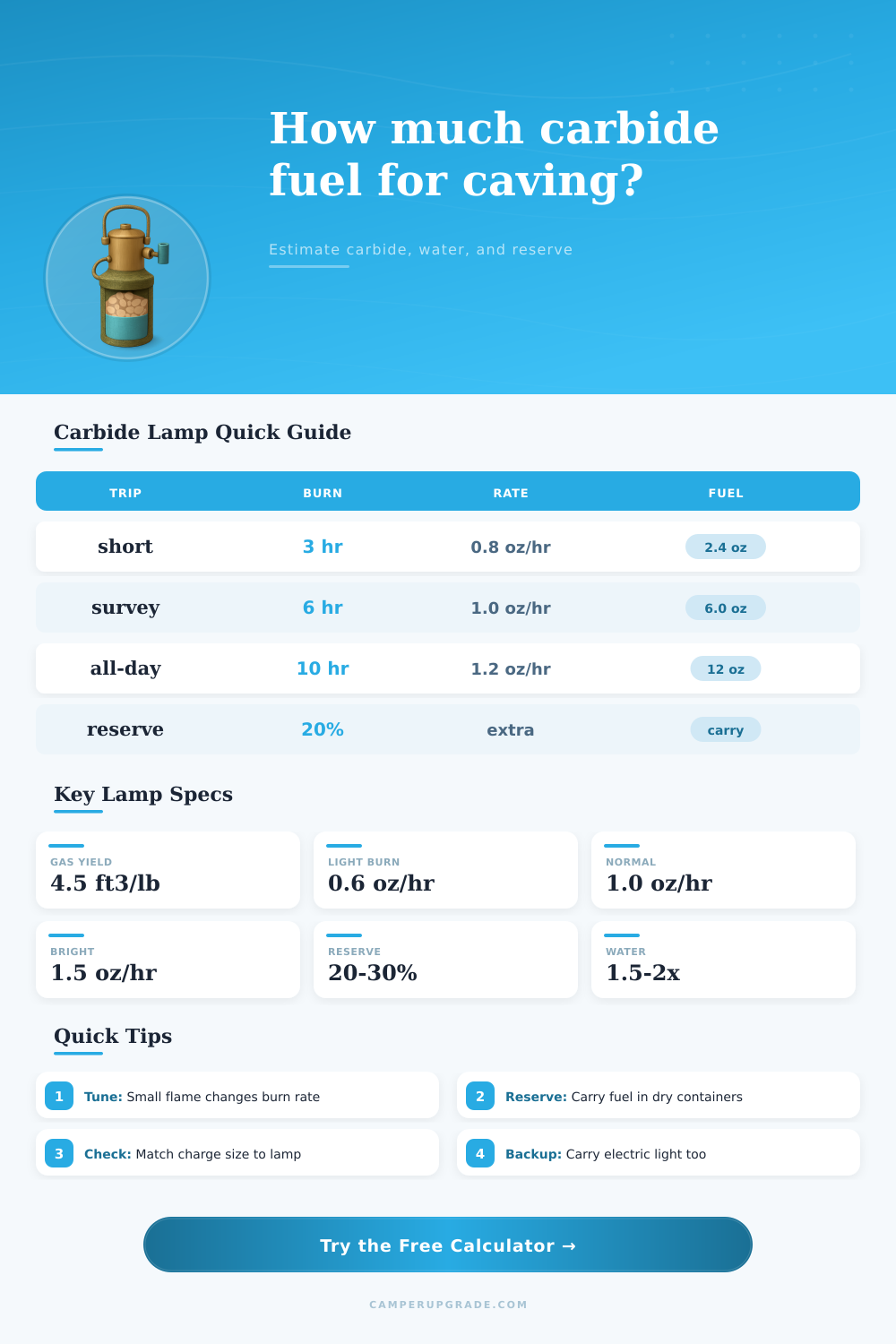
Estimate calcium carbide fuel, lamp charges, acetylene volume, water demand, burn-time reserve, and carried weight for carbide lamp cave trips.
⛏Caving Trip Presets
⚙Lamp, Burn Rate, Trip Duration, and Reserve Inputs
This tool estimates fuel from adjustable carbide burn rate, burn time, reserve, commercial acetylene yield, water ratio, and lamp charge size. It is for trip planning only; carbide lamps use an open flame and acetylene gas, so follow local cave rules and carry independent electric backup lights.
🧮Formula Cards Used by the Calculator
Burn-rate fuel mass
Base carbide equals burn rate times planned underground hours, extra delay hours, and number of carbide lamps.
Trip margin added
Carry fuel equals base carbide multiplied by one plus the selected reserve percentage.
Acetylene yield
Estimated acetylene equals carbide pounds multiplied by selected cubic feet of gas per pound.
Charge and service plan
Charges equal carry weight divided by usable carbide per charge, rounded up to whole lamp fills.
🔥Lamp and Burn-Rate Spec Grid
📊Carbide Fuel and Lamp Reference Tables
| Lamp Setting | Planning Rate | 4 oz Fuel | 8 oz Fuel |
|---|---|---|---|
| Low backup flame | 0.5 oz/hr | 8.0 hr | 16.0 hr |
| Economy travel | 0.7 oz/hr | 5.7 hr | 11.4 hr |
| Normal caving | 1.0 oz/hr | 4.0 hr | 8.0 hr |
| Bright passage | 1.5 oz/hr | 2.7 hr | 5.3 hr |
| Trip Length | 0.8 oz/hr | 1.0 oz/hr | 1.3 oz/hr |
|---|---|---|---|
| 3 hr + 20% | 2.9 oz | 3.6 oz | 4.7 oz |
| 6 hr + 20% | 5.8 oz | 7.2 oz | 9.4 oz |
| 10 hr + 30% | 10.4 oz | 13.0 oz | 16.9 oz |
| 16 hr + 50% | 19.2 oz | 24.0 oz | 31.2 oz |
| Fuel Packed | Weight | Gas at 4.5 | Normal Burn |
|---|---|---|---|
| 4 oz bottle | 0.25 lb | 1.13 ft3 | 4 hr |
| 8 oz bottle | 0.50 lb | 2.25 ft3 | 8 hr |
| 1 lb tin | 1.00 lb | 4.50 ft3 | 16 hr |
| 2 lb cache | 2.00 lb | 9.00 ft3 | 32 hr |
| Reference Item | Typical Value | Metric | Use |
|---|---|---|---|
| Normal charge | 2-3 oz | 57-85 g | cap lamp |
| Small reserve | 4 oz | 113 g | short cave |
| Standard bottle | 8 oz | 227 g | day trip |
| Dry cache | 16 oz | 454 g | long trip |
💡Carbide Fuel Calculation Tips
Using a carbide lamp require constantly monitoring the amount of fuel left in the container. The rate at which the lamp consumes the fuel is dependent upon the brightness of a flame. By increasing the brightness of the flame to focus on large area of the cave, the lamp increases the rate of consumption of the fuel (calcium carbide).
By decreasing the brightness of the flame to focus on small areas of the cave, the rate of consumption of the fuel (calcium carbide) is decreased. An understanding of these factor is essential in determining how long the fuel will last on a given trip. In order to exit the cave, a person must perform some mental arithmetic to ensure the lamp doesnt run out of fuel.
How to Manage Carbide Lamp Fuel
Planning a trip into the cave require that you account for the time that may be occupied by unexpected delays. The time required to rig rope for others or to assist teammates into the cave will consume fuel. It is important to account for this time in planning the trip; a person may spend additional time in the cave performing other tasks than the time spent traveling, so planning for unexpected delays will provide for a more realistic scenario for fuel consumption rather then a best-case scenario.
The burn rate of the lamp is not a fixed number; it change based upon the quality of the calcium carbide that is used and the tuning of the jet at which the lamp’s flame exit. The higher the grade of the calcium carbide, the more gas that will exit the lamp per pound of calcium carbide that is consumed. Additionally, high grade calcium carbide allows for more light to be provided with less weight of the calcium carbide that is consumed.
If the grade of the calcium carbide is low or the calcium carbide is wet, the flame may be erratic in it’s output of gas. In these instances, it is possible that the individual must carry more calcium carbide. In order to accurately determine the burn rate of the lamp, some carbide will need to be weigh, the lamp will be allowed to burn for exactly one hour at a certain brightness, and the remaining weight of the calcium carbide will be weighed to determine burn rate.
A reserve of calcium carbide should always be carried in addition to the amount that is required for the trip. Many spelunkers use a twenty percent margin for there carbide fuel reserves. In instances, however, where a cave is wet or on long expeditions into the cave, a fifty percent margin for calcium carbide reserves may be needed.
Having a reserve of calcium carbide will provide psychological peace of mind to the spelunker regarding their fuel source. In order to properly function, a carbide lamp require the presence of water. Without water, the chemical reaction that occurs within the lamp will not be able to create the acetylene gas that light the lamp.
The amount of water that is carried into the cave, therefore, must be sufficient to both perform the chemical reaction and also to rinse the lime sludge that forms inside the container of the carbide lamp. If the cave system is dry, the spelunker will have to carry all of the water that will be needed for the lamp; in this case, the water weight will need to be calculated as a ratio to the weight of the calcium carbide to be carried. Refueling the carbide lamp require that the spelunker cease movement.
The lime that has reacted with the water must be dumped from the container; the speleologist will then reload the fuel container and relight the fuel. This process take several minutes to perform. Additionally, the fuel containers should be small bottles because a leak in one bottle will destroy the fuel supply for that cave trip.
The goal is for the speleologist to exit the cave with a small amount of calcium carbide remaining in the containers. Any amount of calcium carbide left in its containers after the spelunker has exited the cave indicates that the fuel lasted for less than the time spent in the cave. Thus, a successful trip will have a depletion of the fuel yet will leave the speleologist with a fuel container that is not empty.