Cathole Depth Calculator
Plan a backcountry cathole by depth, diameter, soil type, group size, spacing, and required 200 ft setbacks before you leave the trailhead.
Calculated Cathole Plan
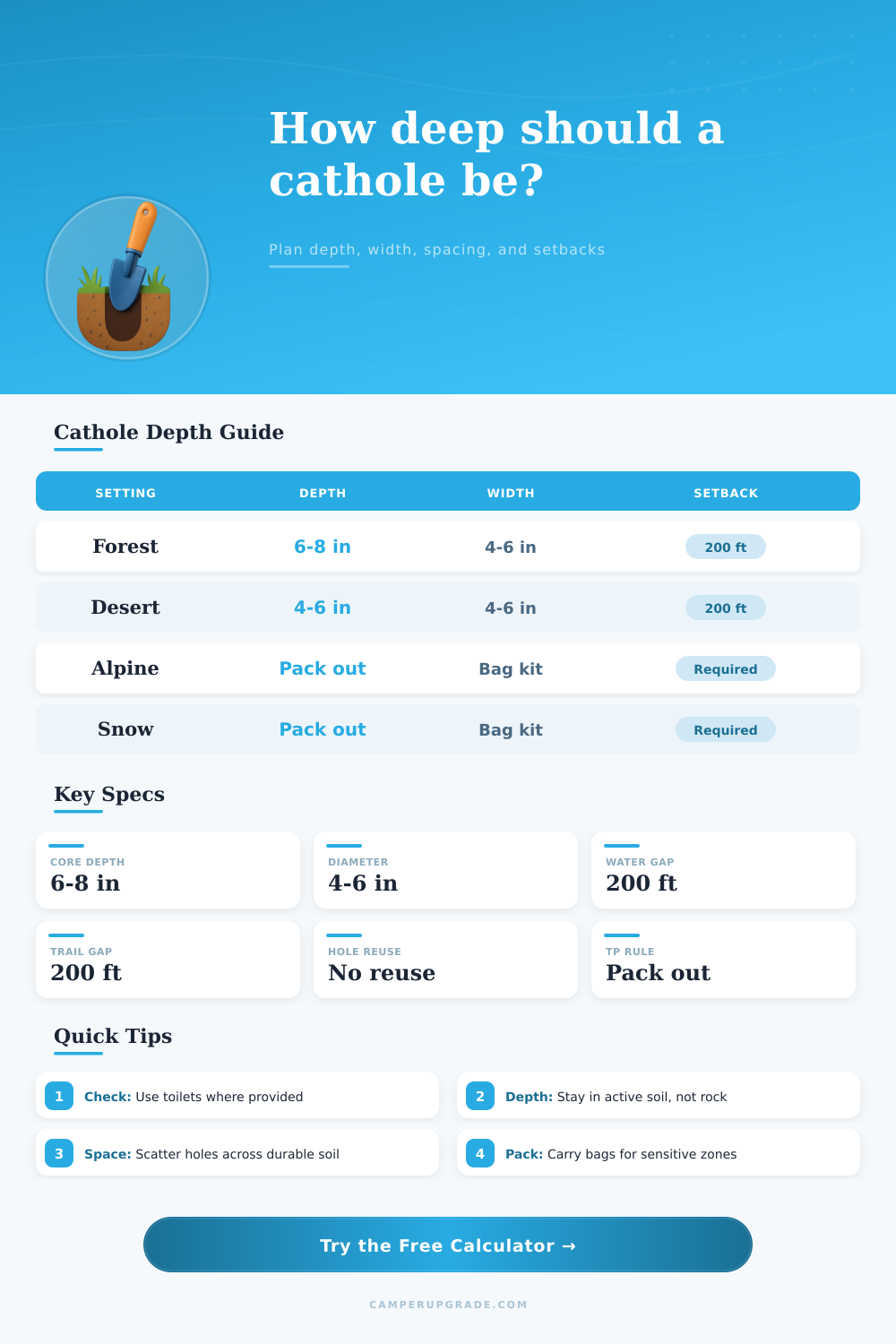
| Environment | Recommended disposal | Depth | Why it changes |
|---|---|---|---|
| Moist forest duff | Single-use cathole | 6-8 in | Active organic soil supports decomposition while staying below casual disturbance. |
| Grassland mineral soil | Single-use cathole | 6-8 in | Mineral soil can work if the spot is away from drainages, trails, and camp. |
| Dry desert soil | Shallower cathole or pack out | 4-6 in | Dry soils decompose slowly; excessive depth may miss biological activity. |
| Rocky shallow soil | Pack out if depth cannot be reached | As allowed | Rocks make full burial unreliable and may expose waste after rain or animal digging. |
| Alpine tundra | Pack out | Not advised | Short seasons and fragile vegetation make decomposition slow and impacts visible. |
| Snow or frozen ground | Pack out | Not advised | Spring melt can move waste directly into water or campsites. |
| Planning factor | Standard value | Metric value | Use in calculator |
|---|---|---|---|
| Water source setback | 200 ft | 61 m | Minimum distance from lakes, streams, springs, and drainages. |
| Trail / camp setback | 200 ft | 61 m | Minimum distance from sleeping areas, kitchens, and travel corridors. |
| Typical width | 4-6 in | 10-15 cm | Controls soil volume and whether a trowel can make a usable hole. |
| Standard depth | 6-8 in | 15-20 cm | Baseline for common forest and mineral soils where catholes are allowed. |
| Scatter spacing | 20 ft | 6 m | Practical minimum for separating multiple single-use holes in one camp area. |
| Group example | Trip length | Estimated uses | Spacing footprint |
|---|---|---|---|
| Solo overnight | 1 night | 1-2 holes | 20 ft scatter line is usually enough. |
| Two hikers | 2 nights | 4 holes | 60 ft line or a loose 20 ft radius scatter. |
| Family of four | 3 nights | 12 holes | 220 ft line or several separated zones. |
| Group of eight | 2 nights | 16 holes | 300 ft line; consider toilets or wag bags. |
| River party | 4 nights | 24+ holes | Pack-out systems are often required or preferred. |
| Tool / method | Best soil | Typical time | Limitation |
|---|---|---|---|
| Ultralight plastic trowel | Forest duff, loose mineral soil | 2-4 min | Can flex in roots or compacted soil. |
| Aluminum backpacking trowel | Mixed duff, small roots, firm soil | 1.5-3 min | Still limited by rock layers. |
| Steel garden trowel | Basecamp, canoe camp, compacted soil | 1-2 min | Heavier to carry on long hikes. |
| Tent stake or improvised tool | Loose sand only | 4-8 min | Often fails to make a proper 4-6 in width. |
| Waste bag kit | Alpine, canyon, snow, river corridor | Ready | Must be sealed and packed to approved disposal. |
“Huh?” You are 20 feet from camp, standing next to your tent, wondering how far down you should of dig the cathole. Easy question… Until you’re out there holding a trowel in cold earth with no idea if six inches of depth will be enough to remain sanitary.
Don’t guess in the dark: This page does the math for you and creates a concrete plan for your given trip. Enter in factors such as time off trail, your group size, and type of soil in which you’ll be digging. Then the calculator use that information to turn the most unclear guidelines (six to eight inches) into a clear plan for action.
Plan Your Bathroom Breaks in Nature
Why? Most recommendations point to six- to eight-inches because that’s right in the active layer of topsoil… Where decay occur at the fastest rate. Go any deeper, and you hit rock or subsoil, which can slow the biological breakdown process. It also accounts for the fact that different places (alpine tundra, desert sand, and wet forest duff) acts differently below the ground’s surface. Water is limited in dry desert, which slows decomposition no matter what the depth. So in the desert the calculator may recommend only digging down four- to six inches different than eight, for instance.
Wherever you go, leave the waste where nature can digest it effectivey while causing minimal mess. Many first-time hikers gets tripped up by group dynamics. A family on a three-day trip may need a dozen sites, whereas a solo overnighter will only need one or two spot. The calculator helps you see how far apart your holes should be to keep the sites separate, it also shows how many times they will all have to be used in total. Because saturated means less effective and more smelly, you don’t want to use the same hole again. By spreading out each site further, no one spot become a noticeable impact zone.
Another place precise planning beats random wandering: When it comes to protection downstream, the golden rule is to stay two hundred feet from water sources. Until you take a packed down pack out there and learn just how far 100 feet is when all the gear are on your back, and just how far you end up traveling to get past that barrier of 100 feet. It will check your inputted distances against those standards for you, so you know if you’re away from the trail/lakes/streams enough before you start digging.
Perhaps the most controversial issue of backcountry etiquette is how to handle TP. For many folks, burying it is no big deal, but moddern toilet papers is made to not decompose! They can easily be seen weeks or even months later after being buried. Increasingly, the norm is to pack it out (in a sealed bag) particularly in sensitive alpine zones or high traffic areas where vegetation grows slow. This can be included in the calculator and helps ensure your plan matches both personal preferences (comfort level) and local regulations.
Selecting an appropriate digging tool is more important than most give credit. While an ultralight plastic trowel is fine for soft forest duff, it will flex uselessly when met by small roots or compacted mineral soil. When the ground is solid, carry a good steel or aluminum trowel which will save you both time and effort. Set reasonable expectations about how much time you’ll spend at each stop; knowing what you’re carting around will help. The less time out there, the better. The more efficient it is, the better.
But at the end of the day, it’s about treating the land with such respect that we don’t have to leave anything behind. That means proper planning so that if another hiker comes through our campsite days or even weeks later, all they will notice is untouched ground. You have to plan ahead to get the spacing and depth right but it ultimately makes the experience cleaner for everyone who follows us.