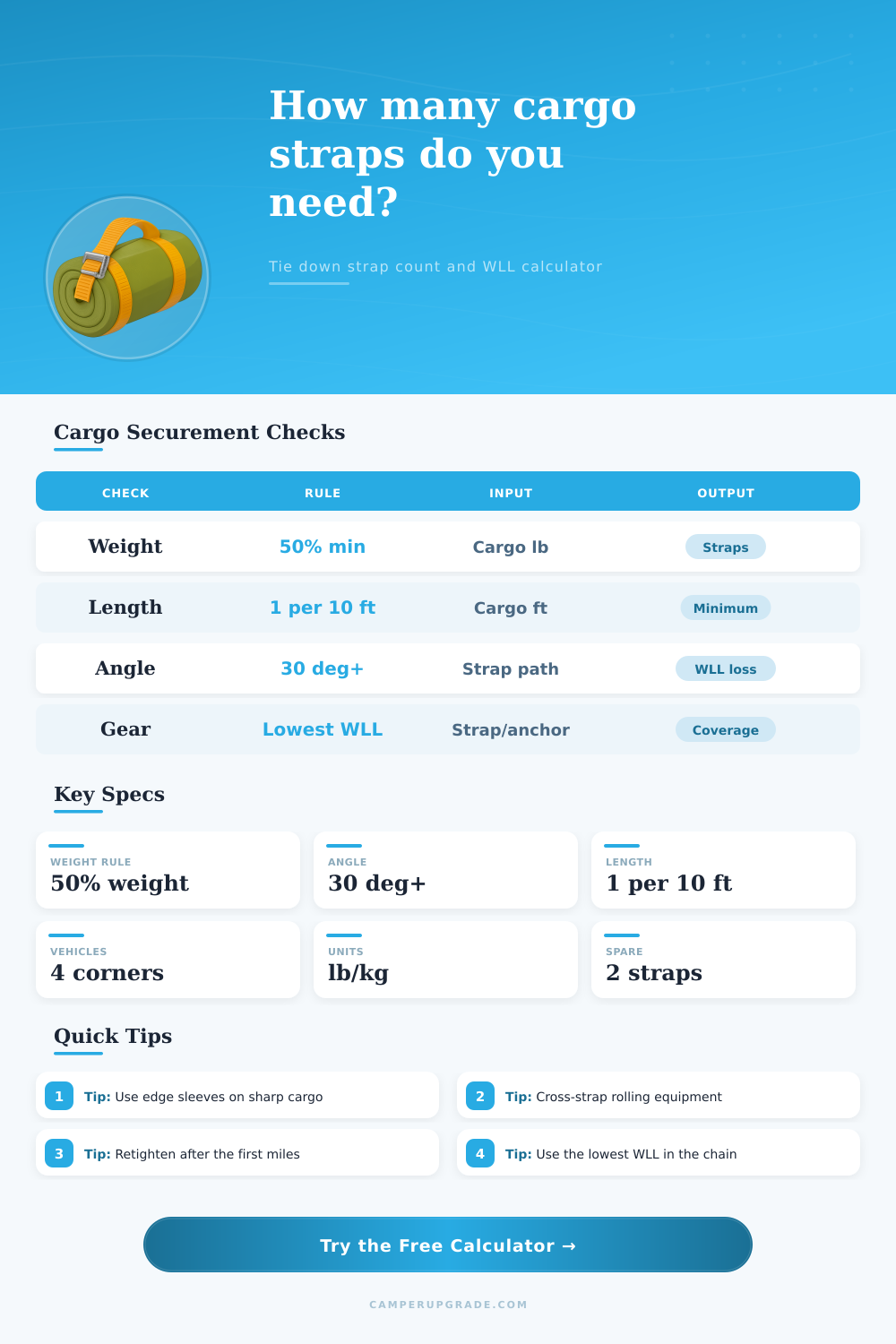
Cargo Tie Down Strap Count Calculator
Estimate how many cargo straps to pack by combining cargo weight, length minimums, working load limit, strap angle, anchor rating, securement method, deck grip, and a realistic spare margin.
🚚Cargo Securement Presets
Strap Count Snapshot
⚙Cargo, Strap, And Route Inputs
Securement note: This calculator is a planning aid for choosing strap quantity and capacity. Follow the cargo, trailer, carrier, vehicle, and road authority rules that apply to your actual load.
📋Material And Strap Spec Comparison
📊Reference Tables
| Strap or assembly | Typical WLL range | Best use | Watch point |
|---|---|---|---|
| 1 inch cam buckle strap | 500 to 1,500 lb | Kayaks, rooftop boxes, soft cargo | Check tag rating and buckle slip under vibration. |
| 1 inch ratchet strap | 500 to 1,100 lb | Motorcycles, totes, appliances | Easy to overtighten on fragile or hollow cargo. |
| 2 inch ratchet strap | 1,000 to 3,333 lb | ATVs, lumber, UTVs, equipment | Use corner sleeves where webbing crosses sharp edges. |
| Transport chain and binder | 4,700 lb and up | Tractors and heavy implements | All hooks, binders, and anchors must be rated. |
| Cargo length | Practical minimum | Why it matters | Example |
|---|---|---|---|
| 5 ft or shorter and 1,100 lb or less | 1 tie-down may be enough | Small compact load with limited length leverage | Single strapped tool chest |
| Over 5 ft or over 1,100 lb | At least 2 tie-downs | Controls both ends and basic fore-aft shift | Appliance, ATV, mower |
| Over 10 ft | 2 plus 1 per extra 10 ft | Long cargo can bow, pivot, or walk sideways | Lumber, canoe, pipe |
| Wheeled vehicle | Often 4 corner points | Suspension and tire movement need opposing restraint | Motorcycle, UTV, tractor |
| Strap angle from deck | Approx. useful factor | Planning meaning | Best correction |
|---|---|---|---|
| 75 to 90 degrees | 0.97 to 1.00 | Near vertical down force or direct path | Good strap geometry |
| 45 to 60 degrees | 0.71 to 0.87 | Common trailer setup with moderate loss | Use rated anchors closer to cargo |
| 30 degrees | 0.50 | Shallow path loses half the useful component | Add straps or change anchor point |
| Under 30 degrees | Below 0.50 | High side load and poor vertical restraint | Re-route before relying on the count |
| Securement method | Count behavior | Strong fit | Weak fit |
|---|---|---|---|
| Indirect over-the-load | Fewest straps when deck grip is good | Boxes, lumber bundles, bins | Rolling equipment without chocks |
| Direct opposing corners | Higher count but better directional control | Motorcycles, ATVs, tractors | Loose stacked cargo |
| Basket or loop path | Can improve capacity when correctly routed | Pipe, round bundles, frames | Sharp edges without protection |
| Hybrid setup | Balances direct restraint and top compression | UTVs, mowers, appliances | Loads with weak attachment points |
🧭Common Cargo Starting Points
| Cargo | Typical loaded weight | Common strap WLL | Starting count |
|---|---|---|---|
| Single kayak on roof rack | 45 to 90 lb | 500 to 700 lb cam straps | 2 hull straps plus bow/stern lines when needed |
| Motorcycle on trailer | 350 to 900 lb | 800 to 1,200 lb ratchet straps | 4 corner straps, usually with wheel chock |
| ATV or side-by-side | 700 to 2,200 lb | 1,500 to 3,333 lb ratchet straps | 4 rated straps at suspension or frame points |
| Lumber bundle, 12 to 16 ft | 400 to 1,500 lb | 1,000 to 3,333 lb ratchet straps | 3 or more straps with edge protection |
| Compact tractor | 2,000 to 5,000 lb | Chain or heavy ratchet assemblies | 4 corner points plus implement restraint |
💡Securement Tips
The unmistakable clacking rhythm of cargo sliding back and forth in a trailer is a sound no one wants to hear during a lengthy journey down the interstate. Not accounting for real-world forces necessary to hold an object in place mean the thump gets louder with each passing mile. If you want your equipment to reach its destination in one piece, you need more than gut instinct to determine how much gear you can secure without breaking something off. This calculator do the math for you, taking road conditions, weight, and geometry into consideration when determining number of safe straps to use.
The way most folks view securing items in their cargo area is simply “pull ’em tight”. Well, that’s only half of the equation. Straps exert direct force and works by friction depending on where they’re routed. Direct corner straps applies force directly to frame or suspension of the vehicle. Indirect straps rely heavily on the grip of your trailer deck to prevent a box from sliding forward.
How to Secure Your Cargo Safely
When hauling motorcycles or ATVs, you might use indirect straps that appear tight. However, without direct straps, the bike can still pivot back and forth. This causes the handlebar to bang against things until they hit something solid. The tool takes these different methods into account by accounting for the effective strength of each strap based off direction restraint or compression use.
The strap angle is important but most folks don’t know that you should of route your strap as close to vertical as possible. If routed at a shallow angle, much of the strap’s holding power is used trying to pull sideways instead of down into the anchor point. Routed steeper, say closer to vertical, virtually all of that holding power get fed straight down into attachment hardware. The calculator will lower the WLL to account for that geometry reduction if you’re tying in with lower tie points off to side of the trailer, versus D-rings right by the cargo itself. It keeps you from assuming you’ve got four straps to hold something together when poor routing means you only have job of two-and-a-half done.
The other piece of this puzzle you’ve got to make yourself respect is the weakest link in the whole dang chain. Sometimes it’s not the webbing at all, it can be the hook. It could be the D ring on the trailer. Heck, it could even be the tie down point on your cargo frame. Tie a three thousand pound rated heavy duty strap to a cheap aluminum rack point rated for eight hundred pounds. Suddenly, your effective capacity have dropped to the lower number. So the calculator makes you put in the lowest rating in the system. If you don’t, the calculator can’t tell you your coverage percentage. This means you’ll either underestimate weight or get overconfident and both will ruin your securement plan faster.
Length matter as well. For long loads such as kayaks or lumber, you want more than one tie-down point to get maximum strength and to keep things from bowing or shifting sideways. A 12 foot board tied down in the center by only one strap will not keep it from twisting end-to-end. This is why the page has a reference table that shows how minimum number scales based only on length, regardless of weight. Even lightweight thing require some strategy to remain flat on their back.
Don’t neglect real world. The road have curves, and it’s not a flat surface. Add dynamic factors like wind gusts, hard stops, and rough patches that far exceed static weight calculations. Having some planning buffer give you total combined strength to absorb these peaks. Better to show up with 2 more straps in the back of your truck then show up to a rest stop because your load is falling out.
After 10 miles do a walk around inspection. The suspension will compress, the webbing will stretch a bit when tightened, and the loads will settle. So things that were all snug and secure at home will loosen up some as you gain speed. Tighten it back down now and then again before each significant fuel stop. Securing cargo isn’t a one-and-done deal. It’s an ongoing conversation with the road and your gear. Get the initial number tight with the tool, but keep your eyeballs on your load the rest of the way. If you plan ahead from start, you can easly avoid that thump-thump-thump.