Car Camping Cargo Space Calculator
Estimate whether coolers, bins, tents, chairs, roof box storage, visibility reserve, and payload limits fit your vehicle before camp day.
Cargo Fit Results
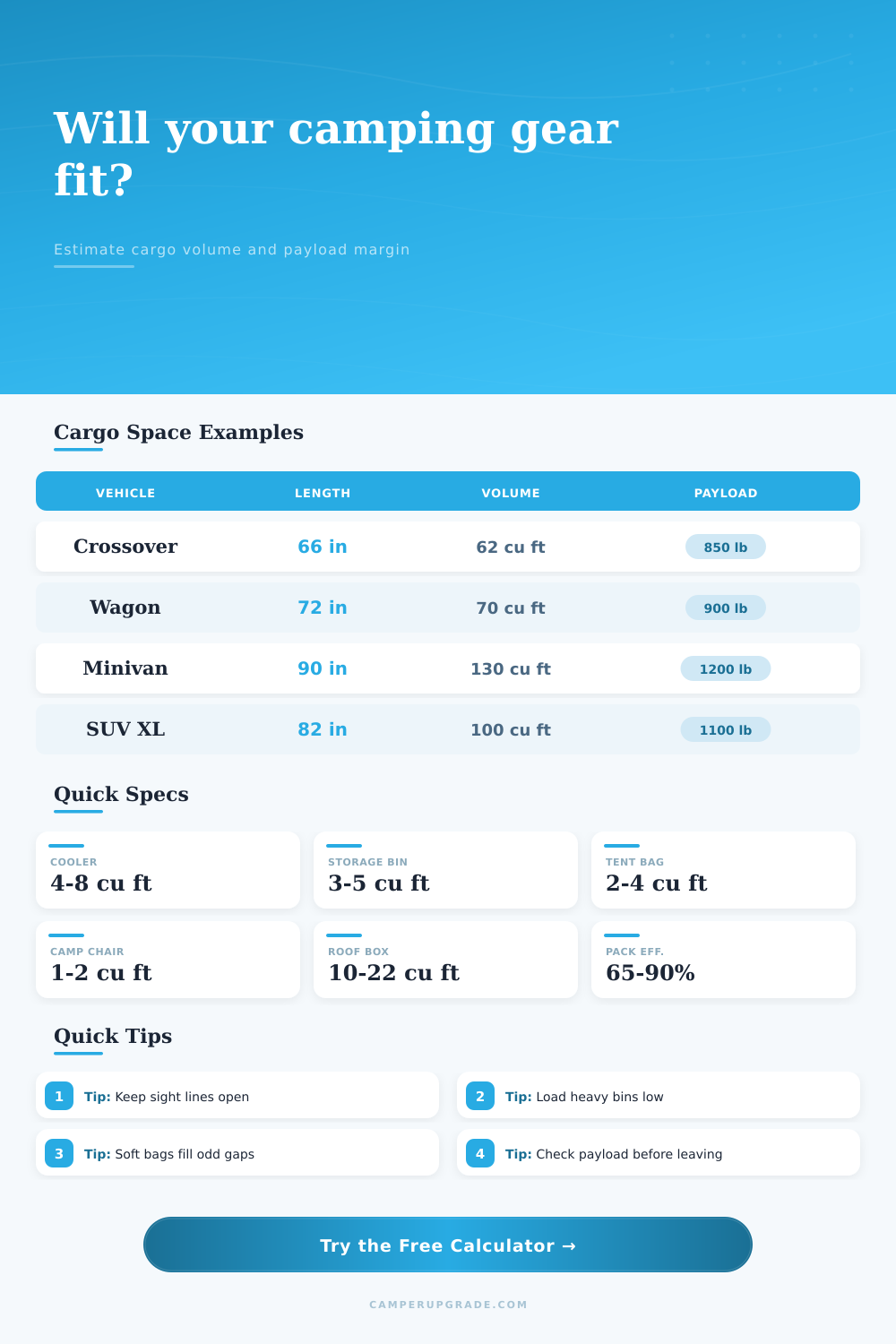
| Vehicle style | Typical usable length | Approx cargo volume | Camping fit note |
|---|---|---|---|
| Compact crossover | 60-68 in | 45-65 cu ft | Best with soft bags and roof box |
| Wagon / long hatch | 68-76 in | 60-78 cu ft | Strong length, modest height |
| Midsize SUV | 68-78 in | 65-90 cu ft | Good four-person weekend base |
| Full-size SUV | 76-86 in | 90-120 cu ft | Handles bins and coolers well |
| Minivan flat floor | 84-96 in | 110-150 cu ft | Best interior volume per footprint |
| Short pickup bed | 62-68 in | 65-85 cu ft | Use bins, covers, and tie-downs |
| Item | Small setup | Family setup | Weight planning |
|---|---|---|---|
| Hard cooler | 4-5 cu ft | 6-8 cu ft | 35-75 lb loaded |
| 27 gal storage bin | 3.6 cu ft | 3.6 cu ft | 20-45 lb loaded |
| 4-person tent | 2.5-3.5 cu ft | 3.5-5 cu ft | 12-35 lb packed |
| Folding chair | 1.0-1.4 cu ft | 1.4-2.0 cu ft | 6-14 lb each |
| Sleeping bag | 0.8-1.5 cu ft | 1.5-2.5 cu ft | 2-8 lb each |
| Camp kitchen box | 2-4 cu ft | 4-8 cu ft | 25-60 lb loaded |
| Planning point | Typical range | Use in calculator | Why it matters |
|---|---|---|---|
| Remaining payload | 500-1200 lb | Weight limit | Passengers reduce available cargo capacity |
| Roof box volume | 10-22 cu ft | Roof box offset | Moves bulky light gear out of cabin |
| Roof dynamic load | 100-165 lb | Keep roof gear light | Roof ratings are separate from space |
| Rear sight reserve | 8-18% | Visibility reserve | Prevents full-height stacking at the glass |
| Packing efficiency | 65-90% | Efficiency input | Rigid bins waste more edge space |
| Trip style | Typical gear volume | Typical gear weight | Best packing move |
|---|---|---|---|
| Solo overnight | 18-30 cu ft | 90-180 lb | One cooler, one bin, soft sleep kit |
| Couple weekend | 32-48 cu ft | 170-320 lb | Use roof box for sleeping bags |
| Family weekend | 55-85 cu ft | 350-650 lb | Stack bins low, chairs on top |
| Remote overland | 70-110 cu ft | 550-950 lb | Audit water, tools, recovery load |
What happens when you discover your gear won’t fit? That’s called panic. You’ll stand there in your driveway on a Friday evening, look at your overloaded cooler and overstuffed duffels, and wonder how you got here.
The car camping cargo space calculator provide a grid of known payload and volume limitations inside your car. No magic. Just measure what you’re working with before heading out.
Why You Should Use the Car Camping Calculator
When most people think “packing,” they envision shape: Will my tent fit? Does my cooler obstruct the license plate? But since we’re talking pounds and cubic feet, not inches and gallons, the math doesn’t add up that way. There are two constraints that don’t often works together. That’s where the calculator comes in; it do the math for you, but knowing what to plug into it, why it needs things like packing efficiency, is what lets it help. Packing efficiency takes into account those curvy SUV wheel wells and hard-sided storage bin that leave gaps. If there were only one way to pack a car perfectly, it wouldn’t be called traveling; it would be called moving. Eighty percent is typically safe, as it is better to be cautious.
Car camping is a weighty endeavor. You don’t notice it. But weight kills car camping trips silent. It gets none of the volume attention. You look around and see all this empty space staring you in the face. Weight doesn’t get noticed till you bottom out on the highway or find yourself with nowhere to go except up a very steep driveway.
Every time your trip has X number of passengers (that includes pets), Y gallons of gas, etc., that is payload. Your maximum allowable cargo weight are reduced by each person, each gallon of gas, etc. When you’ve got three adults plus a dog in the front seat, you may only have fewer than four-hundred pounds of ACTUAL cargo capacity remaining. And the calculator makes you SUBTRACT them FIRST. THAT’s what most campers overlook until it’s too late, when they are straining to lift their loaded cooler.
Keep heavy items like water filters and cast iron skillets inside the car rather than in a roof box. A roof box is frequently thought of as an unlimited stash bin, and yet it isn’t. A big box that provides, say, twenty cubic feet of storage will greatly alter how wind moves around your vehicle. Plus, it raises your center of gravity. The tool works by letting you balance out your cabin capacity with some roof storage (great if you have lightweight but bulky gear such as pillows or sleeping bags). Heavy stuff like cast iron skillets and water filters go inside the car. Mass on top of the roof will increase braking distance and make you more prone to swaying in crosswinds. It’s a balancing act between being comfortable inside and staying stable outside.
Until you’re backing down a narrow trail at dusk and need visibility, you don’t know how much it matter. In certain jurisdictions, leaving part of your back window unobstructed isn’t optional; it’s the law. But even if it wasn’t, it’s a safety feature: A sight-line allowance allows you to use the calculator to set aside a fraction of the total height for vision. You may gain two cubic feet by stacking all that stuff right up to the window, but what good is an extra two cubic feet if you can’t see past the car to spot a child or a dog? Bad deal.
There are also some reference tables supplied with the calculator that give you a reality check when it comes to various types of vehicles. No matter how well you pack, a smallish crossover is not going to carry as much than a flat-floor minivan. Boxes-on-wheels win out here. Minivans rock. Wagons and SUVs loses volume to their sloping hatches and wheel wells. So knowing what can fit into your particular vehicle is going to help you establish realistic expectations. For example, a family of four with a week’s worth of food might need a full-size SUV or some clever use of a roof box. A solo camper can pack himself or herself into a hatchback with one big bin and some kind of soft bed thingy.
Because it’s about managing risk. It is not necessarily about maximizing space. If you estimate your weight and volume of gear prior to loading up, then you’re eliminating guesswork. You will know whether you need to rent a trailer or leave some stuff behind. You will know if you are going to be able to legally fit your tent on your roof box. It is a planned operation instead of a chaotic loading session. Then you get in the car, drive away, and actualy enjoy the camping part.