Canvas Tent Oil Finish Coverage Calculator
Estimate oil finish volume for wall tents, bell tents, wedge tents, awnings, and treated floor cloths using real coverage rates and canvas absorption factors.
Heavier fabric usually takes more finish per coat.
Coverage estimate
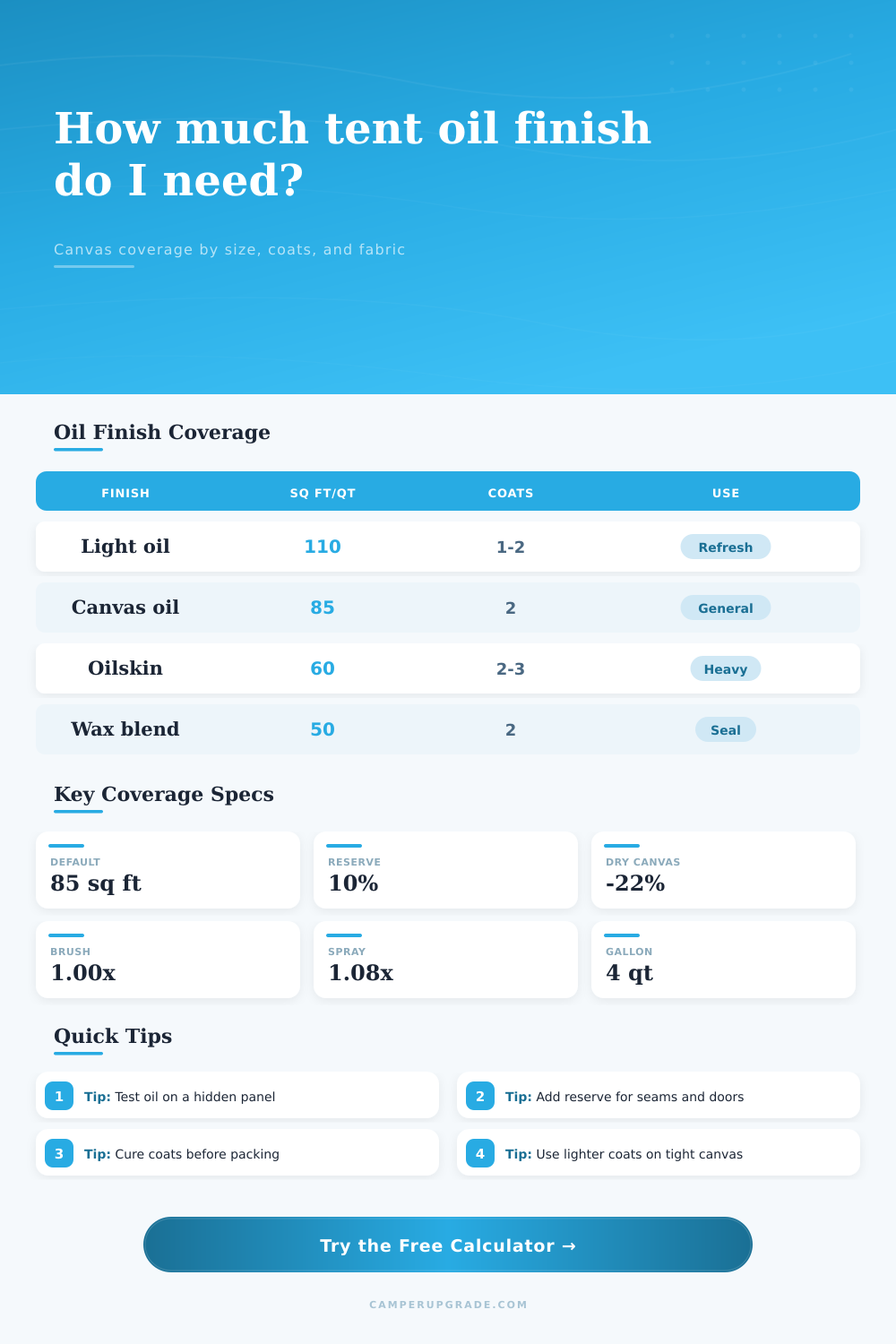
| Finish type | Base coverage | Typical coats | Best use |
|---|---|---|---|
| Light reproofing oil | 110 sq ft/qt | 1 to 2 | Routine water-shedding refresh on tight canvas |
| Traditional canvas oil | 85 sq ft/qt | 2 | General wall tent and cabin tent treatment |
| Paraffin and mineral oil mix | 70 sq ft/qt | 2 | Weathered canvas that needs moderate buildup |
| Heavy oilskin dressing | 60 sq ft/qt | 2 to 3 | Dense field canvas, storm flaps, exposed doors |
| Wax oil blend | 50 sq ft/qt | 2 | High-solids finish where penetration is slower |
| Silicone oil waterproofer | 130 sq ft/qt | 1 to 2 | Lightweight treatment with a thin liquid carrier |
| Shelter | Approx coated area | Standard canvas oil | Heavy oilskin |
|---|---|---|---|
| 10x12 patrol tent | 310 sq ft | 7.3 qt | 10.3 qt |
| 12x14 wall tent | 500 sq ft | 11.8 qt | 16.7 qt |
| 14x16 wall tent | 670 sq ft | 15.8 qt | 22.3 qt |
| 5 m bell tent | 430 sq ft | 10.1 qt | 14.3 qt |
| 12x16 range fly | 215 sq ft | 5.1 qt | 7.2 qt |
| Canvas condition | Coverage factor | Effect | Calculator treatment |
|---|---|---|---|
| New tight weave | 1.10x | Spreads farther | Raises effective sq ft per quart |
| Clean used canvas | 1.00x | Baseline | Uses listed finish coverage |
| Sun-faded exterior | 0.90x | Moderate thirst | Lowers coverage by 10% |
| Dry porous canvas | 0.78x | High absorption | Lowers coverage by 22% |
| Patched or abraded canvas | 0.85x | Uneven take-up | Adds finish for rough zones |
| Container | Quarts | Liters | Use in calculator |
|---|---|---|---|
| Pint touch-up can | 0.5 qt | 0.47 L | Seams, doors, and patch panels |
| Quart can | 1 qt | 0.95 L | Small tarps and final reserve |
| Half gallon | 2 qt | 1.89 L | Small tents or one maintenance coat |
| Gallon can | 4 qt | 3.79 L | Most full tent treatments |
| Five-gallon pail | 20 qt | 18.93 L | Group tents, outfitter tents, or fleet work |
When you unzip your old canvas tent from storage and open it up after a few months in storage, what does it smell like? Yeah, it’s got a hint of neglect on it. You’ll know it’s just dry and dusty. And that means it’s time to oil your shelter and make sure it will shed water again before you take it back into the wilds.
But if you don’t heed that warning and treat your gear properly, it will get you all riled up come morning and make for a wet bag and grumpy moods all around. If you do treat it right, though, you’ll keep your kit going for decades.
How to Oil Your Canvas Tent
Knowing how much finish to purchase is always the key… Enough to do the job without having half a can left over (or worse yet, run out halfway through). But most folks does the latter by guessing based off the size of the tent box it came in. And that just doesn’t work out, as old, used, heavy oilskin canvas soaks up oil at a rate different than new, light, thin summer fly material.
Even two identically sized tents can soak up a finish differently; a heavier piece of 16 ounce oil skin will drink up the finish much quicker then an identically sized lighter 8 ounce summer fly. Before you consider how much surface area you’re dealing with, you need to consider what that surface is made of.
Once you understand that, the variables like amount of rain you’re going to get, or the size of your tent’s roof, you can input them into the calculator above. This eliminates having to remember all the conversion factors and coefficients involved, but knowing why they exist makes it easier for you to make smarter decisions.
It is thirsty work because dry canvas soaks it all in much more than a nice tight weave does. That’s because, if left improperly dried and/or sun-faded while in storage, the tent’s fibers will open up and soak the heck out of whatever goes on them. So even though the can may say it’ll cover eighty five square feet with a quart, if the material is porous, that coverage amount gets cut way down.
It is no biggie, but it is something to consider when you are outdoors with a brush in hand. You might think there is no way you will finish before dark, unless you add a bit of extra time to account for this. Also, those reinforced guy points and door flaps and other parts of the tent requiring special care will get covered too.
Everything else depends upon what kind of oil you use. Wax blends can be heavier. Heavier waxes like oilskins has more penetrating power and create a stronger barrier against water, but they coat less area per quart. Thinner light reproofing oils do not penetrate as far, sit more on the surface and therefore spread farther. These are great for a tent that still has some life left but needs a quick refresh.
So you get what you pay for in volume. A gallon will go further if you used a lighter wax blend than if you used oilskin or a heavy wax blend. Remember, if you’re dressing a big wall tent with a heavy duty finish, it’s going to take more gallons (several) vs. It will take a couple of quarts.
It’s protective and that’s why you do it, but it also costs you in volume. The last number to consider is how you apply it. You would think spraying with a low pressure sprayer would be the most economical way, but then you find yourself wasting large amounts of product due to over spray. Hand rubbing or brushing allows for more precise application and provides a bit of feedback as to whether you’re penetrating into the fiber or merely coating the surface with the oil.
When the canvas isn’t completely coated you can feel this and see where it is wet vs dry. This keeps everything from looking slick and uneven because the excess has soaked in.
The other half of the equation is timing. Allowing oil to cure takes time, so that rain runs off cleanly instead of soaking through. If you pack your tent up with still tacky finish on it, you’re trapping moisture inside the fabric layers and creating mildew issues. Allow several days between the last coat application and storing the tent so it has time to breathe.
At least 24 hours should be allowed between each coat. Patience pays in the field because rain won’t soak into the tent but will rather just run right off. Oiling should never feel like a task to hurry through or not bother with at all. Consider it an investment into how long your gear lasts.
Do it right by measuring, choosing the right finish for your canvas weight, and working slowly and carefully. You’ll end up with a tent that looks cared for, smells fresh, and remains dry. When you put it away next season, it will still smell just as fresh and remind you it was well worth the extra work.