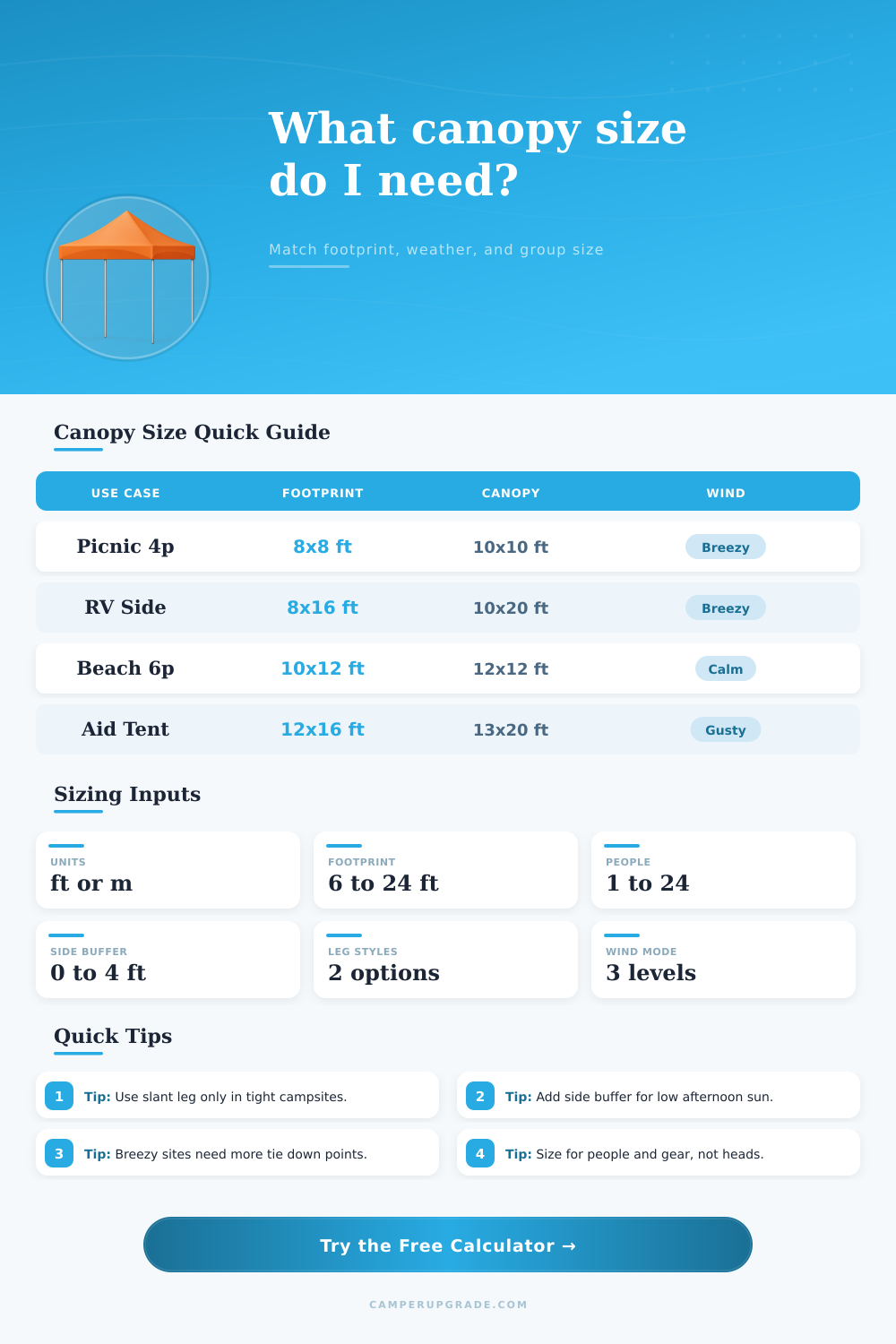
Canopy Size Calculator
Plan shelter size from footprint, people, weather load, and leg style so your canopy covers real campsite use, not just top fabric dimensions.
🏕Camp Setup Presets
⚙Canopy Inputs
📐Standard Canopy Classes
| Canopy Class | Top Area | Straight Leg Usable | Slant Leg Usable | Best For |
|---|---|---|---|---|
| 8 x 8 | 64 sq ft | 59 sq ft | 53 sq ft | 2 chairs + gear |
| 10 x 10 | 100 sq ft | 92 sq ft | 83 sq ft | small picnic group |
| 10 x 15 | 150 sq ft | 138 sq ft | 124 sq ft | dining table + aisle |
| 10 x 20 | 200 sq ft | 184 sq ft | 166 sq ft | RV side camp zone |
| 12 x 12 | 144 sq ft | 132 sq ft | 119 sq ft | square family lounge |
| 12 x 18 | 216 sq ft | 199 sq ft | 179 sq ft | kitchen + social area |
| 13 x 13 | 169 sq ft | 156 sq ft | 140 sq ft | event style shelter |
| 13 x 20 | 260 sq ft | 239 sq ft | 215 sq ft | aid station or booth |
| Required Footprint | Clear Buffer | Recommended Top | Notes |
|---|---|---|---|
| 8 x 8 ft | 1.0 ft each side | 10 x 10 | covers chairs and cooler |
| 10 x 12 ft | 1.5 ft each side | 12 x 18 | works for mixed seating |
| 8 x 16 ft | 1.5 ft each side | 10 x 20 | fits RV side utility lane |
| 12 x 12 ft | 2.0 ft each side | 13 x 20 | sun shift needs extra width |
| 10 x 10 ft | 0.5 ft each side | 12 x 12 | compact in crowded sites |
| 6 x 10 ft | 1.0 ft each side | 10 x 15 | camp kitchen plus prep shelf |
| Wind Class | Anchor Pts | Weight Per Leg | Tie Strap Angle | Setup Rule |
|---|---|---|---|---|
| Calm | 4 to 6 | 15 lb | 35° to 45° | corner tie-down minimum |
| Breezy | 6 to 8 | 25 lb | 35° to 50° | add mid-side anchors |
| Gusty | 8 to 10 | 35 lb | 40° to 55° | lower canopy one notch |
| Scenario | People | Profile Density | Area Target | Starting Size |
|---|---|---|---|---|
| Day hike rest stop | 2 to 3 | lounging | 45 to 70 sq ft | 8 x 8 |
| Camp dining group | 4 to 6 | dining | 80 to 130 sq ft | 10 x 10 |
| Family base camp | 6 to 8 | lounging | 120 to 180 sq ft | 10 x 15 |
| RV side lounge | 5 to 8 | tailgate | 130 to 200 sq ft | 10 x 20 |
| Camp kitchen prep | 2 to 4 | kitchen | 90 to 140 sq ft | 12 x 12 |
| Aid or vendor tent | 6 to 12 | vendor | 160 to 260 sq ft | 13 x 20 |
When you chooses a canopy for camping, you must consider the dimension of the canopy. The dimensions that the manufacturer of those products lists for canopies are typically not the dimension of the shade that the canopy will provide to the camping area. The manufacturers typically list the dimensions of the top of the canopys fabric.
However, those measurements dont include the space that is taken up by the frame of the canopy or the slanted leg of the canopy. For canopies that include slanted legs, the slanted legs will reduce the footprint of the shade that the canopy will provide. For instance, a 10×10-foot canopy will provide 92 square feet of shade if the legs are straight.
How to Choose the Right Canopy for Camping
However, the same type of 10×10-foot canopy with slanted legs will provide only 83 square feet of shade. Before you select a canopy for camping, you need to measure the area that will be taken up by the camping chair and coolers under the canopy. You also should provide some additional space beyond the area that you have measured.
The sun will move during the day and will move under the edge of the canopy during the day. The number of people that will be under the canopy when you are camping is another consideration. The number of people under the canopy will determine how much shade is required for that area.
One person sitting in a chair require approximately 22 square feet of space for the person to have enough room for they elbows. However, one person sitting at a dining table only requires 18 square feet of space for the same reason. Areas that are used for dining require more space per person than areas for individuals to lounge.
For instance, a kitchen area require 28 square feet per person. A family of six may require 130 square feet of shade if they want for all of the family members to lounge under the canopy. In addition, the shaded area requires extra space to allow for weather condition.
For instance, if the sun will be moderate in intensity during the camping trip, then the shaded area needs to provide 12% extra overhang to ensure that the people under the canopy will not be exposed to the sun during peak solar radiation level. Similarly, if there is a chance of light drizzle while camping, then the shaded area needs to have 6% extra overhang to allow for water runoff during rainfall. The wind at the campsite is another consideration for canopies.
If the area where you plan to set up your tent has breezy winds, then the shade that the canopy will provide is 5% less then the shade that the canopy is rated for. If the area is expected to have gusty winds, then the shade that the canopy will provide is 12% less than the shade that is advertised for the canopy. This is true if the campers do not lower the peak of the canopy.
Canopies with straight legs will maintain the shade that the canopy is rated for. Canopies with slanted legs provide 10% less shade than the amount of shade that is advertised for those canopies. The height of the peak of the canopy is another consideration.
For instance, if you have a 10×20-foot area that you would like to shade and the peak of the canopy is 8.5 feet in height, then you will need 12 feet of guyline from the center of the center of the area. This will prevent the stake of the canopy from becoming loose if there are gusts of wind at the campsite. The weight of the anchor that you utilize to hold the legs of the canopy will also impact how much shade the canopy will provide.
For instance, if you plan to use the shaded area in the corner of the camping area that experience the least amount of wind, then 15-pound anchor will be sufficient to hold the legs of the canopy. However, if the area that is to be shaded has slanted side that are exposed to gusts of wind, then 35-pound anchors will be needed to provide enough shade for the campers. There are several standard size for canopies.
For instance, an 8×8-foot canopy is typically used for two camping chairs and one cooler. However, an 8×8-foot canopy will provide only 59 square feet of shade. An 8×18-foot canopy is the standard size for an RV side lounge.
A 10×14-foot canopy is the standard size for a tailgate social gathering of eight individual. An aid station for camping trips should use a 12×20-foot canopy and have provisions made for the wind. Standard canopies should provide 100% coverage for the area that you desire to shade.
However, 105% coverage is a safe margin for the camping gear that is to be shaded. When you are choosing a canopy for camping, you must avoid some common mistake. One of the most common mistake is choosing a canopy that is too large for the camping area.
For instance, a 13×20-foot canopy is much larger than a 10×10-foot canopy. Another mistake is choosing a canopy that is too small for the area. If you select a small canopy, then the shade that it will provide will not be enough for those camping in the area due to the angle of the sun during the mornings.
One last mistake is choosing a canopy that has slanted leg. Although slanted legs will allow the canopy to fit in a tight spot in the camping area, the shade that the canopy will provide will be less than those with straight legs. Furthermore, if the area in which you will be camping may receive rain, you will need to provide 16% extra space to avoid the formation of puddles in the shaded area.
In this case, eight to ten anchors of the appropriate size will be needed to keep the canopy from catching the wind like a sail. Finally, the environment in which the canopy will be established is another consideration. If the ground at the campsite is not even, then the frame of the canopy may tilt.
If the frame of the canopy tilts, it will reduce the height and the coverage of the shade that the canopy will provide. If you are camping near other campers, you may have to use slanted legs to avoid encroaching on others camping area. Any gear that is to be parked in the camping area, such as bicycles or firewood, will take up 20 square feet of area when camping.
This will reduce the amount of shade that the campsite can provide for those camping. Furthermore, test out the canopy at your home before you go camping. This will allow you to determine how long it will take to raise the canopy when camping.
Additionally, if you determine the area for the camping chairs and the other gear that will be in the shaded area, you can account for the wind and the sun that will fall on the shaded area. By doing so, you can ensure that the canopy will provide the amount of shade that you require for camping.