🛶 Canoe Weight Calculator
Calculate your total loaded weight and check it against your canoe's rated capacity for a safe trip.
| Material | Typical Weight | Durability | Best For |
|---|---|---|---|
| Kevlar / Carbon | 30–45 lbs | Moderate | Long-distance tripping |
| Fiberglass | 45–65 lbs | Good | Touring & flatwater |
| Royalex / ABS | 50–70 lbs | Excellent | Whitewater & rivers |
| Polyethylene | 65–90 lbs | Excellent | Rentals & rough use |
| Aluminum | 65–85 lbs | Very Good | Rentals & lakes |
| Trip Type | Typical Gear Load | Food & Water | Recommended Canoe |
|---|---|---|---|
| Day Paddle | 5–15 lbs | 5–10 lbs | Solo or Tandem Rec |
| Overnight Solo | 25–40 lbs | 10–20 lbs | Solo Touring |
| Weekend Tandem | 40–70 lbs | 20–35 lbs | Tandem Recreational |
| Multi-Day Expedition | 60–100 lbs | 40–80 lbs | Tandem Touring / Family |
| Family 3-Day | 70–110 lbs | 50–90 lbs | Family / 3-Person |
The weight of a canoe is very important, but the real weight depends on how one uses it. More lightweight canoe are easier to carry and move around. Even so stronger canoes usually weigh more.
So there is always a compromise. When carrying is part of the plan, the weight must be a main thought. If the canoe simply stays parked beside the water then the weight does not matter that much.
How Heavy Are Canoes?
One finds a typical one-person plastic canoe in weight of around 50 pounds. Two-person canoes from fiberglass range between 55 and 70 pounds. Aluminum canoes start at 60 to 75 pounds.
A 17-foot canoe on average weighs around 84 pounds. The model from Coleman in 17 feet has around 85 pounds, which makes it hard for any carrying. An 82-pound canoe even so can still be carried alone.
Usually, when it rests on the shuolders, the balance of front to back helps it stay centered, and the main task simply is walking.
Materials affect a lot both the weight and the price. Used aluminum canoe can cost between 300 and 400 dollars and weigh 80 pounds. Its form is not the best for paddling, but aluminum stays very strong.
Canoes from high-tech materials cost around 2200 dollars and weigh from 40 to 45 pounds. Kevlar canoes are commonly built to be lightweight instead of very strong. A canoe from Kevlar by Souris River weighs only 39 pounds.
Royalex canoes reach around 65 pounds, even so staying quite strong.
Wooden parts also add too the weight. Lighter rails from ash, walnut covers, flat seats, yokes and such all seem nice. Even so wooden parts add only around 3 pounds to a two-person canoe.
White pine works well as a cover for the body, if the weight does not bother you. One calculator for weight of canoe gave exactly 37 pounds for that build.
A canoe at 45 pounds is not too heavy for carrying. Getting one in the range of 20 to 30 pounds is not really needed for most folks. Even so spending money for more lightweight canoe rarely causes regret.
Lightweight weight has good and bad sides. Heavy canoes simply do not entertain. One paddler swapped plastic seats for more lightweight wooden versions on an 83-pound Old Town Discovery, to remove a bit of weight.
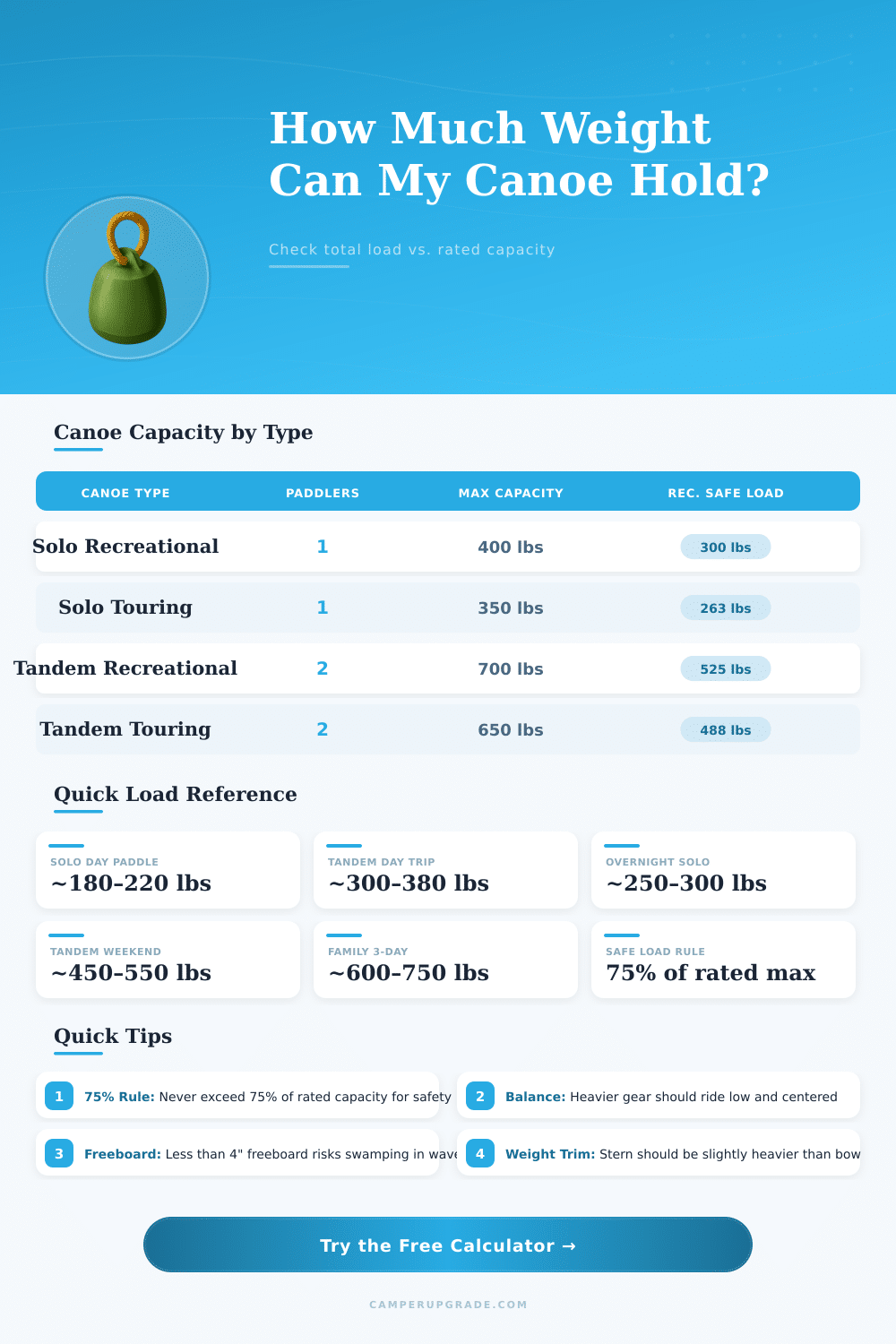
When one talks about capacity for weight, average 16-foot canoes for fun fit around 940 pounds. A 14-foot canoe can hold around 700 pounds. A 17-foot canoe can reach up to 1140 pounds.
Longer and broader canoes spread the weight over the water more evenly, which creates more floating. Some canoes for products can hold up to 3000 pounds. Laying 360 pounds in a 14-foot boat sinks it too much for safety.
Almost all boats have a stamped metal plate, thatshows the maximum capacity for load.