Canoe Portage Weight Split Calculator
Balance canoe, barrel, packs, and loose gear between two paddlers before the carry starts.
🛶Canoe Trip Presets
⚙Portage Load Inputs
📊Portage Spec Grid
📋Canoe Weight Reference
| Canoe Type | Typical Weight | Best Carrier Setup | Load Planning Note |
|---|---|---|---|
| Ultralight Kevlar tandem | 34-46 lb | Canoe plus light day gear | Watch wind on exposed landings. |
| Kevlar or carbon tripping canoe | 42-58 lb | One paddler with pack under 25 lb | Often feasible in a clean single carry. |
| Royalex or T-Formex river canoe | 58-74 lb | Canoe alone or tiny thwart bag | Reduce partner pack weight on rough trails. |
| Aluminum camp canoe | 68-85 lb | Strongest carrier, frequent rests | Double carry is usually more efficient. |
| Prospector loaded with spray deck | 60-78 lb | Canoe carrier stays hands-free | Deck, painters, and flotation add real weight. |
🎒Pack and Barrel Split Table
| Item | Typical Range | Who Usually Carries It | Balance Rule |
|---|---|---|---|
| Food barrel, 30 L | 28-45 lb | Non-canoe paddler or second trip | Keep dense food close to spine. |
| Food barrel, 60 L | 45-75 lb | Stronger gear carrier | Avoid stacking with another heavy pack. |
| Duluth or canoe pack | 45-70 lb | Either paddler | Pair with paddles, not with a heavy canoe. |
| Personal dry pack | 20-38 lb | Canoe carrier if light enough | Use it to trim the canoe side. |
| Loose day gear | 6-20 lb | Whichever side is light | Bundle small items before the landing. |
🚶Carry Strategy Comparison
| Strategy | Walking Factor | Best For | Tradeoff |
|---|---|---|---|
| Single carry | 1.0x distance | Light canoe, low-volume gear | Highest per-person load. |
| One-and-a-half carry | 2.0x distance | Moderate tandem route loads | One staged return but less overload. |
| Double carry | 3.0x distance | Heavy boats, family loads, rough trails | More walking, better control. |
| Heavy double with extra shuttle | 4.0x distance | Coolers, fishing gear, or camp groups | Slow but avoids unsafe carries. |
🗺Distance and Rest Planning
| Portage Length | Trail Feel | Rest Spacing | Planning Note |
|---|---|---|---|
| Under 200 yd | Short carry | Usually none | Single carry often wins if landings are clean. |
| 200-700 yd | Normal route carry | One short set-down if heavy | Balance is more important than speed. |
| 700-1200 yd | Long carry | Every 8-12 minutes | Double carry may beat a painful single carry. |
| Over 1200 yd | Commitment carry | Scheduled rests | Stage loads cleanly and hydrate before moving. |
There you are: bottom of a muddy portage trail. That ridge up there appears to be taller then what was marked on the map. It’s getting hot, and your crew is checking the time. Welcome to intersection of good intentions and gravity.
Here’s what you’re carrying: Two full barrels of food, a canoe, tents, sleeping bags, loose gear and more. Whether this portage will be a brisk walk or an exercise in suffering comes down to how you divide all that weight. Let calculator do the math for you. The calculator will run the math for you, but understanding why those numbers matter is what keeps you moving.
How to Share the Weight on a Portage
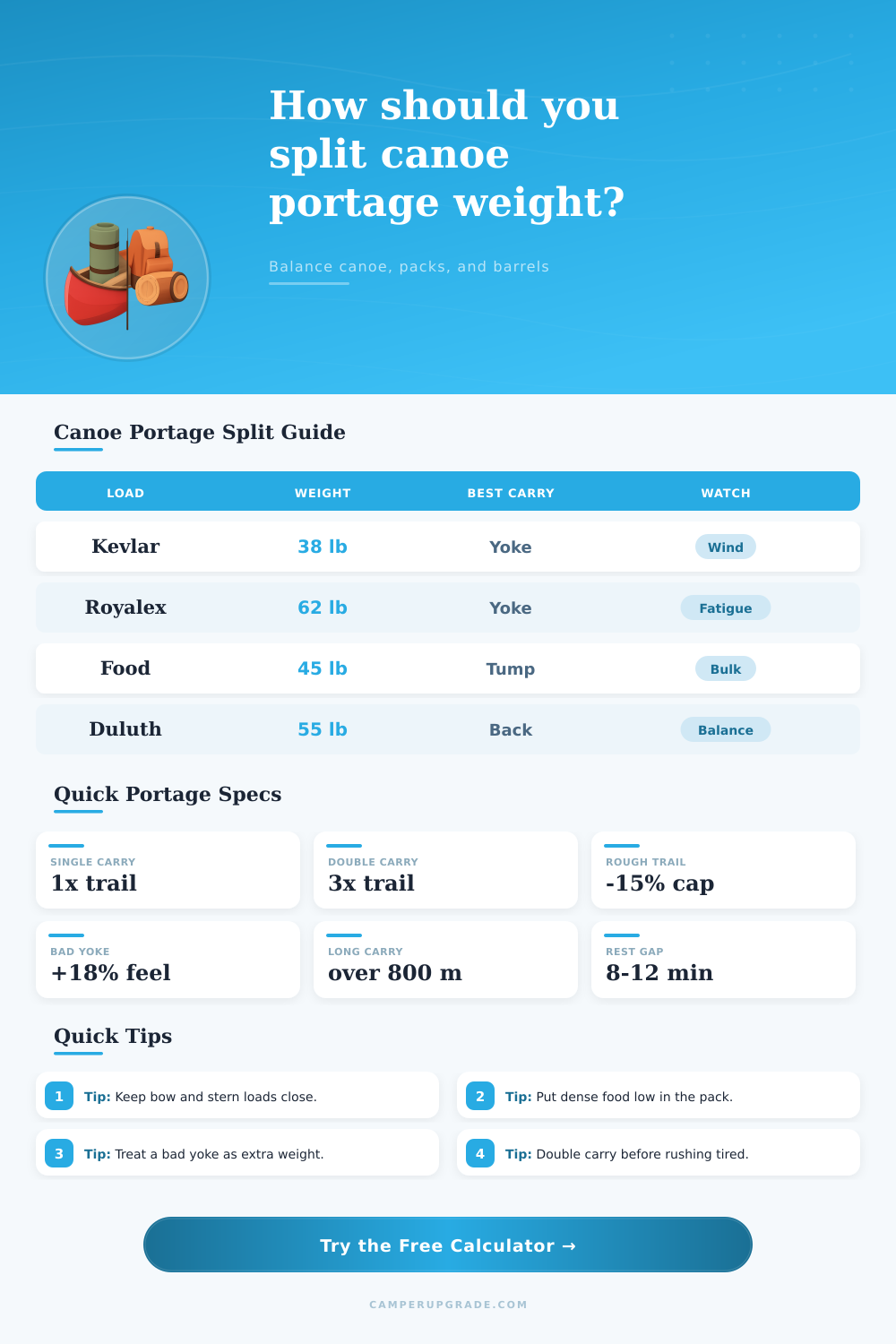
The most common error among paddlers are believing weight is simply a number. No it isn’t. It’s a feeling. And it fluctuates. A 40 pound Kevlar canoe will feel like nothing on level ground. In the wind, or when you’re stuck in mud, that same hull turn into a stone around your neck.
You can use the calculator to include terrain and yoke comfort. It knows that a poorly padded yoke is adding weight. A poor fit makes your body compensate for the shifting load. This make you work harder than necessary to maintain stability. Folks miss this point. They’ll take the poundage into account but not discomfort of an ill-fitting yoke or uneven footing.
What about the boat? You might be tempted to take just one carry with a very light tripping canoe. On shorter trails it is quicker and easier. However, if there are no thick pads and combination of gear plus canoe shifts suddenly as you stop moving, it becomes dangerous. By assigning specific weights to the canoe versus the shared gear, the tool helps you visualize this scenario and ask who carries what based off true capacity.
Who is strongest? Habit and gender should of never play a role. Typically the stronger paddler grabs the barrel. Food is packed in dense packs and placed near the spine so it stays steady. Awkward shapes go in the canoe. And it’s likely good for them to have less gear spread out more evenly.
Most undervalue impact terrain has on the equation. If it’s a nice, graded trail, you’re able to keep moving at a good clip. That hard work becomes easy work. If it’s rocky, steep, or filled with boggy spots, that pack become painful. Conditions like this affect how fast you go, when you need to stop.
When it recommends stopping, do so. Don’t let the combined effects of exhaustion cause injury. You may feel like you’ll be fine going another mile while carrying that thing. Your knees won’t agree in a few days. Stopping isn’t weak. It’s smart.
The food weighs less the farther you get into the trip. That makes splitting up at the beginning tricky. You need to bring as much as you can on the first trip because of course everything else is packed out. So you have all the meals, still. As you go further, those barrels will be lighter. That means you can be a little more flexible with other things you’re bringing.
Sometimes you’ll get soaking wet backpacks or soaking wet tarps. No one thought about that, but it adds weight back on. Before you leave camp make sure you weigh yourself so you don’t have an imbalanced carry on the hard part of trail. That’s why you want efficient but comfortable. Don’t try to save weight at any cost.
That may mean two carries instead of one. Yeah, it’s annoying. You will do twice or even three times as much walking. But sometimes it’s better than lugging heavy packs over an impossible trail.
This page has a comparison table that maps strategies against challenge level and length. If your carry isn’t too long or hard, one trip makes sense. Otherwise, spreading the load saves energy to paddle when you get there. You don’t want to show up at the takeout with bruised shoulder. Nor do you want to be in a bad mood.
In the end, portage is a balancing act of terrain and human limitations. Use the math as a starting point. Let your gut be the finish line. Pay attention to the terrain. Hear your group out. Adapt accordingly. You’ll feel like you’re barely carrying anything when you have a good split. If not, then you drag yourself down with each footfall.
Center the heavy loads. Make sure everyone knows what they are bringing. Realize that getting there matters more than getting there quicky. The trail will challenge you. Plan smart so it won’t beat you.