Canoe Load Capacity Calculator
Estimate usable canoe payload, remaining capacity, freeboard risk, and load distribution from rated capacity, paddlers, gear, water, safety reserve, hull size, and lake or river conditions.
🛶Canoe Trip Presets
⚙Capacity, Load, Freeboard, and Hull Inputs
This planning tool does not replace the canoe manufacturer's rating, local boating rules, flotation requirements, skill judgment, or a conservative on-water test before committing to a route.
📏Canoe and Load Spec Grid
Solo pack canoe
Light day loads and compact camping kits.
Recreational tandem
Two paddlers with moderate lake gear.
Tripping tandem
Camping packs, food barrels, and water.
Wide family hull
Stable platform, but still sensitive to wind.
Water weight
Full jugs add up quickly in the center bay.
Normal reserve
Useful margin for chop, wakes, and mistakes.
River reserve
More margin for turns, waves, and current.
Trim target
Close to level trim for efficient tracking.
📊Canoe Capacity Reference Tables
| Condition | Reserve | Freeboard | Planning Note |
|---|---|---|---|
| Calm lake | 15-20% | 6-8 in | Sheltered water only |
| Open lake | 20-25% | 8-10 in | Allow for wakes |
| Windy lake | 25-35% | 10-12 in | Reduce top-heavy gear |
| Slow river | 25-35% | 10-12 in | Keep bow responsive |
| Swift river | 30-40% | 12-14 in | Pack low and centered |
| Rated Capacity | 20% Reserve | 30% Reserve | 40% Reserve |
|---|---|---|---|
| 400 lb | 320 lb | 280 lb | 240 lb |
| 550 lb | 440 lb | 385 lb | 330 lb |
| 700 lb | 560 lb | 490 lb | 420 lb |
| 850 lb | 680 lb | 595 lb | 510 lb |
| 1000 lb | 800 lb | 700 lb | 600 lb |
| Common Load | Typical Weight | Where to Place | Trim Effect |
|---|---|---|---|
| Small dry bag | 10-20 lb | Near center | Minor |
| Food barrel | 30-60 lb | Center low | Major |
| Cooler | 25-70 lb | Center low | Major |
| Water jug | 20-45 lb | Center low | Major |
| Bow day bag | 5-15 lb | Forward seat | Small |
| Hull Size | Best Use | Capacity Clue | Watch For |
|---|---|---|---|
| 10-12 ft | Solo day | Lower payload | Twitchy trim |
| 13-14 ft | Solo/tandem | Moderate load | Short waterline |
| 15-16 ft | Tandem trip | Balanced carry | Pack height |
| 17-18 ft | Expedition | High payload | Windage |
| Wide 36+ in | Stable lake | Good initial feel | Slow in wind |
🧭Load Planning Tips
A canoe have a rated capacity. The rated capacity indicate the maximum weights the canoe can carry under ideal conditions. However, the canoes should not be loaded to it’s rated capacity because the conditions of the water are not always ideal.
The conditions of the water include the effects of wind, currents, and the waves cause by other boats. These conditions change the way that the canoe will handle the load in the canoe. To be safe, a person should always subtract a safety margin from the rated capacity of the canoe.
Canoe Capacity and Safety Tips
The size of the safety margin will depend on the environment in which the canoe will be row. For instance, a person should subtract a safety margin from the rated capacity of a canoe that will be rowed on a river, as compared to a canoe that will be rowed on a calm lake. The canoe calculator can be used to calculate the usable weight of the canoe.
To use this calculator, a person should enter the rated capacity of the canoe. Additionally, the person must enter the number of people that will be in the canoe. The weight of the gear that will be carry in the canoe should also be entered into the calculator.
The weight of the drinking water that will be taken in the canoe should also be entered into the calculator. Additionally, the length of the canoe and the width of the canoes must be entered into the calculator. The calculator will estimate the freeboard of the canoe.
Freeboard is the distance between the waterline of the canoe and the top of the canoe (the gunwale). If the canoe is not built to handle the number of passengers and the weight of the gear and water that will be in the canoe, then the canoe might tip over when encountering wave. Because water is a very heavy substance, the weight of the drinking water will significant contribute to the weight of the canoe.
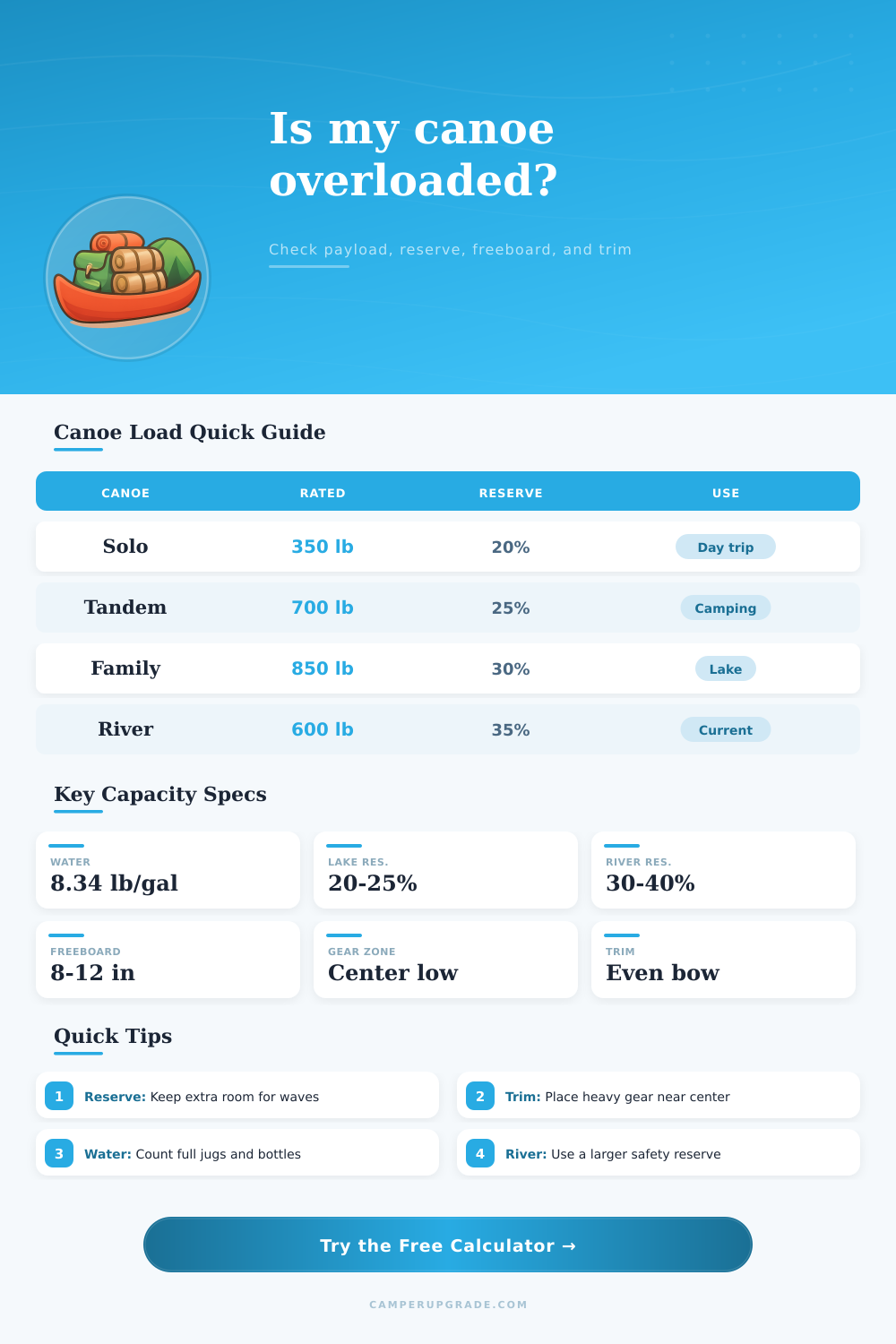
One gallon of water weigh more than eight pounds. If a person is planning to row a canoe on a lake, for example, they may carry several gallon of water in a number of small containers. This small amount of water can add up to a significant weight that must be subtracted from the rated capacity of the canoe.
Additionally, the placement of the gear will also affect the way that the canoe rows. If the gear is not placed in the canoe in such a way that the canoe will row efficient, then the canoe may plow through the water or drag in the water. The canoe calculator can model the distribution of the gear in the canoe by using the distribution setting in the calculator.
The reference tables on the page indicate the reserve percentages of the canoe for different environments. For instance, table displays the reserve percentages for trips on rivers as compared to trips on lakes. A person can use these tables to help them determine if the safety margin that they plan to use will be adequate for the canoe for the given environment.
For example, the canoe might need to have a thirty percent margin of safety when rowing on a river as compared to a canoe on a lake. This is due to the fact that moving water is more dangerous than calm water. Moving water will react more quick to the canoe when it is overloaded with people and gear.
The dimensions of the canoe will affect the way that the canoe handles the load of people and gear. For example, a canoe that is very long will track in a straight line, but it will be more difficult to turn the canoe. Additionally, a canoe that is wide will be more stable in the water, but it will also be more likely to catch the wind.
Although the canoe calculator cannot calculate each of these variable, a rower should take them into account when making a decision about how to load the canoe based off the calculators results. There are a number of common mistakes made by people when loading a canoe. One of the most common is loading the canoe up to the rated capacity.
The load should always be less than the rated capacity of the canoe. Another common mistake is forgetting to account for the weight of the drinking water that will be carried in the canoe. If a person make this mistake, the canoe will sit lower in the water than they would of expected.
Using the canoe calculator will help a person to avoid these mistakes. One should plan for changes in the canoes conditions during the canoeing trip. For example, it might be calm and clear when a person begins their trip, but the weather may change.
Additionally, a short trip can become a long trip. By loading the canoe with a safety margin, there will be extra capacity in the canoe in the case of changes to the canoes condition. This extra capacity can be used to carry more gear or water in the canoe.
By running the numbers through the canoe calculator before rowing in the canoe, a person can make adjustments to the canoes load. For instance, a person can use the calculator to decide what gear to leave in the vehicle. Additionally, a person can use the calculator to determine where heavy item should be placed in the canoe in order to have a level trim to the canoe.
By loading the canoe with a level trim and with the hull of the canoe at the correct height, the canoe will efficiently move through the water. Additionally, if the canoe is properly balance, it will be easier to paddle the canoe to its destination.