Canoe Freeboard Calculator
Estimate canoe displacement, loaded draft, remaining freeboard, capacity margin, and practical load safety from hull length, beam, depth, shape, paddlers, gear, water type, and trip conditions.
🛶Canoe and Load Presets
📏Hull, Load, Water, and Safety Inputs
This calculator is a planning estimate, not a manufacturer capacity plate or a substitute for local conditions, flotation, skill, and life jackets.
📊Canoe Freeboard Spec Grid
📋Freeboard Tables and Formula References
| Canoe Type | Length | Common Beam | Typical Load |
|---|---|---|---|
| Solo pack canoe | 10 to 13 ft | 27 to 32 in | 180 to 300 lb |
| Recreational tandem | 13 to 15 ft | 34 to 38 in | 350 to 550 lb |
| Touring tripper | 16 to 17 ft | 35 to 37 in | 500 to 750 lb |
| Expedition canoe | 17 to 18.5 ft | 36 to 40 in | 650 to 900 lb |
| Square stern canoe | 15 to 17 ft | 38 to 42 in | 500 to 800 lb |
| Condition | Minimum Freeboard | Reserve | Watch Point |
|---|---|---|---|
| Calm pond | 6 to 8 in | 15% | Wake from boats |
| Light chop | 8 to 10 in | 20% | Quartering waves |
| Exposed lake | 10 to 12 in | 25% | Wind shift and spray |
| Moving river | 9 to 12 in | 25% | Standing waves and eddies |
| Rough water | 12 in or more | 30%+ | Delay or reduce load |
| Formula | Calculation | Use | Note |
|---|---|---|---|
| Block volume | L x B x D | Outer box around hull | Beam and depth in feet |
| Max displacement | Block volume x hull coefficient x water density | Approximate water to gunwale | Not a capacity plate |
| Loaded displacement | Hull + paddlers + gear | Total supported weight | Everything in and on canoe |
| Draft | Load / waterplane area / water density | Estimated sinkage | Adjusted for hull fullness |
| Freeboard margin | Actual freeboard - target freeboard | Trip safety check | Positive is better |
| Load Item | Typical Weight | Freeboard Effect | Best Placement |
|---|---|---|---|
| Adult paddler | 140 to 240 lb | Primary displacement load | Seats trimmed level |
| Child passenger | 40 to 120 lb | Moderate load | Low and supervised |
| Dry camping pack | 35 to 70 lb | Can stack too high | Low near center |
| Food and water | 20 to 90 lb | Dense and useful for trim | Floor centerline |
| Dog or motor | 40 to 120 lb | Moves trim quickly | Secure and balanced |
💡Two Canoe Loading Tips
Canoe freeboard is an distance between the waterline and the gunwale of a canoe. Canoe freeboard are one of the most important measurement of a canoe because the measurement will determine the volumes of the canoe hull that is left as a reserve when the wave or the wind bumps the canoe. If a canoe has too little freeboard, then the canoe will be unstable when in use.
Too much freeboard, though, means that the canoe will be carry less gear than the canoe and trip will require. Input field for canoe length, beam, depth, total load capacity of the canoe, type of water to be used, and trip conditions will allow users to find the canoe freeboard for they canoe using the calculator. The calculator will provide the draft of the canoe, the freeboard, and the margin above the minimum canoe freeboard setting for stability.
Find Canoe Freeboard and Check Stability
These three values is important in determining if a load of the canoe will allow the canoe to remain stable when exposed to change weather conditions. The hull of the canoe will play a critical role in the number of inch that the canoe sinks when load is added to the canoe. The hull design will dictate the rate of increase of the draft as the canoe sink.
For instance, shallow arches will allow for a more even distribution of the load on the canoe as compared to a round hull or a performance hull. A canoe with shallow arches will have a slower rate of increase of the draft of the canoe as compared to a canoe with a round hull or a performance hull. Each of the hull types has coefficient that are utilized in the canoe freeboard calculator because each hull will result in different draft measurement for the same length and beam dimensions.
A prospector canoe hull will have a heavier load at each end of the canoe with a moderate rocker as compared to a flat hull that is used for recreational canoeing. The density of the water is another factor to consider in the canoe load calculation. The density of the water is important in that different type of water have different weights.
For instance, salt water is more denser than fresh water. Cold water is also more dense than warm water. By including these density variables in the calculator, users wont have to remember these variables when planning a canoe trip in the ocean or in the northern river where the water is either warmer or saltwater.
The trim of the canoe and the environmental conditions when the canoe will be used are two of the least consider variables. These two variables are critical for maintaining the proper canoe freeboard. If the load is not centered on the canoe, one end of the canoe will drop and the other end will rise.
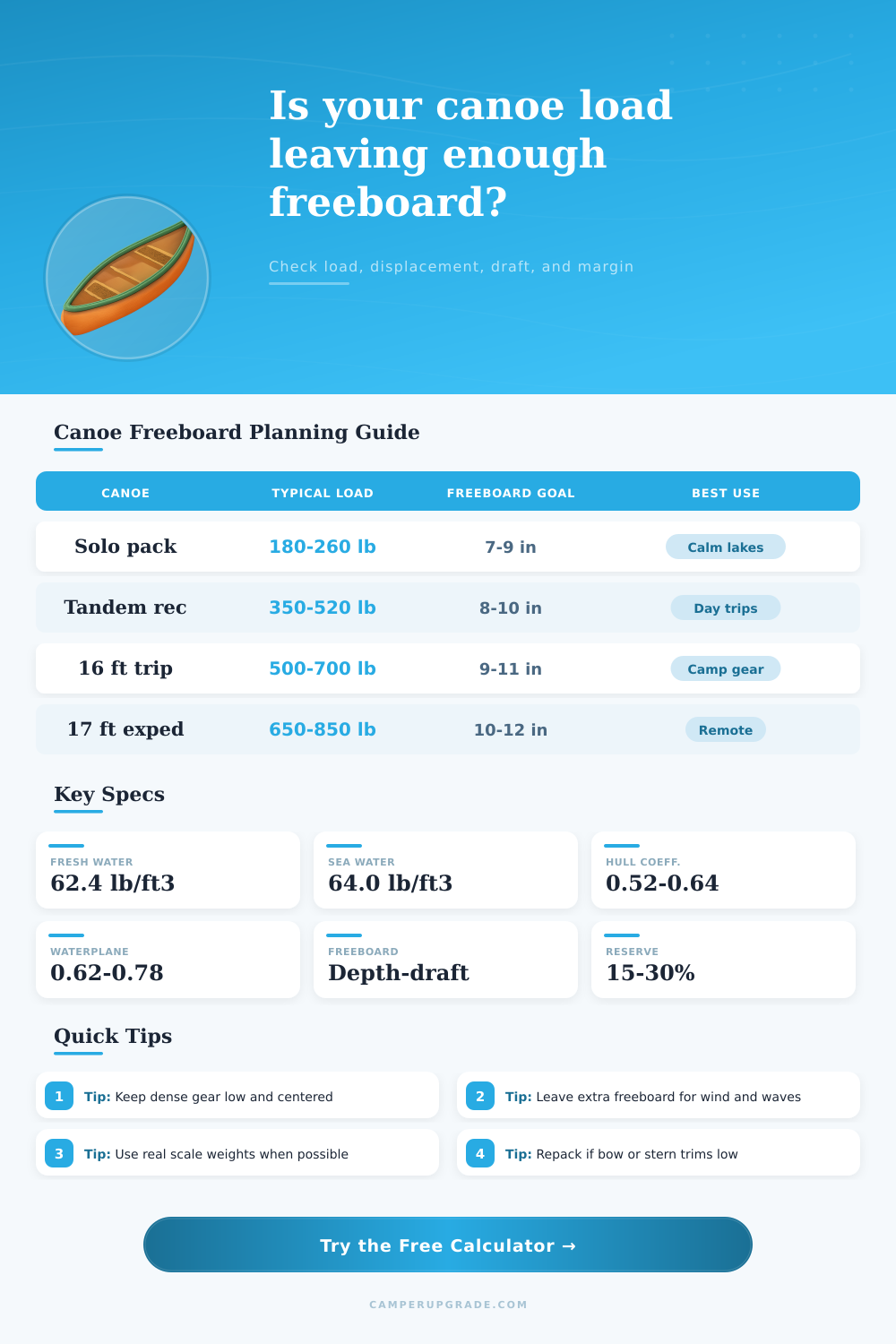
The canoe include variables for both wind and river because both of these environmental element will cause the canoe to sit lower in the water than it would in calm waters. These variables are small when the waters will be calm but will become more important in choppy water. These reference table show the goals for canoe freeboard according to the type of trip that is to be taken.
These goals include the percentage of the canoe that is expected to have a reserve of volume if the canoe is to be used in open water. These goals allow canoeists to compare their canoe freeboard calculation with the canoe goals so that they dont have to memorize these measurement. If the margin for canoe freeboard is a negative number, then the load of the canoe should be reduce or the position of the load should be moved to a lower position within the canoe.
Real canoe trip tend to be different than the calm waters calculation. If the load contains wet gear, the weight will be more than when the gear is dry. If there are dog in the canoe, their weight can change.
The crosswind will push against the canoe and change the way in which the canoe is sit in the water. Although the canoe freeboard calculator will provide a baseline for the trip, the decision of the safety of the canoe belong to the paddler of the canoe. Always run the canoe freeboard calculator twice.
Calculate the weight of the canoe and its occupants once with all gear. Calculate the weight of the canoe and its occupants a second time with only the essential gear to determine how much gear is need to ensure the canoe is comfortaly during the canoeing trip.