🛶 Canoe Distance Calculator
Calculate distance, time, or speed for your canoe trip — adjusted for current, wind, and paddler type.
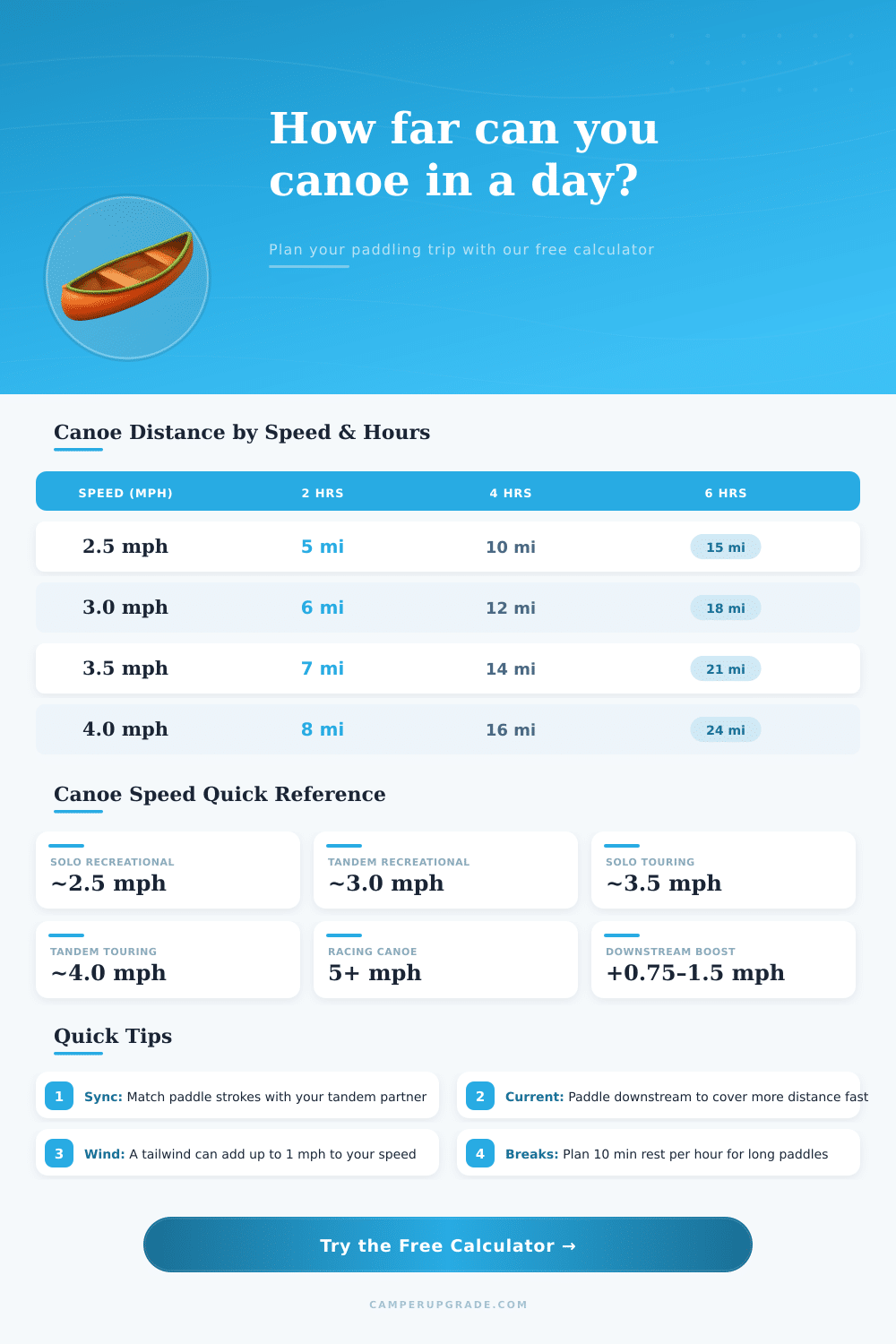
| Speed | 1 Hour | 2 Hours | 4 Hours | 6 Hours | 8 Hours |
|---|---|---|---|---|---|
| 2.5 mph | 2.5 mi | 5 mi | 10 mi | 15 mi | 20 mi |
| 3.0 mph | 3 mi | 6 mi | 12 mi | 18 mi | 24 mi |
| 3.5 mph | 3.5 mi | 7 mi | 14 mi | 21 mi | 28 mi |
| 4.0 mph | 4 mi | 8 mi | 16 mi | 24 mi | 32 mi |
| 5.0 mph | 5 mi | 10 mi | 20 mi | 30 mi | 40 mi |
| Route | Distance | Days | Difficulty |
|---|---|---|---|
| Boundary Waters, MN | 50–150 mi | 5–10 | Moderate |
| Algonquin Park, ON | 30–100 mi | 3–7 | Moderate |
| Everglades Wilderness Waterway | 99 mi | 7–10 | Challenging |
| Yukon River, AK | 2,000 mi | 60+ | Expert |
| Shenandoah River, VA | 55 mi | 3–4 | Easy–Moderate |
| Buffalo National River, AR | 135 mi | 7–10 | Moderate |
How far can you row canoes in one day? That is not a simple question. Too many factors affect the answer.
Your canoe, your experience, the wind, whether you row against the flow or with it, and how heavy your load is, all those matter Even so, some rough figures will help you when you plan your trip.
How Far Can You Row in a Day?
On a tandem canoe in calm water, covering one kilometer takes around ten minutes of steady rowing. That gives about six kilometers per hour. But beginners?
They row more slowly, maybe only two kilometers per hour. A new rower could need almost two hours to cover that same six-kilometer distnace. Someone with much experience could do that in only one hour.
Without pushing too hard, a loaded canoe moves at around two miles per hour. If you push more strongly, you could reach three miles per hour. On average, rowing through flat water, you will reach about three miles per hour…
So ten miles will take around three and a half hours if you do not stop. Most folks find that ten to twelve miles a day is a comfortable rhythm. Rowing fifteen or twenty miles is entirely possible, but that depends on your level and the state of the water.
The flow alters everything. If your normal pace is 2.2 miles per hour and you row against a flow of one mile per hour, you move forward at only 1.2 miles per hour. Then a ten-mile journey against the flow takes eight hours.
If one adds a safety buffer, around a quarter extra time, you look at ten and a half hours, which probably means that you will have to halt the day hear of the way.
A fifty-mile journey through the Boundary Waters differs entirely depending on who is in the canoe. One team could row five hours a day for ten days. Another group goes harder, ten hours a day for five days.
And there is also the person that rows twenty miles the first day, rests two days, and later rows ten miles for the next three days. Planning your distance according to what your group can actually do is the most important thing.
The canoe itself also affects your pace. Most rowers favor models of sixteen or seventeen feet, they find a balance between pace, movement and stability. Longer canoes glide better when they already move, covering longer distances with less effort.
Touring canoes that are more than sixteen feet offer more space for goods and shapes built for stability during long journeys. A well designed, lightweight canoe that cuts the water easily is very useful if you want to reach long distances. Whether you are strong enough to carry a loaded canoe alone through portages or whether you need help also determines howmuch ground you can cover.