Canister Stove Boil Count Per Canister Calculator
Estimate how many practical water boils a backpacking or camping gas canister can deliver after water temperature, altitude, wind, stove efficiency, and fuel reserve.
⚡Named Stove And Trip Presets
📝Boil Count Inputs
Reserve protects the final meal, cold start, or canister tail-off.
Use trail test data when you have it; otherwise select a system above.
Calculation Breakdown
🧪Fuel And Stove Spec Comparison Grid
📊Reference Tables
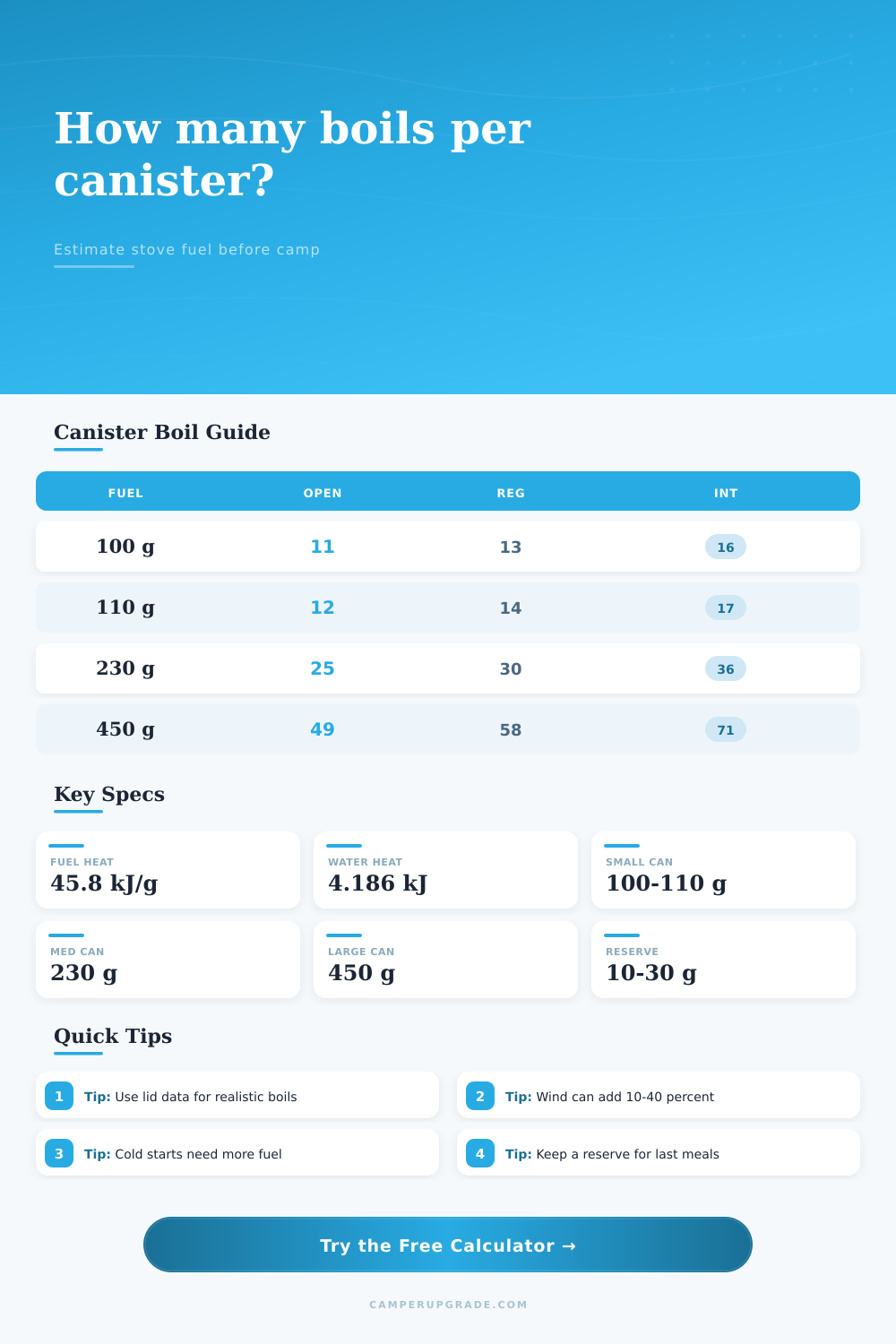
| Canister class | Net fuel | Common use | Approx 0.5 L boils at 56% |
|---|---|---|---|
| Small short canister | 100 g | Solo overnight or backup | 13 boils |
| Compact kit canister | 110 g | Nested stove-kit fuel | 14 boils |
| 8 oz MSR-style canister | 227 g | Backpacking pair or long weekend | 29 boils |
| Medium canister | 230 g | Common two-person trip size | 30 boils |
| Large basecamp canister | 450 g | Group kettle and repeated meals | 58 boils |
| Stove or pot setup | Input efficiency | When it fits | Fuel behavior |
|---|---|---|---|
| Open burner, standard pot | 45-52% | Lightweight burners and simple pots | Most sensitive to wind and pot width |
| Regulated burner with lid | 54-60% | Better flame control in cool weather | Steadier pressure until the canister tails off |
| Wind-resistant burner | 58-64% | Burner heads designed for breezy sites | Lower wind penalty with a good lid |
| Integrated heat-exchanger pot | 66-72% | Fast water-only meals and drinks | More heat captured by the pot skirt |
| Radiant enclosed system | 70-76% | Cold or exposed alpine boiling | Strong boil efficiency, limited simmer tasks |
| Condition | Multiplier | Use in calculator | Boil-count impact |
|---|---|---|---|
| Calm and sheltered | 1.00x | Pot lid on, flame not blown sideways | Baseline |
| Light breeze | 1.08x | Normal camp cooking with some air movement | About 7% fewer boils |
| Exposed table | 1.18x | Picnic table or trail lunch in a breeze | About 15% fewer boils |
| Gusty alpine site | 1.32x | Unsteady flame, cold pot, shielded poorly | About 24% fewer boils |
| Poor shelter and wide pot | 1.45x | Flame spills around a large cool pot | About 31% fewer boils |
| Scenario at 10°C start | Water per boil | Fuel per boil at 56% | 230 g canister before reserve |
|---|---|---|---|
| Solo coffee mug | 0.35 L | 5.2 g | 44 boils |
| Freeze-dried pouch fill | 0.50 L | 7.4 g | 31 boils |
| Two mugs or meal water | 0.75 L | 11.1 g | 20 boils |
| One-liter kettle boil | 1.00 L | 14.8 g | 15 boils |
| Group pot boil | 1.50 L | 22.2 g | 10 boils |
💡Calculation Notes
Now you’re standing atop a freezing ridge, clutching a half-empty fuel canister and an empty pot. You don’t wonder if you’d like something for dinner; now you wonder if you can make it happen through magic of physics. And that’s where abstract wishful thinking give way to real mathematics. Hikers estimate the duration of their fuel based off either pack’s label or a distant memory of a three-year-ago trip that featured nicer weather then what they are experiencing right now. It works just fine, until it doesn’t.
Backpackers know: Stoves is really crappy heaters dressed up like cooking equipment. Half the energy from gas goes straight out into the cool night air, lost forever as your open burner sits below broad-bottomed pot. Better stoves incorporate heat exchangers that push that wasted heat back around inside walls of the pot, increasing efficiency up towards the seventy percent mark. That’s not just about faster heating; it’s about how much longer you’ll make a two-hundred-thirty-gram cylinder last before the valve fail and starts spitting flame rather than delivering it. Trust your math, and you don’t have to pack on any more weight to sleep well.
Why You Need to Do Math for Your Camping Fuel
The rest is dependent on the starting temperature; the degree of warmth or cold that comes off the mountain spring where you fill up or the stagnant pond water that’s been stewing in the sun all day. If the water you pull from a lake begin just below freezing, it requires more energy to warm the initial liter compared than water sitting at 25 degrees on a sweltering summer afternoon. Once you plug in your own conditions, the calculator does all math for you so you don’t have to fumble through conversions and coefficients. Because temperature decreases with elevation, the calculator factors in how much higher or lower you go and adjusts to match. You’ll actualy require fewer BTUs to get water to a full, rolling boil at 4,000 meters than if you’re boiling water at sea level. Sounds like good news, until you remember that high camp are not only cooler but also windier, effectively eliminating the heat bonus unless you’re equipped with an appropriate windshield.
Wind is the silent killer of fuel efficiency. You may not notice it on your face. Even a slight breeze will cool the surface of your pot quickly and make your stove struggle to keep it hot. This is why closed burners (or wind shields) is so important in practice. And if you’re cooking on an open picnic table with no cover, you’re losing a lot of your energy through convection. The worst case scenarios multiplies fuel use by nearly fifty percent. Not only that but its not just about comfort; it’s about survival margin.
The chart on the page lays it all out. Most plans fail because everyone burns down to the last gram of fuel so they has just enough boil to make it. But when the canister gets low on gas, it loses it pressure and those last two dozen grams are nearly worthless for maintaining a constant flame. A little reserve ensures that your last supper isn’t a bowl of lukewarm soup because there’s not enough vapor pressure to ignite. It is a small insurance policy with no weight that give big dividends in terms of dinner time dignity.
No spreadsheet can tell you what you will find when you field test your system. How many grams of fuel do you burn in one boil? The only way to know is by weighing your canister full and empty. You also need to know your style and the specific wind patterns where you live. Adjust your expectations based on the measured grams, not just the specifications given to you by manufacturer. Turn abstract efficiency numbers into actual fuel budget line items.
So what’s the takeaway? Preparing enough gas boils down to understanding the factors in your control and prepping for those beyond it. Want to boil more water at once? That’s on you. Got a place with a lid? Nice choice. The elevation doesn’t change though, nor will the wind, but by planning with razor-sharp margins, you’ll be able to leave the excess behind without worrying about a chilly night. Anxiety becomes arithmetic. When you get ready to chow, the pots filled and the fire’s burning.