Campsite Tree Distance Calculator
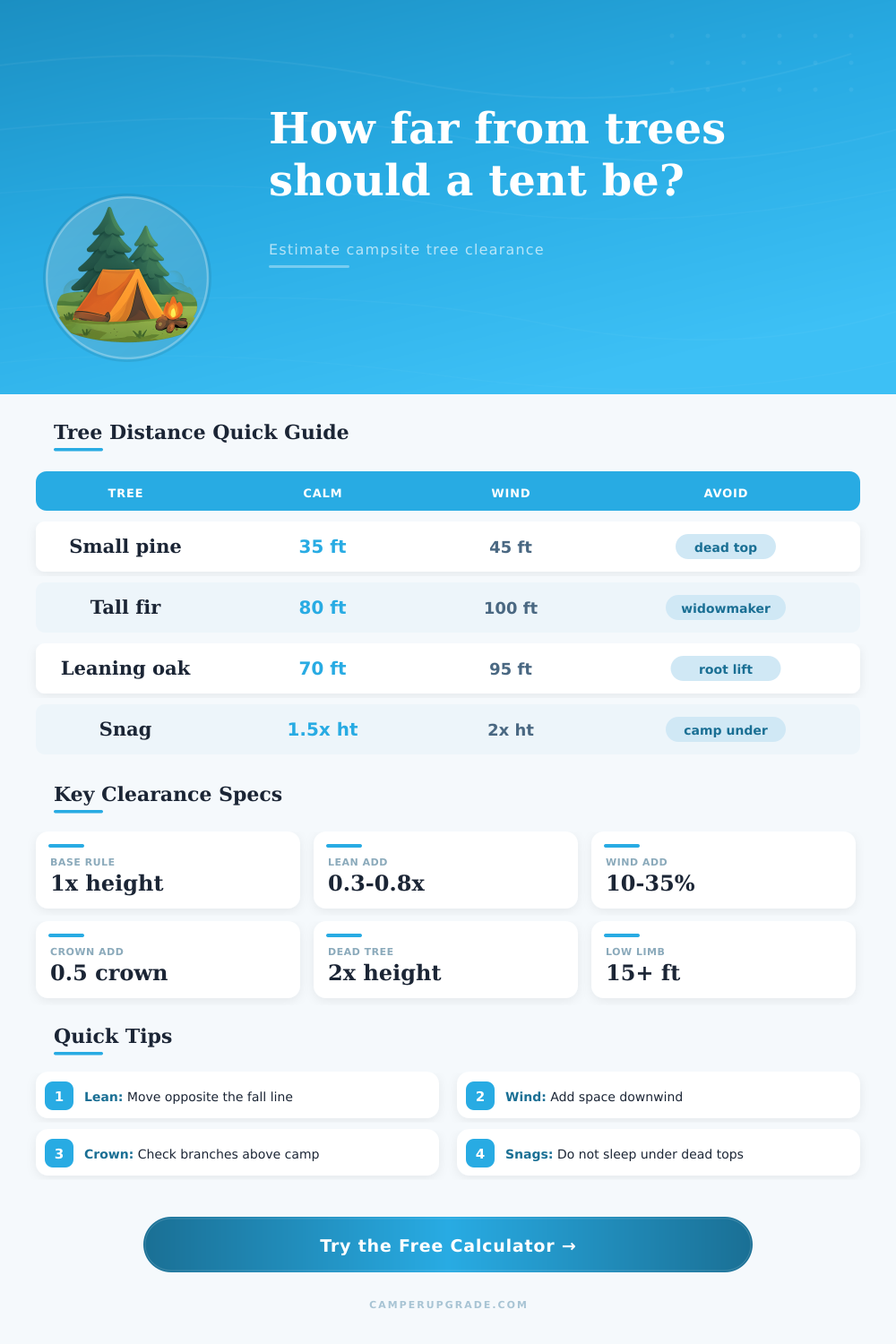
Estimate tent and camp clearance from tree height, lean, wind exposure, slope, crown spread, and visible hazards before choosing a site.
⛺Camp Scenario Presets
📏Tree And Campsite Inputs
⚠Hazard And Clearance Grid
Base Fall Zone
1x heightUse at least full tree height for a healthy standing tree in mild weather.
Lean Buffer
+10-60%Clearance grows when the tent sits toward the visible lean or side lean.
Wind Buffer
+5-35%Gusts and downwind exposure push recommended distance outward.
Defect Buffer
+20-80%Dead tops, snags, root lift, and cracked trunks need much wider spacing.
🌲Tree Condition Specs
📊Tree Clearance Reference Tables
| Tree Height | Healthy | Windy | Defect |
|---|---|---|---|
| 30 ft | 30 ft | 40 ft | 60 ft |
| 50 ft | 50 ft | 65 ft | 100 ft |
| 70 ft | 70 ft | 91 ft | 140 ft |
| 90 ft | 90 ft | 117 ft | 180 ft |
| 110 ft | 110 ft | 143 ft | 220 ft |
| Lean | Away | Side | Toward |
|---|---|---|---|
| 0-3° | +0% | +0% | +0% |
| 4-8° | +0% | +8% | +15% |
| 9-14° | +5% | +18% | +35% |
| 15-22° | +12% | +30% | +60% |
| 23°+ | avoid | avoid | avoid |
| Gust | Upwind | Cross | Downwind |
|---|---|---|---|
| 0-10 mph | +0% | +0% | +5% |
| 11-20 mph | +3% | +8% | +15% |
| 21-30 mph | +8% | +15% | +25% |
| 31-40 mph | +15% | +25% | +35% |
| 40+ mph | avoid | avoid | avoid |
| Overhead Clue | Minimum | Caution | Avoid |
|---|---|---|---|
| Live limbs | 15 ft | 10-15 ft | <10 ft |
| Dead limbs | none above | near edge | above tent |
| Snow load | 25 ft | 15-25 ft | <15 ft |
| River trees | 1.5x ht | wet bank | undercut |
| Burn scar | 2x ht | black bark | hollow snag |
💡Clearance Notes
When you choose a campsite, one of the factors that you should consider is the objects that is above the ground at your potential camping spot. The reason that you should consider these objects is because those objects can fall into your tent or onto you while you are sleep outdoors. For instance, one of those objects that can fall is a tree.
A tree has the potential to fall into your tent, so you must calculate the distance between your tent and the tree to ensure that your tent is not fall into you or onto you while you sleep. There are many factor that determine the distance that you should maintain from a tree. Some of those factors include the height of the tree, the width of the crowns of the tree, the lean of the tree, the wind at the site, the slope of the area where you plan to camp, the condition of the soil, and the height of the lowest limb of the tree.
Safe distance from trees when camping
First, the height of the tree is one of the main factors in determining the falling distance of the tree. If the tree is of significant heights, then the arc in which the tree will fall will be of wide distances as well, indicating that the tree will fall over a greater distance. Second, the width of the crown of the tree is another of the main factors in determining the distance that the tree has a potential falling distance.
The crown of the tree is the group of branches that extend out from the tree’s trunk. Therefore, you must account for half the width of the crown, since the branches will extend beyond the trunk of the tree. Thus, trees with wide crowns will require more distance between the tent than trees of the same height but with narrow crowns.
Third, the lean of the tree is a factor. If the tree leans in any direction, it indicates that the tree has a chance of falling in that same direction. If you are camping on the downhill side of a leaning tree, you must account for the lean by increasing your distance from that tree.
A small lean may become a large problem, so it is better to camp on the other side of the tree. Fourth, the wind is another of the factors to consider. The wind can move the branches of the tree, as well as the tree itself.
The wind is often underconsidered when camping. However, the overnight gusts of the wind can cause trees to fall. If you are camping downwind of a tree, you must increase the distance between your tent and the tree.
The broken branches of the tree may fall into your tent while you sleep. Fifth, the slope of the land and the condition of the soil is another of the factors to consider. The slope and soil will impact the stability of the tree while it is standing in that location.
The calculator considers the effect of the soil by allowing you to set the soil type in the calculator. For example, if the soil is saturated with water, the tree has more ease in falling. You must set the soil condition in the calculator, because you cannot see the soil grip on the roots of the tree from distances.
Sixth, the height of the lowest limb of the tree is a factor to consider. Even if the tree does not fall, the limbs may fall onto the tent. Therefore, you need to consider the height of the lowest branch of the tree.
If the lowest branch is too low to the tent, the tent will account for this by increasing the distance that you must maintain from the tree. Seventh, any defect in the tree may be a factor to consider. Factors such as dead tops, hollow trunks, and roots that appear to be lifting out of the ground indicate that the tree does not have the stability of healthy trees.
Therefore, the further your tent is from such a tree, the safer you will be while sleeping. Trees with defects will have a larger multiplier in the calculator to indicate that they have less of a margin for error. Another of the factors to consider is the reference tables that the calculator provides.
These reference tables will indicate the distance that a tree will fall based off the conditions of the tree. For instance, if the conditions of the tree are healthy, windy, and defective, the distance will be different than if the conditions are healthy, windy, and clear of defects. These tables will allow you to determine if your tent is within the distance calculated by the calculator, or outside of that calculated distance.
Thus, if the calculator states that your tent needs to be a certain distance from the tree, you should move the tent to a spot that ensures that distance is maintained between the tent and the tree. It is also recommended that you observe the tree prior to setting up your tent. When camping, take a close look at the tree.
First, look for cracks in the soil at the base of the tree. Second, look at the crown of the tree; it should not lean more than the trunk of the tree. Finally, look into the crown of the tree for any dead branches.
Any of these indications may be signs that the tree is failing or falling. The calculator will account for these observations so that you can make an informed decision about where to camp. Thus, the purpose of this calculator is to create a margin of safety for you while you are sleeping outdoors.