Campsite Sun Direction Calculator
Estimate sunrise direction, noon altitude, hot-afternoon exposure, tree shade reach, slope boost, and the best tent, tarp, RV, or solar-panel orientation for a campsite.
🏕Campsite Sun Presets
☀Latitude, Date, Tree Shade, Slope, and Orientation Inputs
Solar angles are planning estimates based on latitude and day of year. Terrain, tall trees, smoke, clouds, and local time zone offset can shift the exact clock time outdoors.
🧭Shade And Orientation Grid
Morning Gear Drying
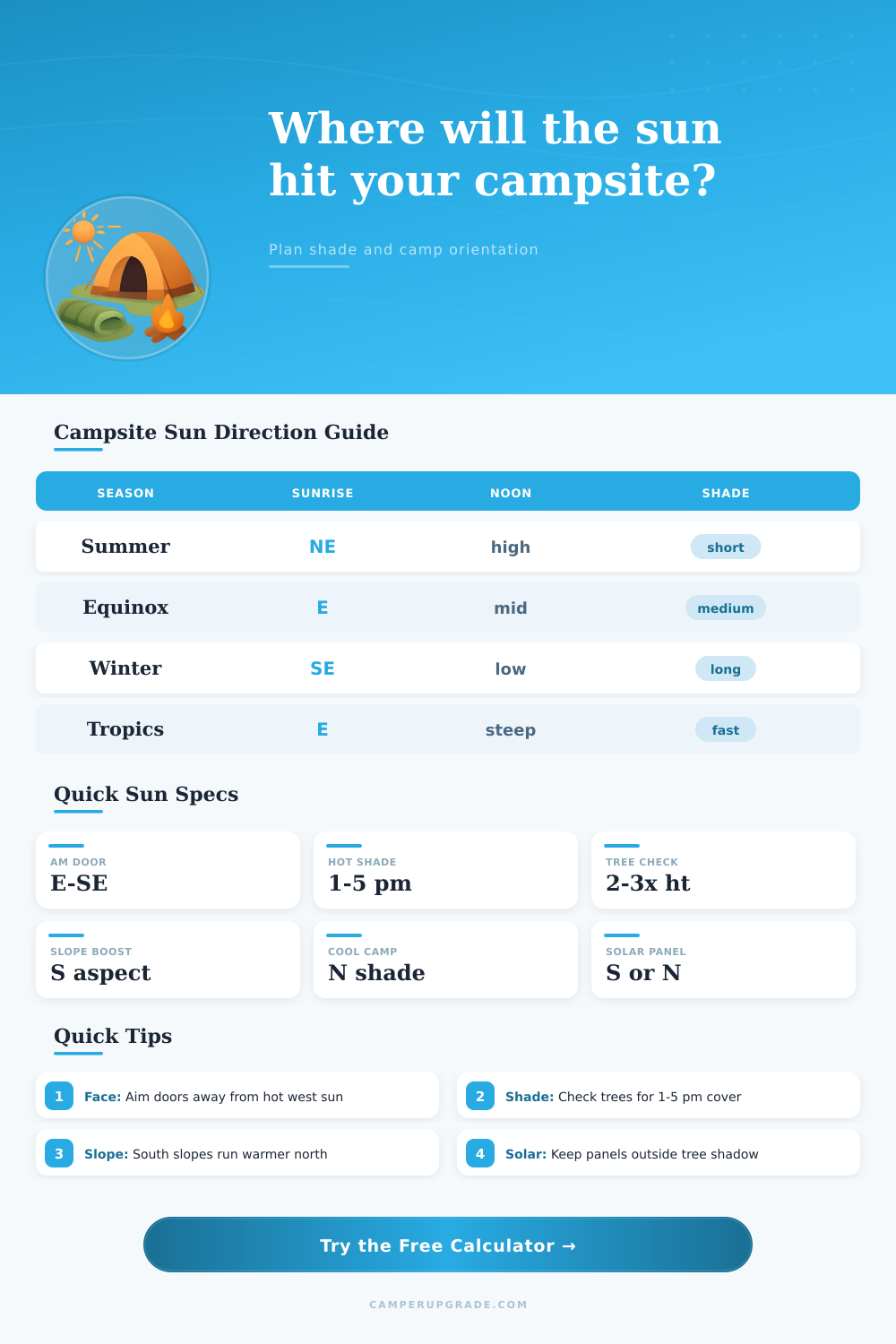
E-SEDoor or clothesline catches early sun while avoiding the hottest late-day glare.
Hot Afternoon Relief
N-NEOpen sitting areas away from the west sun and use trees to the southwest or west.
Solar Panel Priority
EquatorFace panels south in the northern hemisphere and north in the southern hemisphere.
Cold Weather Warmth
S or NIn the north, favor south exposure. In the south, favor north exposure.
Tree Shade Reach
2-3x htLow sun can cast long shadows, but midday shade may be only a short footprint.
West Glare Control
Avoid WWest-facing doors and awnings get direct low sun when camp is already warm.
Slope Heat Boost
AspectA slope facing the sun acts warmer, drier, and brighter than flat ground.
Cooler Placement
NW sideUse afternoon tree shade or the north side of a vehicle or tent where available.
📐Sun Direction Spec Grid
📊Sun Angle Reference Tables
| Date | Sunrise | Sunset | Noon Path |
|---|---|---|---|
| Mar equinox | East | West | Middle arc |
| Jun solstice N | NE | NW | Highest |
| Sep equinox | East | West | Middle arc |
| Dec solstice N | SE | SW | Lowest |
| Latitude | Jun Noon | Equinox | Dec Noon |
|---|---|---|---|
| 20° N | 86° | 70° | 47° |
| 35° N | 78° | 55° | 32° |
| 45° N | 68° | 45° | 22° |
| 55° N | 58° | 35° | 12° |
| Sun Altitude | Shadow | Shade Feel | Camp Use |
|---|---|---|---|
| 15° | 3.7x height | Long | Low glare |
| 30° | 1.7x height | Useful | Tree shade |
| 45° | 1.0x height | Moderate | Tarp shade |
| 60° | 0.6x height | Short | Midday heat |
| 75° | 0.3x height | Tight | Overhead sun |
| Slope Aspect | N Hemisphere | S Hemisphere | Camp Effect |
|---|---|---|---|
| Equator-facing | South | North | Warmer |
| Pole-facing | North | South | Cooler |
| East | Morning sun | Morning sun | Dries gear |
| West | Afternoon sun | Afternoon sun | Hot glare |
💡Campsite Sun Planning Tips
When you go to set up a camp, the position of the sun is one of the factor that will impact your environment within the camp. The sun impacts the amount of light that enter the campsite, as well as the amount of solar energy that the solar panels at the camp can collect. While many people use there eyes to choose the best spot for their campsite, many will have to rearrange their campsite once the sun begin to create heat within the area.
The position of the sun during specific hour of the day will determine whether the campsite that individuals choose to set up is one that is comfortable or uncomfortably to inhabit. One of the first factor to consider for those camping is the latitude of the area that is to be camped in. The latitude for the area will impact the path of the sun throughout the day.
How to Pick a Campsite Using the Sun
For instance, at forty degree north latitude, the sun will climb high into the sky during the summer months, but will remain low in the sky during its winter position. If individuals move to a higher latitude, the sun will be lower in the sky during its peak noon hour. The lower the sun is above the horizon, the longer the shadow that objects like trees create will be.
The earth tilts in relation to the sun in a way that each degree of latitude shift the path of the sun. Another of the factors that will change the position of the sun in the sky is the time of year when the area will be camped in. During an equinox, the sunrise will be almost exactly eastward.
During the summer solstice, however, the sunrise will be further towards the northeast, the sunset will be further towards the northwest, and the sun will remain in the sky for longer period of time. December is one of the months in which the sun will rise in the southeast of the area that is being camped in, and will set in the southwest. During these times, the calculator can help individuals understands the sunrise and sunset times.
Finally, the third major factor that will impact the position of the sun within the campsite are the tree that surround the area that is to be camped in. A tree located to the southwest of the tent will block the sun from shining on the campers during the height of the afternoon, but may shine on the tent during the middle of the day when the sun is directly overhead. The length of the shadow that an object like a tree creates change based on the altitude of the sun.
For instance, at fifteen degree of solar altitude, a forty-foot tree will cast a shadow of nearly one hundred fifty feet in length, but at sixty degree of solar altitude, the shadow of that same tree will only be twenty feet in length. These shadows can be determined with the distance and bearing of the object in relation to the tent. Finally, the last factor to consider is the slope of the land within the area that is to be camped in.
The slope of the land will impact the amount of sunlight that reach the individuals while camping. Slopes that face the sun directly will heat up more quickly than areas that are not sloped, or that are faced away from the sun. For instance, a south-facing hillside will heat up to the individuals who are camping on that slope due to its direct exposure to the sun.
North-facing slopes receive less direct sunlight than south or west-facing slopes, so slopes that face north will be cooler and have more shade. The calculator combines the slope angle and aspect to produce an exposure score, which tells you how much sun a site will receive. If you want to stay cool at the campsite, you should look for a slope that is not facing south or west.
Your specific goal when camping will change the usefulness of each direction of the sun. For example, if your goal is to dry wet gear, the sun will need to be shining on the tent door during the morning. If you have a dog that tends to overheat, you will want the tent door to be facing away from the western exposure of the sun.
If you are using a van with solar panels, the panels will need to be facing south to capture the sunlight. The calculator allows users to select the goal for their tent and then score the exposure of the tent door according to that goal. The calculator outputs a comparison between a user’s goal and the results of the tool.
The heat sensitivity of an individual affect how they use the shade feature of the calculator. Individuals that are heat sensitive or who are taking cooler meals will experience the sun differently than those that enjoy the warmth of the sun. If individuals indicate that they are heat sensitive, the tool will place more weight on the value of shade in the afternoon.
This is because the hours between one and five in the afternoon provide the most heat exposure for campers. Real campsites will often have feature that are different from the geometry feature of the calculator. Many campsites have features like ridges or thick canopies of trees.
Ridges will delay the sunrise, and thick canopies will turn the sunlight into dappled light rather than direct sunlight. The calculator allows for the input of such features to allow for correction of these factor. However, individuals must still use their best judgement when looking at the ground around the area they have chosen for camping.
It is common for campers to mistakenly choose their campsite according to the position of the sun at the time that they arrive at the camping site. For example, the position of the sun at ten in the morning will be different from the position of the sun at three in the afternoon. Choosing a spot at ten in the morning may result in no shade being available by three in the afternoon.
Another mistake is to assume that if a tree provides shade in the morning, it will continue to do so throughout the afternoon. The sun calculator will help campers to determine the position of the sun during the hot hours of the day to avoid these mistake. One benefit of the tool is that it allows campers to choose their camping spot in relation to the position of the sun.
A good spot for camping is a spot that will provide afternoon shade for the tent, where the door is not exposed to glare from the sun, and where any solar panel are exposed to the sky. The calculator allows campers to test these factor before setting up camp, and avoiding the need to move camping equipment once they arrive at the campsite.