Campsite Slope Leveling Calculator
Estimate campsite grade, tire-to-tire drop, low-side lift height, leveling block layers, ramp length, residual tilt, and whether the site is reasonable for a camper, trailer, van, or tent.
🏕Real Campsite Leveling Presets
📏Slope, Rig Geometry, Blocks, and Safety Inputs
Formula basis: grade percent = drop / run x 100, angle = arctan(grade / 100), span drop = tan(angle) x span, and block layers = ceiling(required lift / block increment).
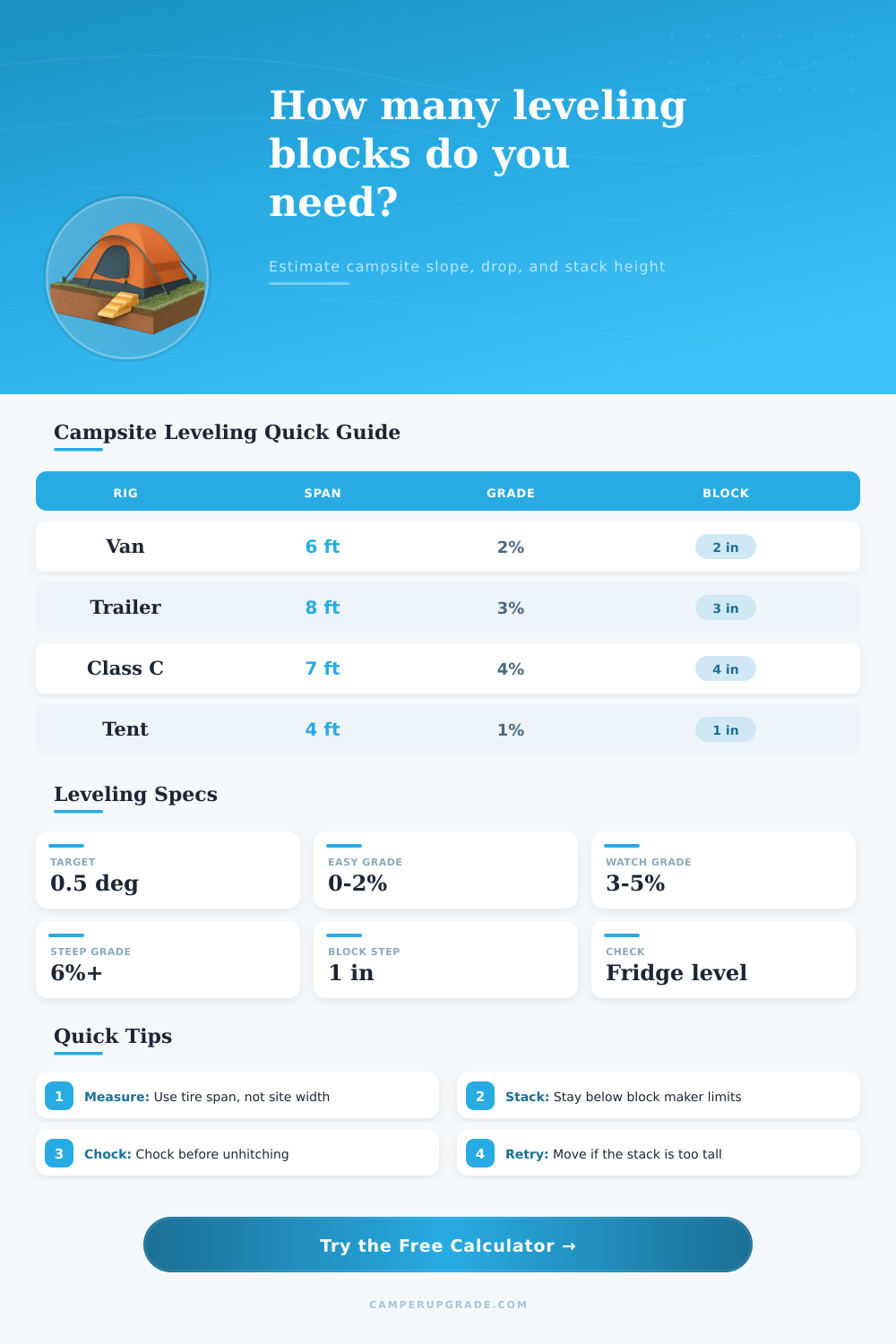
📐Leveling Spec Grid
📊Slope and Leveling Reference Tables
| Slope | Angle | Drop Over 6 ft | Site Call |
|---|---|---|---|
| 1% | 0.57 deg | 0.7 in | Easy |
| 2% | 1.15 deg | 1.4 in | Small stack |
| 4% | 2.29 deg | 2.9 in | Moderate |
| 6% | 3.43 deg | 4.3 in | Watch limit |
| 8% | 4.57 deg | 5.8 in | Move if possible |
| Setup | Typical Span | Target Tilt | Primary Lift |
|---|---|---|---|
| Camper van | 6-7 ft track | 0.5-1 deg | Low tires |
| Travel trailer | 7-8 ft track | 0.5 deg | Low-side tires |
| Motorhome | 7-8 ft track | 0.5 deg | Rated ramps |
| Tent platform | 3-5 ft sleep width | 1 deg | Pad or board |
| Block Height | 1 in Blocks | 2 in Boards | Use Note |
|---|---|---|---|
| 1 in | 1 layer | shim only | Fine tune |
| 2 in | 2 layers | 1 board | Common |
| 4 in | 4 layers | 2 boards | Chock well |
| 6 in | 6 layers | 3 boards | Check rating |
| Measurement | Formula | Example | Result |
|---|---|---|---|
| Grade | drop / run x 100 | 3 in / 8 ft | 3.1% |
| Angle | atan(grade / 100) | 4% | 2.3 deg |
| Drop | tan(angle) x span | 2 deg, 7 ft | 2.9 in |
| Layers | ceil(lift / step) | 3.2 in / 1 in | 4 layers |
💡Two Practical Leveling Tips
Finding an level campsite is a necesary task for many campers. Finding a level campsite is important because if the campsite are not level, individuals will experience physical discomfort and their camping equipment will experience issues. For example, if the campsite isnt level, a refrigerator may open on its own, the stove flame may lean to one side, and individuals may experience discomfort while sleeping.
Additionally, people can try to determine the level of the ground by looking at teh ground. However, looking at the ground is an inaccurate method of determining if the ground is level. To find a level campsite, individuals must measure the slope of the ground.
How to Measure and Level a Campsite
The slope of the ground can be expressed as a percentage. The percentage of the slope is determined by measuring the vertical change of the slope and the horizontal distance of the slope. Using a calculator, the camper can convert the percentage of the slope into the angle of the slope.
Additionally, the angle of the slope can be converted into the number of inches or centimeters of lift that will even out the campsite. The lift is the amount of height that will be added to the low side of the campsite vehicles to even the campsite. The lift should of been enough to even the campsite so that the residual tilt of the campsite is half a degree or less; otherwise, the refrigerators and sleeping platforms will not function correct at the campsite.
The amount of lift required to even a campsite may vary with the type of campsite vehicle. For instance, camper vans has a narrow track, so the drop in height of a camper van will be less than the fifth-wheel trailer when both are parked on the same grade. Additionally, the tent platform has a different lift requirement than the vehicles.
If the ground is sloped side to side, the blocks can be used under the wheels of the camper van. However, if the slope is front to back, a tongue jack or ramp can be used under the axle of the camper van. If the slope is diagonal, the camper must make both the side to side and front to back adjustments so that the camper van is even.
When buying the blocks that will be used to level the campsite, the purchase quantity will affect the stability of the level area. For example, if the measurement calculator indicates that one inch of lift is required, the blocks can be one inch in height. However, if six or seven layer of blocks are purchased, the platform will be less stable.
The required lift of the campsite should be compared to the maximum height of the blocks that can be purchased. If the required lift of the campsite is higher than the maximum height of the blocks that the camper will buy, the vehicle will need to be moved to a different location. Furthermore, a reference table will display different ranges of slope.
These ranges will allow the camper to determine if the campsite is an easy, moderate, or steep slope. As with most task, there are some mistakes that can be made leveling a campsite. For example, one mistake is to measure the whole campsite for the lift instead of the span of the tires of the camper van.
Additionally, a phone level may be used to determine the level of the campsite when it is placed on a picnic table instead of on the camper van. Another mistake is to leave the camper van un-chocked while placing the blocks under the camper van, this is a safety issue. If the camper van is un-chocked, the camper may roll the camper van while placing the blocks.
The proper procedure is to measure the slope of the campsite first and then determine how to even the campsite based on that slope measurement. Furthermore, if the calculator shows that alot of lift will be required for even the campsite, the camper should move the camper van to a different location. A campsite that requires six inches of lift to even the vehicle may be acceptable for one make and model of camper van but may be uncomfortable for another make and model of camper van.
Although the calculator will provide the numbers required for leveling the camper van, the individual will have to decide if that amount of lift is an acceptable amount to level the camper van.