Campsite Gravel Pad Volume Calculator
Estimate compacted pad volume, loose gravel to order, tons, truckloads, bag count, fabric coverage, edging length, excavation, and lift planning for RV pads, tent pads, camper parking pads, and campsite aprons.
⛺Campsite Pad Presets
📏Pad Dimensions
Use trapezoid for a pad that narrows toward the back or widens at the driveway end.
Include the usable parking area from front clearance to rear clearance.
Include door-side clearance, slide clearance, and wheel-track tolerance.
Only used for trapezoid pads. For rectangle and round pads this field is ignored.
Adds extra gravel at the entry for backing, leveling blocks, or tire turning.
Set to 0 if you do not want an apron added.
Add picnic table space, stairs, tongue jack pad, storage bins, or a small walkway.
🚚Gravel Depth and Material
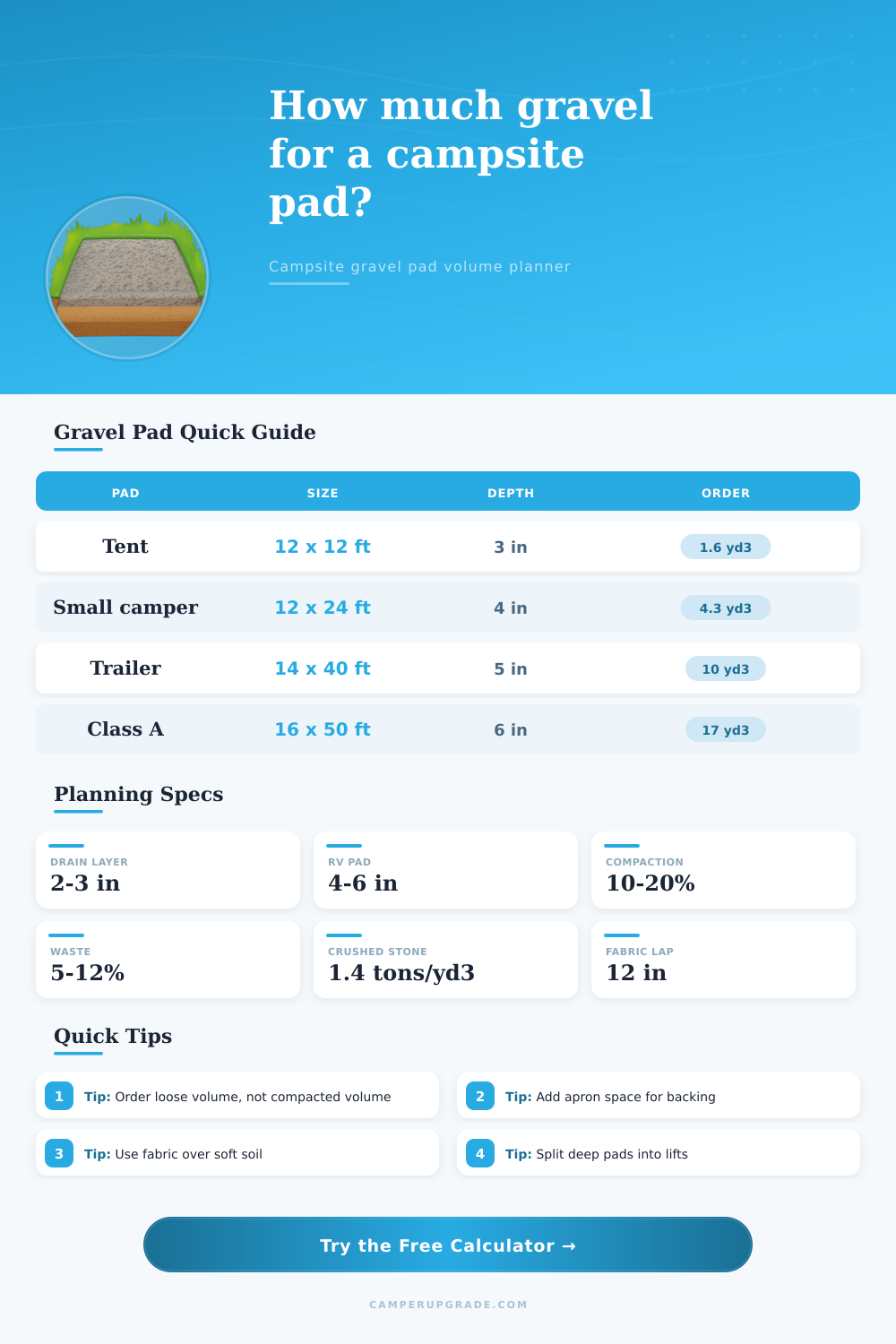
Light tent pads often use 2 to 3 inches; RV pads commonly use 4 to 6 inches after compaction.
Crusher run locks up better under tires; clean stone drains faster but may rut without a firm base.
Only used when custom material is selected. Local quarries can provide the best value.
Order more loose gravel than the finished compacted volume because aggregate tightens when compacted.
Covers slight low spots, edge feathering, truck spread unevenness, and cleanup loss.
Average extra thickness added for center crown, cross-slope correction, or filling shallow dips.
Deep pads compact better when placed in lifts instead of one thick layer.
A common single axle or small dump can haul less than a full-size tri-axle.
🧱Site Prep Add-ons
Fabric helps separate gravel from clay, silt, and organic soil.
Used to estimate roll strips and seam overlap for the main pad length.
Edging reduces gravel migration where tires, rain, or foot traffic push material outward.
Set to 0 for gravel placed over existing grade. Use sod/topsoil removal depth if cutting in.
Bag count is useful for tent pads, touch-ups, and utility landings.
This adjusts the handling note, not the material math.
This is a planning estimator. Confirm local delivery minimums, material density, drainage, utility locations, soil bearing, and campground or HOA rules before ordering.
Gravel Pad Material Estimate
📋Project Planning Specs
🛻Material Density and Use Guide
| Material | Typical loose density | Best campsite use | Planning note |
|---|---|---|---|
| #57 crushed stone | About 1.35 tons/yd3 | Drainage layer, top layer over firm base | Drains well but can shift under tight tire turns. |
| Crusher run / road base | About 1.50 tons/yd3 | RV pads, drive lanes, storage pads | Fines lock together when compacted and shed water with slope. |
| 3/4 in crushed gravel | About 1.42 tons/yd3 | General campsite pads and aprons | Good all-around choice when compacted in thin lifts. |
| Pea gravel | About 1.25 tons/yd3 | Decorative tent or picnic areas | Comfortable underfoot, but not ideal for wheel loads without containment. |
| Recycled concrete aggregate | About 1.45 tons/yd3 | Economy base layer or storage pad | Check for fines, drainage behavior, and local acceptance. |
🔧Build Notes for Gravel Campsite Pads
Putting down a gravel tent or RV site seems easy enough until you get to ordering. How much do you need? How deep are you making it? You measure out the area and make your best guess, but then the gravel guy want to know: How many YARDS? Oh yeah, now it’s about numbers, and if you’re off by even a little, you’ll be left with too much or not enough stone.
Sometimes it makes all the difference between having a level pad that drains versus one that ruts up when it rains so getting the number of yards correct ahead of time is critical before truck arrives.
How to Get the Right Amount of Gravel
The same goes for gravel. You can get away with a couple inches of gravel over a solid surface for a tent platform. However, you’ll need a deeper layer and better compaction if you want to park an RV on it without fear of getting stuck due to tire pressure. When compacted, the gravel will settle so what you spread isn’t necessarily what you ordered. Most folks always end up ordering either too little initially or too much after they attempt to estimate shrinkage themselfs.
Enter the math-free calculator above where all you have to do is input your desired depth and pad size; no need to guess at conversions or coefficients. The one thing that throws most people off are depth. You need four to six inches if you have slides, stabilizers, and other stuff to fit under, or 3 inches if it is just lightly used. When everything gets packed down, you want a total depth of 4-6 inches.
The tool allows a few extra inches around the crown which gives it a bit more thickness in the middle where water would pool otherwise. It helps shed water rather than pool underneath the camper. This keeps those low spots from forming after first season of use.
Then there’s the matter of what soil requires (and in turn requires of you). If you have old topsoil or clay on hand, it’ll eventually mingle with the gravel if not separated. Using fabric to do this adds little expense. The calculator helps estimate your needs based off the overlap setting you select for your soil conditions. The additional square footage might be wasted on a driveway where soil was already compacted; on softer ground, it’s money well spent.
We often gloss over another element: the planning around delivery. How much does your truck hold? How long will it take you to spread a big load by hand? One afternoon becomes multiple afternoons. Knowing how many trips your chosen truck size will take can help, especially if the site has restricted access or the quarry have few drivers (the tool shows this). But most importantly, it matches the numbers to your reality of using the site.
A short apron at the entry means the main pad doesn’t get chewed up at the transition if you back in often. The waste allowance in the calculator builds in a buffer to keep you from stretching out the last few inches over a low corner if you camp in the wet seasons.
Small decisions are what turn a pile of gravel into a surface that remains useful for years rather than needing constant patching. It’s the difference between getting enough material before the first load so you can focus on placing and compacting instead of making multiple trips for more material. The result is completing the pad over the weekend, versus running the edges another two weeks out.
It could of been done sooner.