💧 Camping Water Calculator
Estimate how much water you need for any RV trip, camping weekend, or backcountry adventure
Check each category you use, then adjust the amount per person per day. Daily totals update automatically as you change people or amounts.
| On | Category | Per Person/Day (gal) | Daily Total (gal) |
|---|---|---|---|
| Drinking Water | 1.00 | ||
| Cooking & Food Prep | 1.00 | ||
| Dishwashing & Cleanup | 1.00 | ||
| Personal Hygiene | 0.50 | ||
| Pets | — | ||
| — | |||
| — |
Double in heat
or at altitude
rinsing produce,
coffee & hot drinks
2-bucket method
reduces use
Sponge bath
Camp shower: 2+ gal
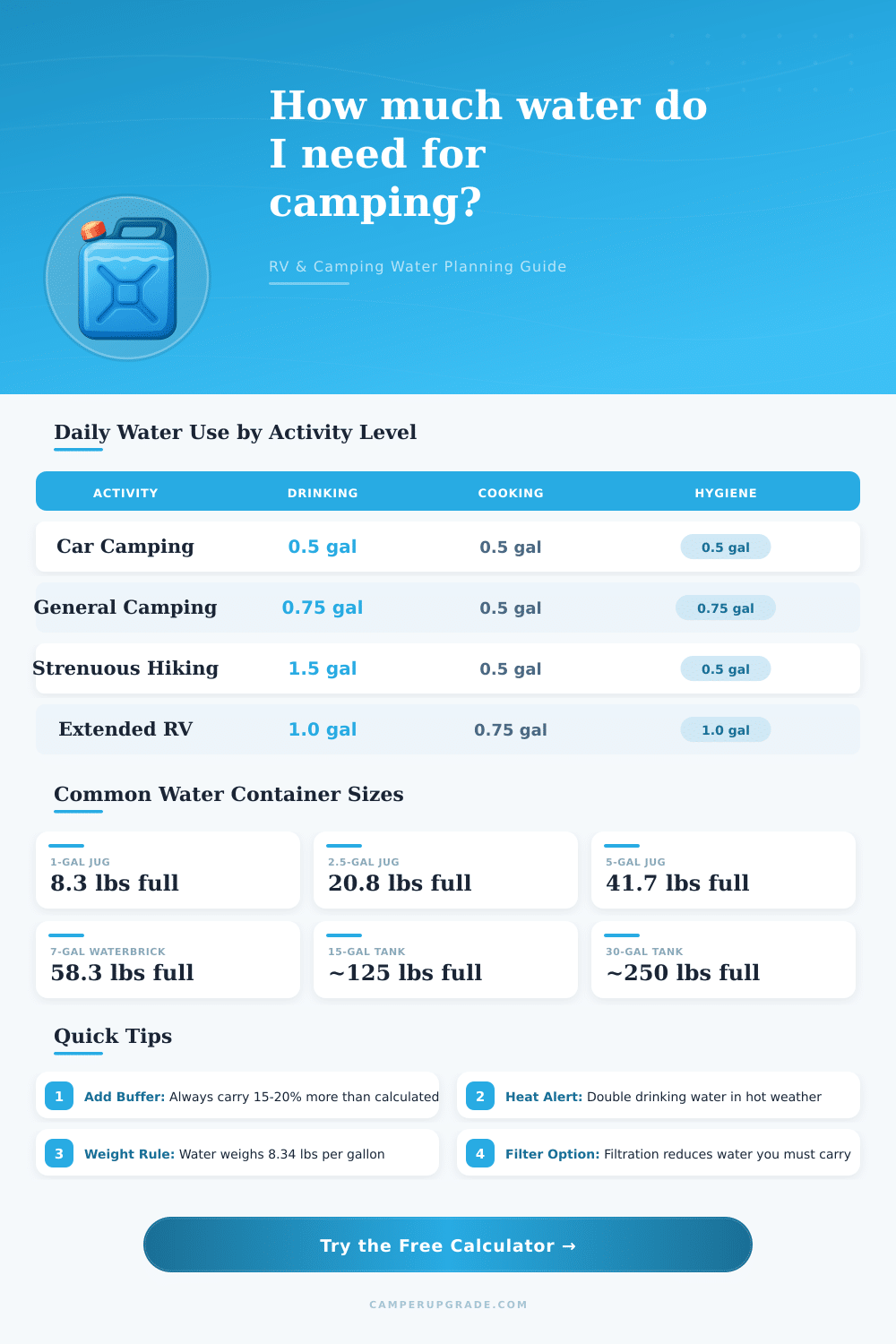
| Camping Style | Drinking | Cooking | Dishes | Hygiene | Total/Person/Day |
|---|---|---|---|---|---|
| Day Hike | 0.75–1.5 gal | 0.25 gal | 0.25 gal | 0 | 1.25–2.0 gal |
| Car Camping (easy) | 0.5 gal | 0.5 gal | 0.5 gal | 0.25 gal | ~1.75 gal |
| General Campsite | 0.75 gal | 0.5 gal | 0.5 gal | 0.5 gal | ~2.25 gal |
| Strenuous Backpacking | 1.5 gal | 0.5 gal | 0.25 gal | 0.25 gal | ~2.5 gal |
| Hot Weather Camping | 1.5–2.0 gal | 0.5 gal | 0.5 gal | 0.75 gal | ~3.25 gal |
| Extended RV Trip | 1.0 gal | 0.75 gal | 0.75 gal | 1.0 gal | ~3.5 gal |
| Container | Capacity (gal) | Capacity (L) | Weight Full | Best For |
|---|---|---|---|---|
| 1-Gal Jug | 1 gal | 3.8 L | ~8.3 lbs | Day hikes, emergency backup |
| 2.5-Gal Jug | 2.5 gal | 9.5 L | ~20.8 lbs | Weekend camping, small groups |
| 5-Gal Jug | 5 gal | 18.9 L | ~41.7 lbs | Car camping standard |
| 7-Gal WaterBrick | 7 gal | 26.5 L | ~58.3 lbs | Stackable RV storage |
| 15-Gal Fresh Tank | 15 gal | 56.8 L | ~125 lbs | Small RVs, day tank |
| 30-Gal Fresh Tank | 30 gal | 113.6 L | ~250 lbs | Class B / C RV standard |
| 50-Gal Fresh Tank | 50 gal | 189.3 L | ~417 lbs | Class A RV, extended trips |
| People | Days | Basic (1.75 gal/p/d) | Moderate (2.5 gal/p/d) | Active (3.5 gal/p/d) |
|---|---|---|---|---|
| 1 | 1 | 1.75 gal | 2.5 gal | 3.5 gal |
| 2 | 2 | 7 gal | 10 gal | 14 gal |
| 4 | 3 | 21 gal | 30 gal | 42 gal |
| 2 | 7 | 24.5 gal | 35 gal | 49 gal |
| 4 | 5 | 35 gal | 50 gal | 70 gal |
| 6 | 3 | 31.5 gal | 45 gal | 63 gal |
Have Camping Water in the camper rank between the many charms of travel by RV. Thanks to the water system, one can wash vegetables, fill a jug, shower and flush the toilet without ever leaving the vehicle. Such practical benefits do the nomadic life much more pleasant.
The water system in a camper leads water from an outside tank to a tap or shower. The basic setup simply uses a foot pump for cold water to the tap. The complex version includes a pump that provides also warm water.
How RV and Camper Water Systems Work
To the water system belong various parts like water tanks, outside shower, pumps, tubes, filters and tanks.
In campers and RV water systems exist three kinds of water: fresh, gray and black. Most RVs own three tanks for each of them. The fresh water tank keeps all the pure drinking water and is the only one that should feed in the RV.
The water system of the RV sends tihs water to kitchen and bathroom sinks, toilets, and inside or outside showers.
The fresh water tank one usually fills by means of a hose, whether through a city water tap or by means of a gravity input on the outside of the camper. City water connects to the RV piping after the pump. A check valve on the pump stops city water from flowing into the fresh water tank.
It is useful to know that, when one fixes the setup up.
One camper uses around three to six liters of water a day, mainly for drinking. Adding cooking, eight to ten liters a day work well. With capacity under thirty liters, one can fill it every four to five days, what is entirely doable.
Some do that every one and a half to too weeks. When water taps appear along the way, tank filling even without water shortage is a wise idea.
RV Camping Water tanks are made by means of rotational molding from FDA-approved plastic material. They work for keeping fresh drinking water, but are also tough enough for use as gray or black water tanks, if needed. Some campers bring also jugs and dispensers as backup for days away from water sources.
One can use a filter to clean tank water and addcalm to the mind.
Water pumps sometimes create troubles. After winter storage, a pump maybe sounds loud but can not push water up, probably because of bad winterizing. Adding an inside water filter and a brass pressure control in the setup helps to protect it and keep good flow.