Camping Trailer Weight Calculator
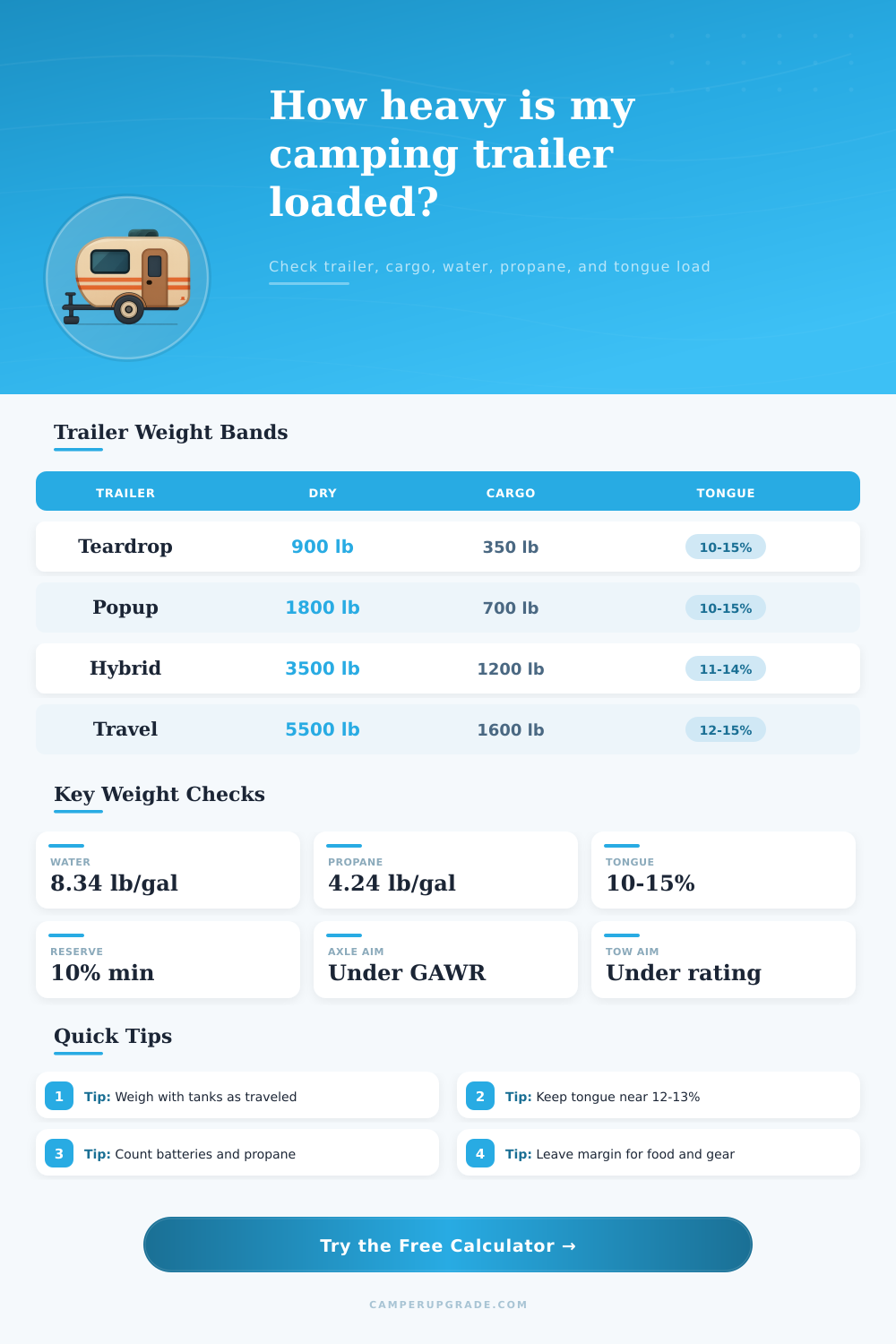
Estimate loaded camping trailer weight from dry weight, cargo, water, propane, batteries, hitch gear, and tongue percentage, then compare the result with tow rating, GVWR, axle rating, and tongue limits.
| Trailer type | Typical dry weight | Common cargo added | Loaded planning note |
|---|---|---|---|
| Small teardrop | 700-1500 lb | 200-500 lb | Water jugs and tongue boxes can change balance quickly. |
| Pop-up camper | 1200-2800 lb | 400-900 lb | Canvas gear, coolers, and full tanks often matter more than expected. |
| Compact travel trailer | 2500-4200 lb | 700-1300 lb | Battery, propane, and front storage can raise tongue weight. |
| Family bunkhouse | 3800-6500 lb | 1000-1800 lb | Use scale tickets because family cargo spreads through every cabinet. |
| Light toy hauler | 4500-7500 lb | 1500-3000 lb | Toys behind the axle may lower tongue share; recheck loaded balance. |
| Load item | Weight rule | Example | Trailer effect |
|---|---|---|---|
| Fresh water | 8.34 lb per gallon | 30 gal = 250 lb | Adds directly to loaded trailer weight. |
| Water heater | 8.34 lb per gallon | 6 gal = 50 lb | Often missed if the heater is full while towing. |
| Propane liquid | 4.24 lb per gallon | 9.4 gal = 40 lb | Cylinder steel weight is usually already in measured bottle weight. |
| Lead-acid battery | 45-65 lb each | Two group 27 = 110 lb | Usually sits on the tongue and raises hitch load. |
| Lithium battery | 22-35 lb each | Two 100 Ah = 60 lb | Lighter, but still counts against trailer payload. |
| Tongue share | Typical meaning | Check first | Action |
|---|---|---|---|
| Under 10% | Light tongue | Sway risk and rear cargo | Move dense cargo forward and reweigh. |
| 10-12% | Usable lower band | Trailer behavior | Often fine for smaller trailers if stable. |
| 12-13.5% | Strong target | Receiver and payload | Common planning target for travel trailers. |
| 13.5-15% | Heavy but common | Rear axle and hitch | May need weight distribution or cargo shift. |
| Over 15% | Very heavy tongue | Hitch rating | Reduce front load unless the trailer maker specifies it. |
| Example setup | Loaded trailer | Tongue load | Axle load |
|---|---|---|---|
| 1200 lb teardrop plus 350 lb | 1550 lb | 194 lb | 1356 lb |
| 2100 lb pop-up plus 750 lb | 2850 lb | 356 lb | 2494 lb |
| 3400 lb compact plus 1100 lb | 4500 lb | 563 lb | 3938 lb |
| 5200 lb bunkhouse plus 1500 lb | 6700 lb | 838 lb | 5863 lb |
| 6200 lb toy hauler plus 2500 lb | 8700 lb | 1088 lb | 7613 lb |
When you hook up a camping trailer, you must understand the number printed on the side of your truck and the numbers printed on the side of the trailer do not always represent the actual weight of your vehicle. The dry weight of your camping trailer is only the starting weight of the camping trailer. This dry weight of the trailer doesnt include any additional items that you may add to your trailer.
You must account for the weight of all the items that you are adding to your trailer. For instance, if you are adding a cooler that has food in it or if you are adding water to your fresh water tank, you must account for this weight. You will eventualy find out the importance of the total weight that your trailer can handle if your trailer starts to sway when you are on a downgrade in the road or if a weigh station pulls one of the individual in your trailer.
Know the Real Weight of Your Camping Trailer
The total weight of the trailer that you are towing is the dry weight of the trailer plus the total weight of the cargo and fluids. Knowing the total weight that you are towing is important for determining if you are within the weight limits of your tow truck’s rating, the trailer Gross Vehicle Weight Rating, and the axle ratings of the trailer. If you exceed the total weight limits of your tow truck or trailer, you could face fines from the road and your trailer components may experience excessive wear and tear.
The total weight that you are towing will determine if you are on a comfort towing experience or if the towing experience becomes stressful for you and your family. Water is a very heavy component of camping trailers that many people ignores when calculating the total weight of their trailer. If a trailer has a fresh water tank, one gallon of water weighs just under eight pounds.
Therefore, a water tank could add up to several hundred pounds to your trailer. Additionally, propane will add some weight to your trailer, but not as much as water do. A pair of twenty-pound propane tanks holds around nine gallons of propane.
Propane weighs around four pounds per gallon. The location of the fresh water tanks and propane tanks will have an impact on the tongue weight of your trailer. Moving heavy items within the trailer will change the tongue weight of the trailer and how the trailer sits in relation to your tow vehicle.
Batteries and other power gear for your trailer will add to the total weight of your trailer. A pair of group 27 lead acid batteries will weigh you over one hundred pounds. Additionally, many people will mount these batteries on the tongue of their camping trailer.
This will add to the tongue weight of your trailer, making your trailer feel like it is nose heavy. Additionally, the weight of the lithium batteries is half the weight of the lead acid batteries. However, the price of the lithium batteries is more than that of the lead acid batteries.
Because of the high price of the lithium batteries, people will opt for lead acid batteries to give their camping trailer a more stable feel. The amount of weight from the loaded camping trailer that presses down on the hitch ball of the tow vehicle is known as the tongue weight. Most bumper pull camping trailers will tow best if the tongue weight is between ten and fifteen percent of the total loaded camping trailer weight.
If the tongue weight is less than ten percent, the trailer could become unstable when traveling at highway speeds. Additionally, if the tongue weight goes beyond fifteen percent, the tow vehicle will lose its steering feel, and the rear axle of the tow vehicle will become overloaded. A calculator can help determine the tongue weight of your loaded trailer.
All you have to do is enter the dry weight of your trailer, the weight of the cargo, the weight of the water in your fresh water tank, the weight of the propane in your propane tank, and the percentage of the total loaded trailer weight that you want the tongue weight to be. The weight of the cargo that you will tow in your trailer is the most difficult to calculate. Nevertheless, the items that will be in your trailer will add to the total weight of the trailer.
Items such as clothes, bedding, cookware, cooking utensils, cooking tools, camp chairs, and food can add up to several hundred pounds to your trailer. Additionally, small items will add up quickly to the trailer that you are towing. However, it is important to note that small items can be challenging to distribute even throughout the trailer.
If you have heavy items in the trailer close to the front of the trailer, the tongue weight of the trailer will increase. Additionally, if you have items positioned behind the axle of the trailer, the tongue weight will decrease. A decrease in the tongue weight can create handling problems for your trailer.
Different types of trailers will have different weight requirement. For example, small teardrop trailers will have a dry weight of as little as one thousand pounds. However, once the trailer is loaded, the total weight will go up to three or four hundred pounds.
Additionally, a family bunkhouse trailer could have fifteen hundred pounds of gear on the trailer. However, as long as the total loaded weight is within the Gross Vehicle Weight Rating of the trailer, it will remain under the limits of the trailer. Additionally, the size of the trailer that you tow is not the only consideration that a trailer owner must make.
The owner must also account for the weight of the fluids and the personal items that will be within the trailer. The use of a weight distribution hitch does affect the loaded weight that is distributed between the trailer and tow vehicle axles. However, it does not give your trailer or tow vehicle an increased rating of the total weights that can be towed.
A weight distribution hitch will allow some of the tongue weight to be distributed to the front axle of the tow vehicle and the axles of the trailer. A weight distribution hitch will provide the trailer with additional stability when towing heavy loads. However, it will not allow the trailer to go beyond the total weight limits that are printed on the trailer and tow vehicle.
In the real world, there are several variable that will change the total weight that your tow vehicle can handle. For example, the fuel weight in your tow vehicle, the weight of the passengers, and the gear that is within the truck will all add to the total payload that your tow vehicle can have. A tow vehicle that can handle six thousand pounds may only have four thousand pounds of payload capacity for the tow vehicle, passengers, and fuel.
This remaining payload will have to account for the tongue weight of your trailer and the payload of the gear that will be in the bed of the towing vehicle. It is common for trailer owners to exceed the payload capacity of their tow vehicle before they exceed the limits of the trailer and the tow vehicle total weight. The best solution to accounting for all the variables of the trailer that will be towed is to weigh your loaded camping trailer on a public scale prior to departing for your trip.
You can use a trailer weight calculator to determine the weight of your loaded trailer. However, a public scale will show you the actual weight of the items that are within the trailer, the actual level of the fresh water and propane tanks, and the actual location of the batteries on the tongue of your trailer. Using a public scale will allow trailer owners to determine if they have properly accounted for all the variables of the loaded trailer.
This can then allow them to move heavy items within the trailer prior to departing for their trip. By understanding the difference between the total weight of the trailer as published versus the actual loaded weight of the trailer, trailer owners can leave a margin for any unexpected loads of gear and items on the trailer. Having a margin for error with the loaded weight of the trailer will allow trailer owners to stay within the limits of their tow vehicle to maintain a stable trailer and to protect their tow vehicle and trailer from damage.