Camping Shovel Weight Calculator
Estimate a camping shovel's trail-ready weight from blade size, head material, handle length, shaft material, grip style, hinge hardware, sheath, and packed configuration.
🏕Camping Shovel Presets
⚙Shovel Size, Material, and Pack Inputs
Camping Shovel Weight Results
📊Material and Spec Grid
📐Shovel Weight Tables
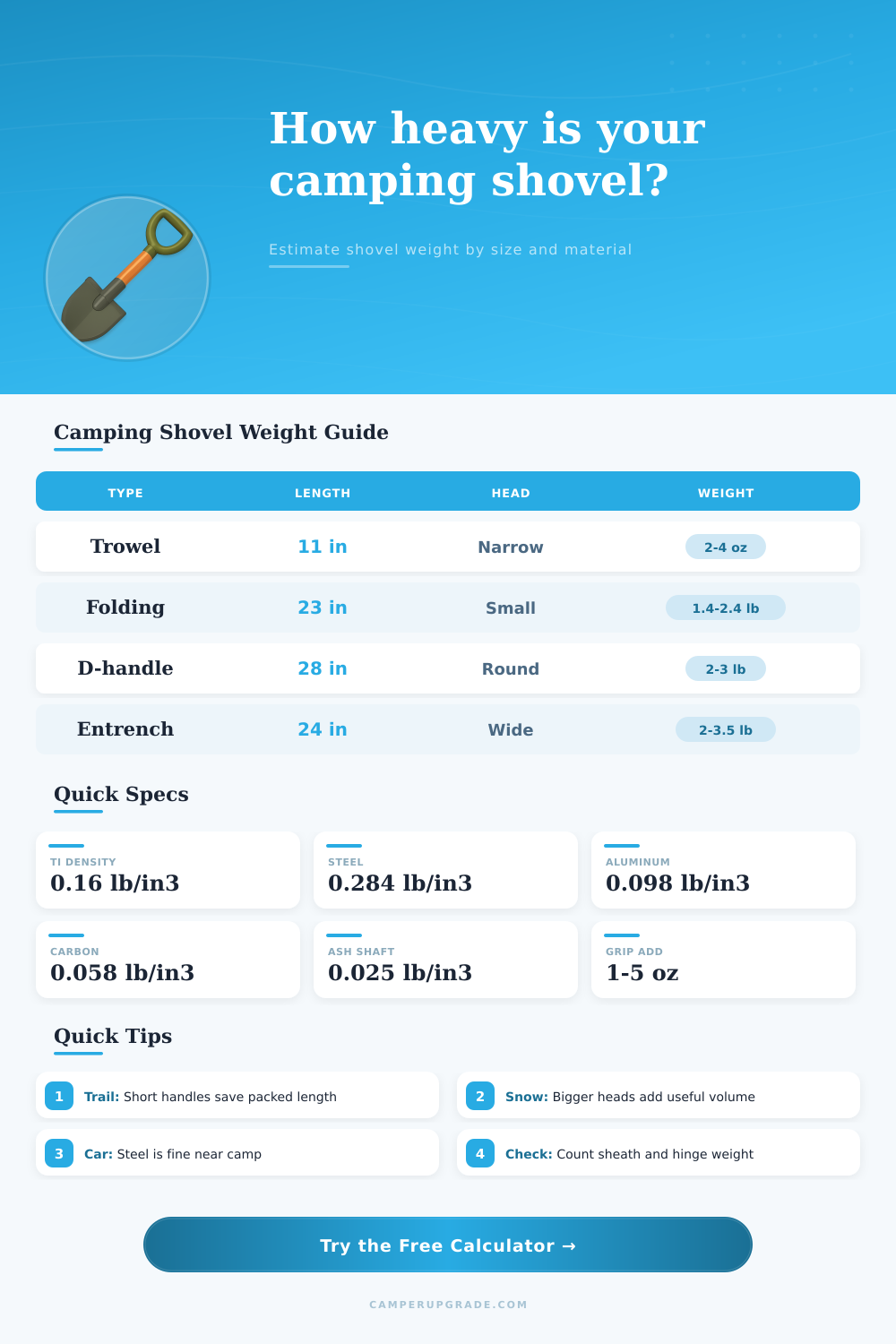
| Camping shovel type | Common extended length | Common packed length | Typical weight range |
|---|---|---|---|
| Ultralight cathole trowel | 6-12 in / 15-30 cm | 6-12 in / 15-30 cm | 0.8-4 oz / 23-113 g |
| Compact folding shovel | 16-25 in / 41-64 cm | 6-11 in / 15-28 cm | 1.3-2.6 lb / 0.6-1.2 kg |
| Fixed D-handle camp shovel | 24-33 in / 61-84 cm | 24-33 in / 61-84 cm | 2.0-3.4 lb / 0.9-1.5 kg |
| Snow camp shovel | 22-36 in / 56-91 cm | 15-24 in / 38-61 cm | 1.0-2.2 lb / 0.45-1.0 kg |
| Entrenching shovel | 20-27 in / 51-69 cm | 8-12 in / 20-30 cm | 2.0-3.7 lb / 0.9-1.7 kg |
| Blade material | Density used | Best camping use | Weight note |
|---|---|---|---|
| Titanium alloy | 0.163 lb/in3 / 4.51 g/cm3 | Backpacking trowels and compact dig tools | Light for strength, costly to form but excellent in a pack |
| Aluminum alloy | 0.098 lb/in3 / 2.70 g/cm3 | Snow shovels, sand scoops, camp utility blades | Light, but usually needs ribs or thickness for stiffness |
| Carbon or stainless steel | 0.284 lb/in3 / 7.85 g/cm3 | Car camping, RV dirt work, truck tools | Strong edge and socket, noticeably heavier on trail |
| Polycarbonate plastic | 0.043 lb/in3 / 1.20 g/cm3 | Snow, sand, ash, and light soil scooping | Very light, less ideal for rocky mineral soil |
| Glass-filled nylon | 0.050 lb/in3 / 1.38 g/cm3 | Budget backpacking trowels and molded blades | Low mass, thickness matters more than metal equivalents |
| Handle material | Geometry estimate | Typical feel | Calculator treatment |
|---|---|---|---|
| Aluminum tube | Hollow round shaft | Light, cool, durable enough for camp chores | Uses outer diameter and wall thickness as a tube |
| Steel tube | Hollow round shaft | Strong, stable, heavier in pack or roof box | Uses tube volume with steel density |
| Ash or hardwood | Solid oval handle | Comfortable and repairable for RV or cabin use | Uses diameter, length, and an oval correction factor |
| Polymer handle | Molded ribbed handle | Weatherproof, moderate weight | Uses a reduced solid-volume shape factor |
| Carbon fiber tube | Hollow tube shaft | Very light, premium snow and alpine use | Uses tube volume with carbon composite density |
| Component | Light setup | Standard setup | Heavy setup |
|---|---|---|---|
| Grip or cap | 0-1.5 oz | 2-4 oz | 4-7 oz |
| Hinge and lock | 0-2 oz | 4-7 oz | 8-11 oz |
| Reinforced edge | 0-1 oz | 1.5-4 oz | 5-8 oz |
| Sheath or cover | 0-1 oz | 2-4 oz | 5-8 oz |
💡Camping Shovel Weight Tips
When you are choosing a camping shovel, you must balance between the digging power that you need from the camping shovel and the weight of the camping shovel. A camping shovel must be strong enough to move the soil or snow that you come across while camping, but a camping shovel must also be light enough so that the camping shovel dont add too much weight to your pack. The weight of a camping shovel will impact the way that you move on the trail while camping, and the weight of a camping shovel will also impact the way that you store your camping shovel in your campsite.
While many people may attempt to guess the weight of camping shovels, the weight of a camping shovel may be more than expected due to its hinge hardware, sheath, and the dirt that collects on its blade. Thus, people should use a camping shovel calculator to determine the weight of their camping shovel. Such a camping shovel calculator will allow people to determine the weight of the camping shovel without including dirt and water (the clean weight), but also with those portions included (the trail-ready weight).
Pick a Camping Shovel by Weight and Size
The material from which the shovel is made will impact the weight of the shovel. For instance, materials like titanium have high stiffness but very little mass, making it a good choice for small backpacking trowels that must move dirt that is not packed tightly. Metals like steel have good strength and a strong blade, but add more weight to the tool if the blade is wider than six inches.
Materials like aluminum sit in the middle of these two different types of materials, and are often used in snow shovels because the blades for snow shovels are large and aluminum metal is not very dense. A calculator will determine the weight of the blade by multiplying the area of that shovel blade by the thickness of the blade and the density of the metal being used to make the tool. The handle of the camping shovel can also impact both the weight and size of camping shovels.
For instance, users can keep hollow handles made of aluminum or carbon to a low weight, but they must have thick walls to prevent bending of the camping shovel. Solid wooden handles made of ash may be comfortable for the person who holds the camping shovel, and may break if the shovel handle is dropped, but may add more weight to the shovel than hollow handle options of the same diameter. The length of the shaft will determine the size of the shovel when it is packed into a backpack, and folding camping shovels may have a collapsible handle to allow the camping shovel to fit into the side pocket of an adventurer’s backpack, while camping shovels with handles that cannot be folded will be of full-length handles that may remain outside of the adventurers vehicle.
The grip style and hardware of the shovel will also add to the weight of the camping shovel. For instance, camping shovels with T-cap grips will have less weight than camping shovels with D-handle grips. Additionally, any folding hinges or lock rings will increase the weight of a camping shovel, as will heavy entrenching locks that may come on the shovel.
Finally, any sheaths that come with camping shovels will also add to the weight of the tool; mesh sheaths will be lighter than those with canvas or rigid guards around the shovel. Each of these features of camping shovels may cause the camping shovel to be beyond the two-pound limit of some adventurers. Each camping shovel will have some effects upon its weight.
For instance, clay that may be encountered while digging can become stuck to the shovel blade while in use, adding to the weight of the tool. Additionally, snow that melts within the camping shovels hinge may refreeze while the adventurer is camping, adding to the weight of the shovel. Thus, adventurers can counteract these effects by keeping their camping shovel dry and clean so that dirt does not accumulate on the shovel’s moving parts.
Camping shovel calculators often allow adventurers to account for moisture or soil in their camping shovel so that they can account for the potential additional weight of the shovel while in the camping environment. For adventurers that camp in vehicles, the weight of their camping shovel is less important than its strength. For instance, when camping in a truck, adventurers can make use of a steel shovel with a full-size handle so that the vehicle can take the extra weight of the camping shovel.
However, such a heavy camping shovel is less ideal for backpackers, who must carry the camping shovel on their back. While a camping shovel calculator will not determine which camping shovel is the best choice for an adventurer, the camping shovel calculator will display the weight of each camping shovel so that adventurers can make their selection. Many people make mistakes when selecting camping shovels.
For instance, some individuals may only consider the weight of the blade of a camping shovel, but such a weight does not reflect the total weight of that camping shovel. Additionally, some people may only consider the length of the camping shovel, but the length will change if the camping shovel is of the folding model. Thus, individuals must consider the dimensions of the camping shovel when it is fully extended, and when it is collapsed to transport it to the camping trip.
By considering each of these dimensions for each camping shovel, adventurers can be sure that the shovel will fit into the space within their camping pack. Overall, adventurers must find a camping shovel that suits their needs. The camping shovel needs to be compatible with the type of soil that they will dig, and should be compatible with the distance that the adventurer will need to carry their camping shovel.
Finally, the camping shovel should fit into the space that has been provided within the adventurer’s pack after the adventurer has packed their food, water, and shelter. By using a camping shovel calculator, adventurers can test each of these requirements before purchasing a camping shovel. Based off the weight of the camping shovel that the camping shovel calculator determines, adventurers can decide if it is the right camping shovel for their camping trip.
They should of checked the weight before they buys it.