Camping Rain Runoff Calculator
Estimate how much storm water sheds from a tarp, tent fly, RV awning, ground sheet, or campsite surface, then check flow rate, drip-line load, and ponding risk.
🌧Rain Runoff Presets
📏Tarp, Tent Area, Rainfall, Slope, and Surface Inputs
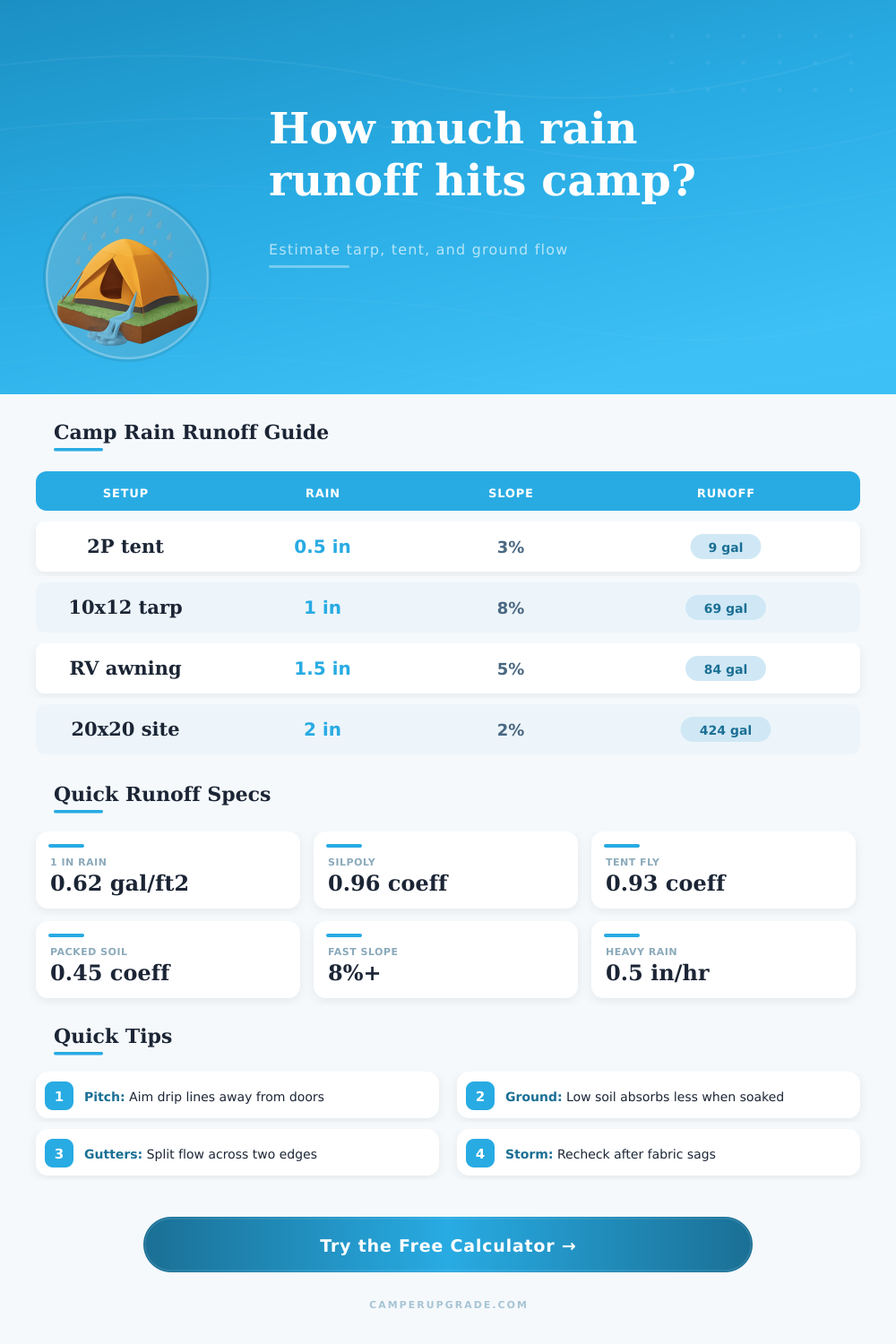
Runoff volume uses catchment area times rainfall depth times a surface runoff coefficient. Slope affects drainage speed, concentration, and ponding risk, but not the basic rain volume.
🧵Fabric and Surface Spec Grid
📊Runoff Reference Tables
| Rain Depth | Gal/ft² | L/m² | Storm Read |
|---|---|---|---|
| 0.25 in | 0.156 | 6.4 | Light shower |
| 0.50 in | 0.312 | 12.7 | Steady rain |
| 1.00 in | 0.623 | 25.4 | Wet storm |
| 2.00 in | 1.247 | 50.8 | Soaker |
| Catchment | Area | 1 in Runoff | Use Case |
|---|---|---|---|
| 2P fly | 36 ft² | 21 gal | Small tent |
| 10x10 tarp | 100 ft² | 59 gal | Dining tarp |
| 10x12 tarp | 120 ft² | 72 gal | Camp kitchen |
| RV awning | 128 ft² | 78 gal | Trailer side |
| Slope | Drain Speed | Ponding | Pitch Note |
|---|---|---|---|
| 0-2% | Slow | High | Sag check |
| 3-5% | Moderate | Medium | Usable |
| 6-10% | Fast | Low | Good tarp |
| 12%+ | Very fast | Low | Splash zone |
| Surface | Coeff | Absorbs | Watch |
|---|---|---|---|
| Silpoly | 0.96 | Almost none | Drip line |
| Canvas | 0.88 | Some wetting | Sag load |
| Gravel | 0.65 | Moderate | Channeling |
| Soil/duff | 0.45 | Variable | Saturation |
💡Rain Runoff Calculation Tips
Rain can turn your campsite into a drainage problem because rain move from the roof to the ground. When it rains on your tarp or your tent fly, your tarp or tent will shed the water and the water that is shed will fall onto the ground. The ground often cannot absorb the water as quick as the tarp or tent will shed the water.
You must understand where the water that falls on the ground will go. A calculator will help you understand where the water will go from your tarp or tent. The first thing you must calculate is the catchment area because the catchment area will tell you how much rain will fall onto your tarp or tent.
How Rain Runs Off Your Tarp and How to Plan Your Campsite
To calculate the catchment area of your tarp, you must measure the tarp horizontal. You dont have to measure the slope of the tarp. Any rectangle that are pitched between two trees will collect any water that falls onto itself.
The area of the ground projection of the rectangle will determine the number of gallon of water that will fall from your tarp. The shape of your tarp will impact the catchment area. Any tarp that is in the shape of a triangle or an oval will collect less rain than a rectangle.
Once you have determined the catchment area of your tarp, you will use the depth of the rainfall to calculate the number of gallons of water that will fall on your tarp. One inch of rainfall will collect 62 gallons of water on a 100 square foot area. The coated fabrics will shed all of the water that falls on the tarp.
The next setting that determine the amount of water that will fall off of your tarp is the runoff coefficient. The runoff coefficient is high for silpoly and vinyl awnings because these materials will absorb almost no water but will shed the water very quick. The runoff coefficient for materials like canvas and packed soil will be lower because these materials will absorb some of the water but will shed the remainder of the water.
The runoff coefficient will change the amount of water that falls off the tarp. Changing the material in the calculator will change the number of gallons of water that fall off the tarp by ten or fifteen percent. The ground saturation option will also change the number of gallons of water that fall off the tarp.
When the ground is dry, it can absorb a large amount of water. When the ground is wet, the same amount of water will become standing water on the ground. The slope of the tarp will determine how long it takes for the water to run off the tarp but will not change the total number of gallons of water that will fall off the tarp.
A steeper pitch will allow the water to run off the tarp quickly but will also concentrate the water at the low edge of the tarp. A gentle pitch will allow the tarp to distribute the weight of the water but will also cause the tarp to sag and create a reservoir of water that collects on the tarp. The cross slope will determine how much water that runs off the tarp will drift off the tarp to one side.
The edge plan will determine how the water that falls off of your tarp will be distributed. If one edge of the tarp is low, all of the water will run off the tarp on that edge. If the tarp has two long edges, the water will divide and run off the tarp on each of these edges.
This setting will change the peak flow rate of the tarp. The peak flow rate will tell you how quickly the water will reach the drip line of the tarp. The duration of the rainfall will change the amount of intensity of the water that falls onto the tarp.
If the same amount of rainfall falls over the course of four hours, the flow of water will be gentle. However, if the same amount of rainfall is poured over the course of forty-five minutes, the flow of the water will be intense. Intense rainfall can overwhelm one corner of the tarp and carve a channel in the ground where the tarp is pitched.
The calculator will divide the total number of gallons of water by the number of hours of rainfall. The number that results from this calculation will be the average rate of flow of the tarp. This number will help you to decide whether or not the water will run away from your tarp or if the water will pond on the tarp.
Many people make mistake when setting up their tarps. One of the most common mistake is to simply treat the tarp as an isolated object when it should be considered as part of the drainage system. People will typically pitch their tarps to provide shade for themselves but will then discover that the water from their tarp lands on the spot where they are walking or cooking.
People often do not consider that the ground will become a catchment area once it becomes saturated with water. In the calculator, you can change the material of the ground to soil to calculate the amount of water that will collect on the ground. Another mistake that people will make is to ignore the first few minutes of rainfall.
Any dry fabric will absorb some of the water that falls on it before shedding the water. The calculator will assume that the tarp is dry and will not account for the water that the tarp absorbs in the first few minutes of rainfall. This underestimation of the amount of water that is absorbed by the tarp in the first few minutes of rainfall is a conservative assumption in the calculator so the amount of water that is reported by the calculator will be higher than the amount of water that falls on the tarp during the first few minutes of rainfall.
Finally, there are a number of variables at the campsite that the calculator cannot consider. For example, the wind can push the rain under an awning or it can push the water along the seams of a tarp. Trees may intercept some of the rain that falls on the tarp but the leaves could also drip onto the same area of the tent.
The roots and rocks on the ground may change the way that the water falls off of the tarp but these variable cannot be considered in the calculator. These variables indicate that the information provided by the calculator is only an approximation of the way that water will move off of a tarp at a campsite. Drip lines are part of your campsite design.
Once you know how many gallons of water will leave your tarp and how fast that water will reach the drip line, you can determine where to place your gear and your cooking areas away from the drip lines. The calculator will provide the information that you need to design your campsite but the design of your campsite is up to you. A well planned campsite will handle rain better than an unplanned campsite at the same location.
A well planned campsite will take into consideration the way that the water will move once it leaves the tarp.