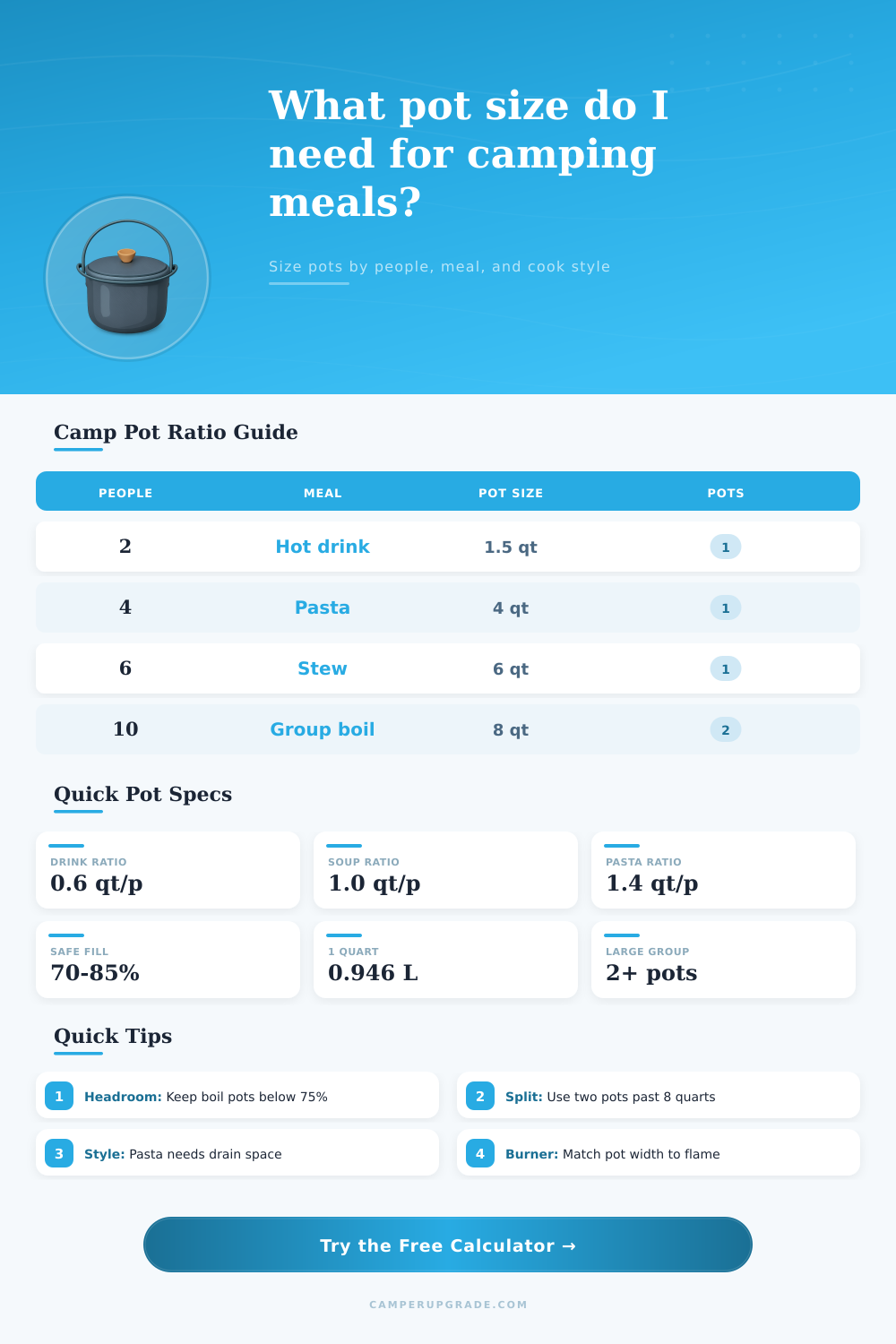
Camping Pot to Person Ratio Calculator
Estimate camp cookware capacity, pot count, boil headroom, servings per batch, and burner fit from group size, meal type, cook style, and pot volume.
🏕Camping Pot Ratio Presets
⚙People, Meal, Pot Volume, and Cook Style Inputs
The calculator sizes usable pot volume from per-person meal volume, servings, appetite, and fill fraction. It then compares that need with your pot capacity, pot count, and burner support.
🍲Cookware Spec Comparison Grid
⚖Pot Material and Shape Comparison
Hard-anodized aluminum
LightGood all-around camping choice with fast heating and moderate durability for simmer meals.
Stainless steel
ToughHandles group cooking and abrasive cleanup, but weighs more and can scorch thick meals.
Titanium
UltralightExcellent for boiling water; thin walls are less forgiving for chili, rice, or sauces.
Wide stock pot
StableBest for car-camp groups when the stove grate supports the wider base safely.
📊Pot-to-Person Reference Tables
| Meal Type | Base Ratio | Safe Fill | Example Use |
|---|---|---|---|
| Hot drinks | 0.55 qt/person | 85-90% | Cocoa or coffee water |
| Oatmeal | 0.70 qt/person | 75-80% | Breakfast grain |
| Freeze-dried water | 0.65 qt/person | 85-90% | Pouch meals |
| Rice or couscous | 0.85 qt/person | 75-80% | Absorption cooking |
| Pasta or noodles | 1.15 qt/person | 65-72% | Drainable starch |
| Soup or ramen | 0.95 qt/person | 75-82% | Brothy meal |
| Chili or stew | 1.05 qt/person | 70-78% | Thick one-pot dinner |
| Seafood boil | 1.60 qt/person | 58-65% | Corn and shellfish |
| Pot Size | Usable 75% | Soup People | Pasta People |
|---|---|---|---|
| 1.0 qt / 0.95 L | 0.75 qt | 1 | 1 small |
| 1.5 qt / 1.4 L | 1.13 qt | 1-2 | 1 |
| 2.5 qt / 2.4 L | 1.88 qt | 2 | 1-2 |
| 4.0 qt / 3.8 L | 3.00 qt | 3 | 2-3 |
| 6.0 qt / 5.7 L | 4.50 qt | 4-5 | 3-4 |
| 8.0 qt / 7.6 L | 6.00 qt | 6 | 4-5 |
| 12 qt / 11.4 L | 9.00 qt | 9 | 6-7 |
| Group Size | Hot Water Pot | One-Pot Meal | Pasta Pot |
|---|---|---|---|
| 1-2 people | 1.0-1.5 qt | 1.5-2.5 qt | 2.5-3 qt |
| 3-4 people | 2.0-3.0 qt | 4.0-5.0 qt | 6.0 qt |
| 5-6 people | 4.0 qt | 6.0-8.0 qt | 8.0-10 qt |
| 7-8 people | 5.0-6.0 qt | 8.0-10 qt | 12 qt or split |
| 9-12 people | 8.0 qt | 12 qt or 2 pots | 2 large pots |
| 13-16 people | 10-12 qt | 2 x 8 qt | 2 x 12 qt |
| Burner Type | Good Pot Base | Max Practical | Best Meal |
|---|---|---|---|
| Canister stove | 4-6 in | 2.5 qt | Boil water |
| Remote fuel stove | 5-7 in | 4 qt | Small simmer |
| Single camp stove | 6-9 in | 6-8 qt | Family dinner |
| Two-burner stove | 7-10 in | 8-12 qt | Main plus side |
| Propane burner | 9-14 in | 20+ qt | Large boil |
💡Camp Pot Ratio Tips
When cooking in the wilderness, its important to understand the difference between the labeled capacity of a pot and the amount of volume that can be use in that pot. Many peoples believe that if a pot has a specific volume labeled on it, that the pot can be filled to the very top with the food that is to be cook. However, pots cannot be filled to the very top with food because this can cause spills of the liquid from the pot.
When cooking it is important to provide some head room for the food within the pot; head room being the empty space provided between the top of the food and the rim of the pot. This head room is necessary for different reasons; food can foam within the pot, the food can boil over, or the food can splash out of the pot if it are stirred. For example, when making coffee no head room is required but head room is required for cooking pasta due to the foaming that occur with pasta.
How to Choose the Right Pot for Camping
The type of food that is to be cooked will change the volume of that food that are required. For instance, if cooking a dehydrated meal with broth, less water will be required to rehydrate the ingredients than if cooking pasta, which require more water. The best way to determine the volume of liquid that is required is to use a calculator to determine the amount of volume of food that will be cooked.
Knowing the volume of the food will allow an individual to determine if there three quart pot will be large enough for the food. Additionally, the method in which the cook will prepare the food will indicate the size of the pot that is required for wilderness cooking. For instance, the low water method use small amounts of water to absorb into the food.
However, boiling food in a large amount of water requires the use of a larger size pot to cook the food. If the size of the pot that is required to cook the food is larger than the size of the pots that an individual own, an purchase of a larger pot or cooking the food in batches will be required. If you are cooking in batches, you must account for the extra time cooking in batches will take.
Therefore, you should of start cooking earlier if you choose to cook in batches. The material of the pot is another of the main factors to consider when choosing a pot for camping. For instance, titanium is a popular material for backpackers due to the lightweight nature of the metal and the ability of the metal to boil water quickly.
However, the thin walls of titanium metal can lead to food easy scorching when cooking thick stew dishes. Hard anodized aluminum metals is a good choice for recipes that require simmering ingredients while stainless steel pots are a very durable option for camping stoves. The stainless steel will hold up to heavy use and metal utensils but is heavier then titanium and takes longer to heat up the metal.
Another factor to consider is the relationship of the pot to the burner on which the cook will heat the pot. Using a pot that is too wide for the canister stove burner can create a danger of tipping of the pot. Additionally, using a top heavy pot that is placed on a narrow burner stove will also create a danger of tipping of that pot if placed on uneven camping ground terrain.
The diameter of the pot should be matched to the diameter of the support base of the burner stove to avoid wobbling or tipping of the pot. Finally, considerations should also be made about the appetite of the group that will use the pot. The appetite of the group can change depending upon the weather and the age of those camping with you.
For instance, the appetite of adult campers in the freezing winter will be greater than the appetite of young children on a warm summer evening. Therefore, the appetite and serving factors can be adjusted to accommodate for different level of hunger within the group. If the capacity of the pot is matched to the appetite of the group, there will be no need to run out of food during camping trips.
Additionally, if all of the camping gear is matched appropriately to the food that will be prepared for the campers, there will be less time spent managing the bubbling pot of cooking food.