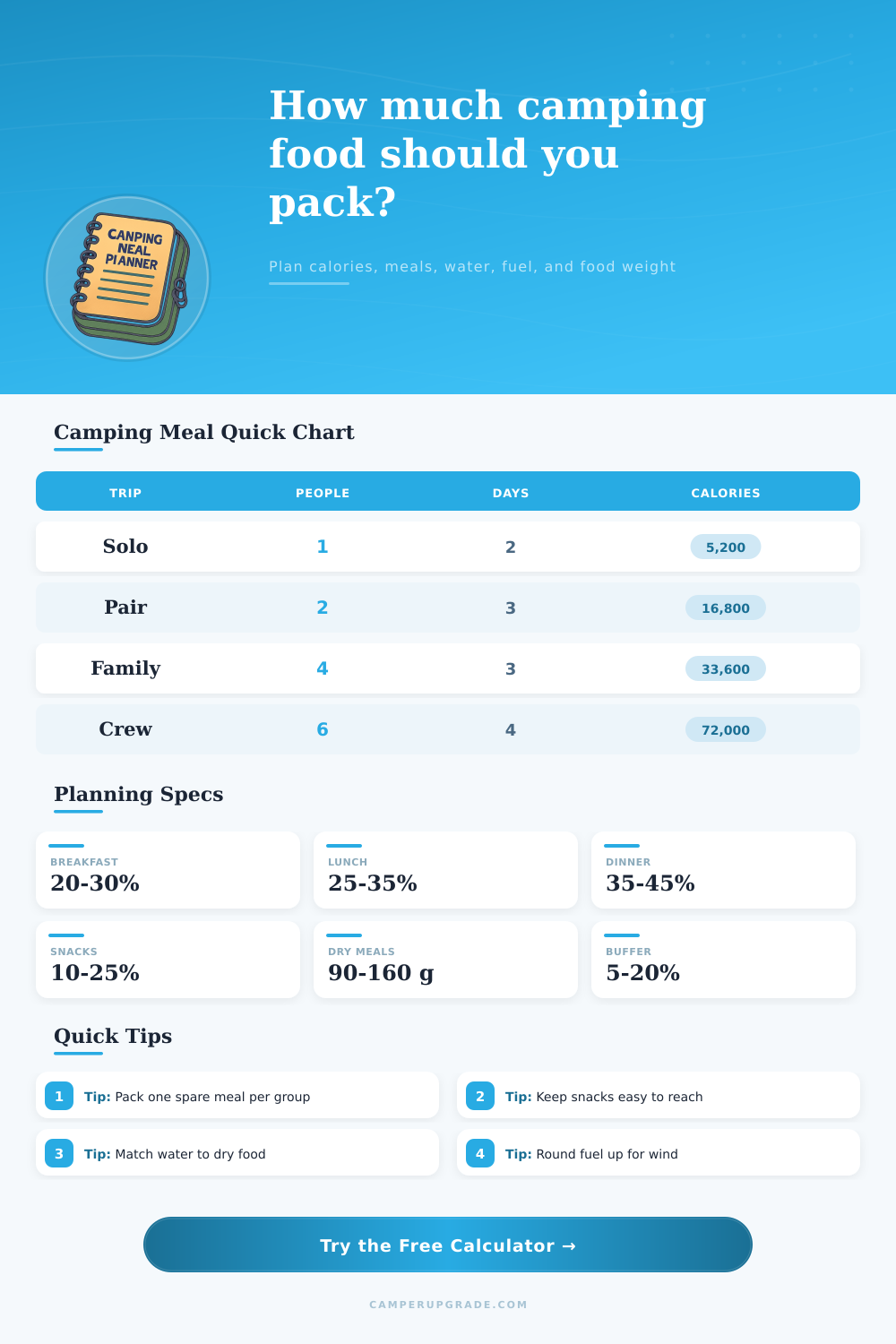
Camping Meal Planner Calculator
Estimate total trip calories, breakfast, lunch, dinner, snack servings, food weight, prep water, and stove fuel from your group size and menu style.
Meal planning estimate
| Trip style | Breakfast | Lunch | Dinner |
|---|---|---|---|
| Easy car camp | 25% | 30% | 45% |
| Trail lunch focus | 20% | 35% | 45% |
| Big breakfast camp | 30% | 25% | 45% |
| Late dinner basecamp | 22% | 28% | 50% |
| Kid-friendly day | 28% | 32% | 40% |
| Diet style | Calories per oz | Hot meal share | Pack note |
|---|---|---|---|
| Balanced camp menu | 115 | 55% | Mixed pantry and cooler food |
| Fresh cooler meals | 85 | 50% | Heavier but familiar meals |
| Dehydrated backpacking | 145 | 75% | Low weight, higher prep water |
| High protein | 125 | 60% | Dense meals and extra snacks |
| Vegetarian | 110 | 58% | Beans, grains, nuts, and dry mixes |
| Family kid-friendly | 100 | 45% | More snack portions and simple lunches |
| Prep style | Water per serving | Fuel per hot serving | Best use |
|---|---|---|---|
| No-cook meals | 0-4 fl oz | 0-2 g | Warm weather lunches |
| Oatmeal and drinks | 8-12 fl oz | 4-6 g | Simple breakfasts |
| Freeze-dried dinner | 12-16 fl oz | 6-9 g | Backpacking dinners |
| Simmered pasta or rice | 16-24 fl oz | 9-14 g | Basecamp stove meals |
| Cold or windy camp | 14-22 fl oz | 10-18 g | Add extra fuel margin |
| Preset | People | Days | Daily calories |
|---|---|---|---|
| Solo weekend hike | 1 | 2 | 2,600 |
| Couple car camp | 2 | 3 | 2,500 |
| Family basecamp | 4 | 3 | 2,800 |
| Backpacking pair | 2 | 4 | 3,200 |
| Scout crew weekend | 8 | 2.5 | 2,900 |
| Winter cabin menu | 5 | 3 | 3,400 |
When planning a camping trip, there is many different variables to consider. The size of the camping trip, the activity level of the peoples on the trip, and the method of cooking the meals all have an impact on the weight of the food that must be transported, the amount of water that will be needed, and the amount of stove fuel that will be required to prepare the meals for consumption. For instance, camping with children is different than camping on foot in backpacks, and camping in the winter is different from camping in the summer due to the additional calories that are burned to maintain body heat in colder temperatures.
Each of these variables have an impact upon the amount of food, water, and fuel that should be calculated for the camping trip. Proper calculation of each of these variables will allow for the camper to save space and weight in their camping backpacks and to avoid searching for snacks during the camping trip. The amount of food that is required for the camping trip is dependent upon the number of variable regarding the camping trip.
Planning Food, Water and Fuel for Camping
For instance, if the activity level of the individual on the camping trip is high, if the weather is cold, or if the individuals that are camping include children, then the number of calories that will be required of each individual will be high. Additionally, the type of meals that is prepared will impact the weight of the food that must be transported for the camping trip. Meals that use fresh ingredient will require more weight to be transported than meals that use dehydrated ingredient, and meals that use fresh ingredient will require more water to prepare than meals that use dehydrated ingredient.
The camping trip calculator will provide a mathematical result that indicates the amount of food, water, and fuel that will be required for the camping trip. To calculate the amount of food, the calculator will determine the percentage of the total calories that are to be contained within each meal (breakfast, lunch, dinner, snacks). The number of calories for each meal will determine the number of individual portion of food that will be prepared and transported.
The diet-style that is chosen will impact the total number of calories that is required for the camping trip, as diets that contain fresh ingredients, high-protein ingredients, and vegetarian diets contain different amount of calories and water than diets that contain other ingredients. The food weight that is calculated is a primary output of the camping trip calculator. The calculator can calculate the food weight by converting the total number of calories that will be consumed on the camping trip to ounces, based off the calorie density of the diet that will be used during the camping trip.
The number of ounces of food can then be converted to pounds. This weight will indicate whether the food is best suited for backpacking light weights versus camping in a car with a cooler. In addition to calculating the weight of the food that will be consumed during the camping trip, a buffer percentage can be utilized.
For instance, if the food plans for the camping trip are calculated to be adequate for the individuals that will go camping, it is likely that the weight and portion of the meals may need to be increased to ensure that the individuals are full throughout the camping trip. In addition to accounting for the potential additional hunger that may develop while camping, the buffer percentage can also account for the extra weight of the food that may be required due to the additional calories that are burned in the additional physical activity that occurs while camping outdoors. In addition to determining the weight of the food that will be consumed during the camping trip, the camping calculator will also provide an estimate for the amount of prep water that will be needed to prepare the meals.
The calculator will calculate the prep water in gallons, and it will be determined by the number of hot meal that are prepared during the camping trip. In addition to calculating the amount of prep water that will be needed, the calculator can also determine the amount of fuel for the stoves. The fuel for the camping stoves can be calculated in grams of canister fuel.
The amount of prep water that will be needed can be calculated based on the diet that is to be used during the camping trip. For example, if the meals that are to be prepared are dehydrated, then more water will be needed to rehydrate the food. Similarly, the fuel that will be needed by the camping stoves can be calculated based on the type of diet that will be used during the camping trip.
For instance, if the meals that are prepared contain high-protein ingredients, then the fuel will be used to simmer the food. In addition to calculating the amount of fuel that will be required to prepare the meals for the camping trip, the fuel amount will also be increased by a certain percentage to account for the additional fuel that may be needed if the camping trip occurs in the wind. The wind will increase the fuel consumption by the camping stoves, as the individuals will have to work against the wind to perform the cooking activities.
The reference tables can provide information regarding the number of calories that are allocated to each type of meal during the camping trip. For instance, tables can indicate the number of calories that is allotted to dinners for camping trips that occur in cars, versus the number of calories that is allotted to lunches for camping trips that occur on foot. These tables can also indicate the number of calories that are allotted to meals of different types.
For instance, meals that contain fresh food may contain fewer calories than meals that contain only high-protein food. Each of these tables are not rules that must be followed during the camping trip, but they can provide the campsites an indication of the number of calories that can be allocated to each meal during a camping trip. Many people often make mistake when planning meals for a camping trip.
For instance, many people make mistakes that suggest that the meals for the camping trip will be planned according to the average appetites of the individuals that will be camping. In addition to this type of mistake, people also tend to forget that snacks are consumed quick during a camping trip. One method of avoiding this type of mistake is to keep snacks in a separate bag so that they are not eaten prior to the main meal.
An additional mistake that is often made is underestimating the amount of fuel that will be needed to prepare the meals. For instance, people may plan based on the amount of fuel that would be needed if the food was prepared in the kitchen, but then underestimates that additional fuel will be needed to heat the food to the temperatures that are required to prepare the meals that have been planned. To avoid this mistake, the amount of fuel is best rounded up to a higher number for the camping trip.
The buffer settings for fuel and food allow for additional fuel and food to be accounted for in the calculation for camping. For instance, if the amount of fuel or food is calculated to provide enough fuel and food for the individuals that will go camping, it is likely that additional fuel and food will be required to accommodate for any additional hunger or calories that will be burned while camping outdoors. The buffer percentage of ten or fifteen percent will provide for these additional meals and fuel requirement.
The additional food and fuel will be accounted for in the calculation of the total weight that will be transported for the camping trip. By providing for additional food, water, and fuel to be accounted for in the camping plan, it is ensured that there will be enough of each of these items to ensure that all of the camping trip requirement are fulfilled. Thus, by using the camping trip plan with the buffer for food, water, and fuel, the plan will be certain to include all of the necessary items to prepare the meals that will be prepared during the camping trip.
Finally, another mistake that can be avoided through the use of the camping trip plan is through determining the amount of food, water, and fuel that will be needed. For example, if the camping trip plan calculates that the weight of the food will be X pounds, that the amount of water will be Y gallons, and that the amount of fuel will be Z grams, then it is likely that the individual planning the camping trip may experience difficulty finding the items that are required to prepare the meals. By determining an amount of food, water, fuel, and items that are needed, the camping trip plan will allow for individuals to ensure that there is enough of each item for the camping trip.