Camping Mattress Size Calculator
Find a camping mattress or pad layout from sleeper height, shoulder width, sleep style, tent floor dimensions, sidewall clearance, pad gaps, thickness, and usable floor shape.
🏕Camping Mattress Presets
⚙Sleeper, Tent, Pad, and Dimension Inputs
The calculator sizes the sleeping rectangle first, then compares it with usable tent floor after wall clearance, gap allowance, and thickness penalties.
🧮Formula Cards
Body Length
height + bufferAdd 4 to 8 inches so feet and pillow do not press into tent ends.
Body Width
shoulders + styleSide and active sleepers need more width than compact back sleepers.
Pad Footprint
pads + gapsTotal width equals pad width times sleepers plus gaps between pads.
Usable Tent
floor - clearanceSide clearance and thick pads reduce the usable width and length.
📏Pad and Mattress Spec Grid
📊Mattress Size and Tent Fit Tables
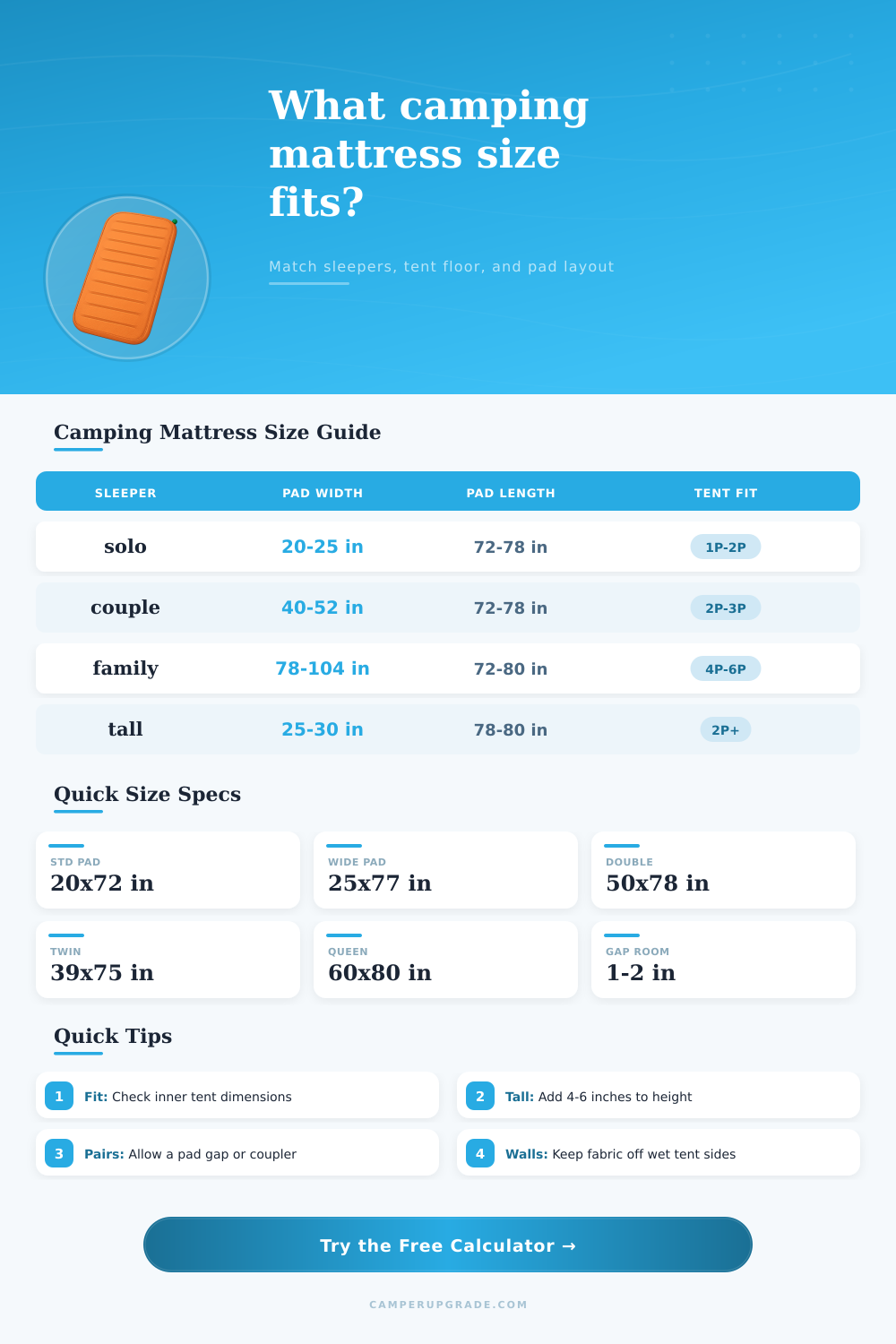
| Pad Type | Common Size | Best For | Fit Note |
|---|---|---|---|
| Regular mummy pad | 20 x 72 in | Solo backpacking | Most 1P tents |
| Regular wide pad | 25 x 72 in | Side sleepers | Check 1P width |
| Long wide pad | 25 x 77 in | Tall sleepers | Needs longer floor |
| Double pad | 50 x 78 in | Couples | Usually 2P wide |
| Queen air bed | 60 x 80 in | Car camping | Often 4P+ tents |
| Tent Class | Typical Floor | Pad Layout | Comfort |
|---|---|---|---|
| 1P backpacking | 28 x 84 in | One 20-25 in pad | Tight |
| 2P backpacking | 50 x 88 in | Two 20 in pads | Close |
| Roomy 2P | 54 x 90 in | Two 25 in pads | Normal |
| 3P tent | 70 x 90 in | Double plus gear | Roomy |
| 4P cabin | 96 x 84 in | Queen or 4 pads | Varies |
| Mattress | Width | Length | Camping Use |
|---|---|---|---|
| Camp twin | 30-39 in | 72-75 in | Cot or single air bed |
| Twin XL | 38-39 in | 80 in | Tall single car camp |
| Full | 53-54 in | 75 in | Compact couple bed |
| Queen | 60 in | 80 in | Common air mattress |
| King | 76 in | 80 in | Large cabin tents only |
| Sleeper Need | Add Width | Add Length | Reason |
|---|---|---|---|
| Back sleeper | 2-4 in | 4 in | Basic movement |
| Side sleeper | 5-7 in | 5 in | Knees and elbows |
| Active sleeper | 7-10 in | 6 in | Turning room |
| Winter bag | 4-8 in | 6-8 in | Loft and clothing |
| Couple shared | 8-14 in | 5 in | Shared movement |
💡Camping Mattress Sizing Tips
When you are choosing a sleeping pad for use within a sleeping tent, you must consider both the dimension of the tent and the dimensions of the sleeping pad. If a sleeping pad is too wide for the tent, the sleeping pad will press against the tent wall. The sleeping pad pressing against the tent wall will create problems for the sleeping pad and the sleeping individual who utilizes the sleeping pad.
If the sleeping pad against the tent walls cause the tent walls to touch the sleeping bag, condensation from the tent walls may be transferred to the sleeping bag. This moisture within the sleeping bag may make the sleeping bag damp, and feeling cold within the sleeping bag may result. Thus, there must be a buffer between the sleeping pad and the tent walls to avoid these problem.
Choose the Right Size Sleeping Pad for Your Tent
The dimensions of the tent that you should consider are it’s floor dimensions. The manufacturers of the tents often advertise the floor dimensions, but the dimensions advertised are typically not the same as the area that can be used by the sleeping individual within the tent. The difference between the tent floor dimension is that many sleeping tents has sloped walls that curve towards the sleeping individual.
Additionally, the thickness of a sleeping pad can have an impact on how much usable area is within the tent. Thick sleeping pads take up more space within the tent than thin sleeping pads. A thick sleeping pad will hit the walls of the tent more often than with a thin sleeping pad.
Thus, the thick sleeping pad will reduce the area within the tent that the sleeping individual can use. The thickness of the sleeping pad should of been considered when determining if the sleeping pad will fit within the tent. The sleeping style of the sleeping individual may also impact the width of the sleeping pad that should be purchased.
Individuals that sleep on their back (back sleepers) may require a sleeping pad that is only of a narrow width. When sleeping on their backs, an individual’s limbs tend to remain in a centered position. Individuals that sleep on their sides (side sleepers) may require sleeping pads that is wider.
When sleeping on their sides, an individual’s limbs extend outwards from the body. Additionally, individuals that are known to be active during the sleep period may require sleeping pads that are of a wider dimension than an individual that is not often active while sleeping. An active sleeping individual will require a sleeping pad that is wide enough to avoid sliding off of the sleeping pad into the ground.
Another consideration of the sleeping pad is if those who are to sleep within the tent will be utilizing sleeping pads together. If two individuals will be sleeping within the same sleeping tent, it is possible to utilize two separate sleeping pads. In this situation, it is also necessary to consider the gap between the two sleeping pads.
A sleeping pad gap allows for the sleeping individual to have breathing room within the sleeping tent. However, if the sleeping pads are separate, the sleeping pads may slide apart from each other. If the sleeping pads slide apart, there will be a gap in the air between the sleeping individual and there sleeping partner.
Methods of preventing the sleeping pads from sliding apart may be the use of couplers between each sleeping pad, or the use of a single large sleeping mattress. In this case, the sleeping mattress may not be designed to fit within the tent. Mattresses that are too large for the sleeping tent may create discomfort within those who sleep on the sleeping bag due to the potential for the sleeping bag to bunch at the sleeping individual.
In addition to the consideration of the sleeping pads that may be utilized within the tent, it is also important to consider the total footprint that the sleeping pads will take up within the tent. The total footprint of the sleeping pads will leave remaining area within the tent for other sleeping individual’s gear. The total footprint of the sleeping pads will determine how much space within the sleeping tent will be left for the bags and boots of the sleeping individual.
If the sleeping pads take up too much of the sleeping tent, there will not be enough space for the sleeping individual’s gear. Thus, ensuring that the sleeping pads are of the correct dimensions for the sleeping individual, and accounting for the sleeping individual’s sleeping style and sleeping partner will ensure that there is enough space for the sleeping individual’s gear.