Camping Lumens Needed Calculator
Estimate lantern and headlamp output from campsite area, task lux, distance, beam angle, reflector brightness, diffuser loss, battery reserve, and runtime.
🏕Camping Light Presets
⚙Area, Task, Distance, and Reflectance Inputs
This calculator estimates practical lighting output for camping visibility. Keep tent lighting cool-running, avoid shining bright beams into neighboring sites, and follow campground lighting rules where posted.
📐Formula Cards
Raw useful lumens equal target area in square meters multiplied by the task lux target.
Rated lumens account for beam efficiency, diffuser loss, color mode, and dark-surface reflectance.
Headlamp beam diameter is estimated from distance and beam angle when cone mode is selected.
Energy estimate divides lumens by LED lumens-per-watt, then multiplies by runtime and reserve.
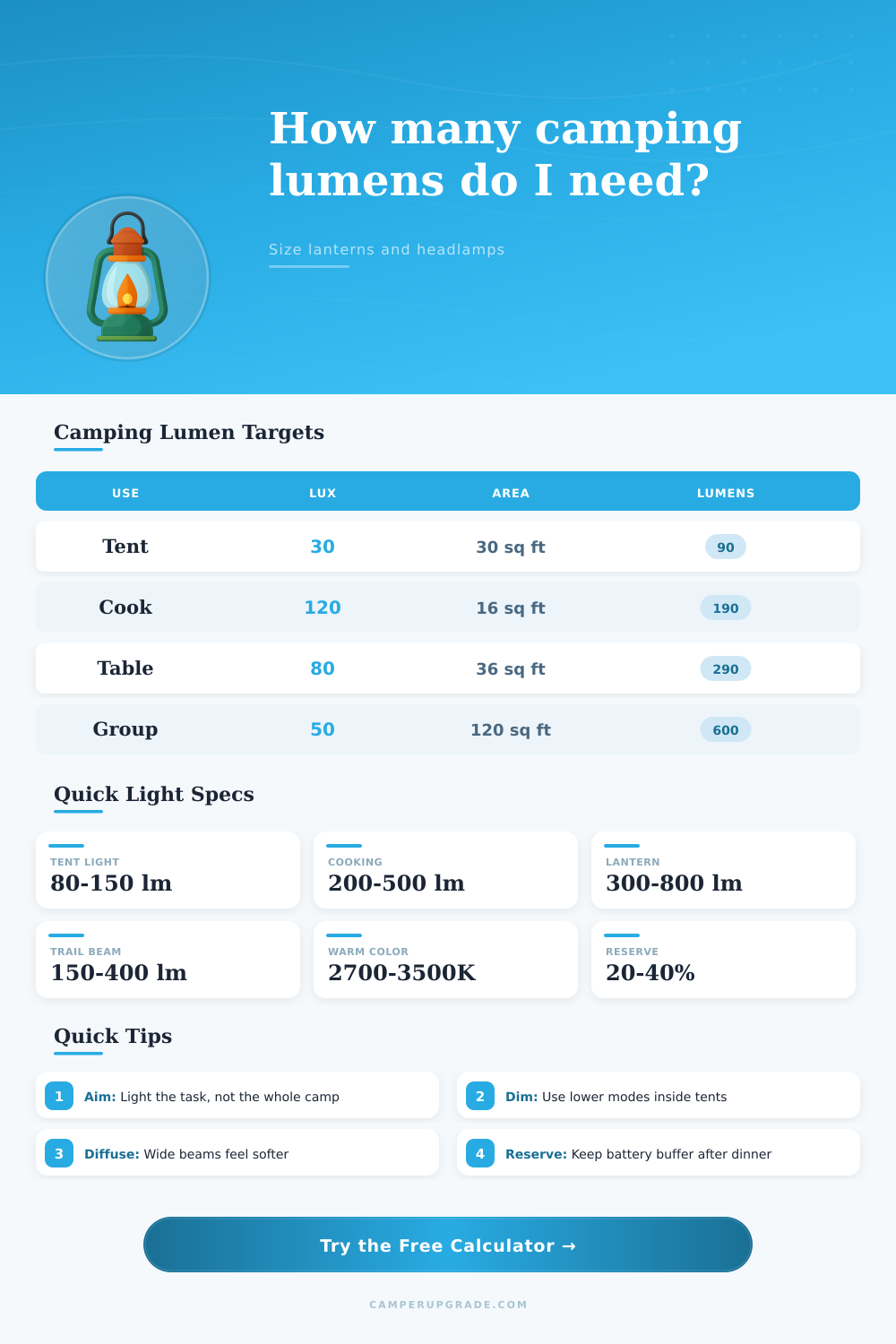
🔦Lantern and Headlamp Spec Grid
📊Lumen Reference Tables
| Camping use | Target lux | Typical area | Useful lumens |
|---|---|---|---|
| Sleep area glow | 5-15 lux | 20-40 sq ft | 10-60 lm |
| Tent sorting | 20-50 lux | 25-50 sq ft | 50-230 lm |
| Picnic table meal | 60-100 lux | 24-40 sq ft | 135-370 lm |
| Cooking and stove | 100-180 lux | 12-25 sq ft | 110-420 lm |
| Repair or first aid | 150-300 lux | 4-12 sq ft | 55-335 lm |
| Reflectance | Example surface | Factor | Effect |
|---|---|---|---|
| High | White tent wall | 0.82 | Needs less output |
| Medium high | Light tarp or sand | 0.65 | Good bounce |
| Mixed | Normal campsite | 0.48 | Balanced default |
| Low | Dirt, bark, wet ground | 0.32 | Needs more output |
| Very low | Black fabric or rock | 0.18 | Use task light |
| Beam type | Efficiency | Best use | Watch for |
|---|---|---|---|
| 360 lantern | 55% | Tent and table | Wasted upward light |
| Wide flood | 70% | Cooking and canopy | Glare near eyes |
| Medium beam | 82% | Walking and tasks | Less side light |
| Spot beam | 90% | Trail distance | Narrow workspace |
| String lights | 60% | Even low glow | Lower task lux |
| Battery plan | Runtime | Reserve | Good for |
|---|---|---|---|
| Short dinner | 2-3 hr | 15% | Developed sites |
| Normal camp | 4-6 hr | 25% | Weekend trips |
| Cold night | 6-8 hr | 40% | Shoulder season |
| Remote camp | 8-12 hr | 60% | Backup margin |
| Tent low mode | 20 hr plus | 25% | Overnight access |
💡Calculation Tips
When you are considering camping lights, it is possible that the rating of lumens that is provided for that product will differ from the brightness of the light that you experience in a dark environment. The lumen ratings provides a measurement of the total amount of light that is emitted from the camping light. However, lumens does not provide a measurement of how much of that light reaches a specific surface.
In order to determine the amount of light that a camping light should provide, it is first necesary to consider the size of the areas that the camping light should lit, the distance that the camping light should travel to the task to be performed, and the reflectance of the surfaces within that area. By only considering the lumen rating of camping lights, it is possible that an individual may purchase a camping light that does not provide enough brightness to meet the needs of the individual. The lux measurement is different than the lumen measurement because the lux measurement provides a measurement of the amount of light that reaches a specific surface in an area.
How to Choose the Right Camping Light
For these calculations, it is possible to use a calculator that will ask for the dimensions of the area that is to be illuminated, as well as the brightness level that is to be provided to those areas. Many individuals who purchase camping lights only consider the total lumen output that will be emitted from that camping light. However, the total lumen output does not consider how the light will spread from the camping light to the surface underneath the camping light.
The reflectance of the surfaces within the camping area will impact the brightness of the camping areas. For instance, a tent with white walls will reflect more light into the tent than a tent with dark walls. Because of this, an individual will need to purchase camping lights with a higher lumen measurement if they wish to camp within a tent with dark walls or if camping on a dark surface like dirt.
An individual can adjust for these differences in reflectance by considering the color of the ground in which the camping light will be used; light colors like sand will reflect more light than dark colors like pine needles. The beam pattern that a camping light utilizes will affect the distribution of the lumens that are emitted from that camping light. For instance, camping lights with wide flood beams will emit a great amount of light in a variety of directions.
Because of this, camping lights with wide flood beams may be less efficient in providing light to the task that is to be performed. Camping lights with tight spot beams will emit most of their lumens in one specific direction, but the rest of the camping area may appear to be in the dark. These two examples of camping lights can be compared to one another to determine which camping light will be more effective in meeting the camping needs of an individual.
Finally, the distance that the light from the camping light reaches the task that is to be performed will impact the brightness of the task. For instance, if the camping light is placed three feet away from a camping task but moved to six feet away, the brightness of that task will significantly decrease. Thus, the distance between the camping light and the task can be accounted for when purchasing camping lights; the farther that the camping task is from the camping light, the higher the lumen measurement that is required for the camping light.
Many people may choose to mount their camping lights high up for convenience. However, if you mount your camping light high up, you will need more lumens to provide the same amount of brightness at the dining table. The features of diffusers and color modes also play a role in the brightness of your camping lights.
Camping lights often have diffusers, such as frosted globes or cloth shades, to diffuse the light and make it soft on the eyes. However, the downside to diffusers is that they will reduce the amount of light that comes off the camping light. Furthermore, warm color temperatures may be more pleasing to the eyes when performing various camping tasks.
However, the warm color temperatures will appear dimmer to the eyes compared to neutral colors with the same lumen ratings. By calculating the brightness that you need for your camping tasks, you can decide whether you would like the comfort of a diffuser or the brightness that a neutral camping light could provide. Once you have determined how many lumens you need from your camping light, you must plan your batteries.
Camping light batteries will last for a certain amount of time at a given brightness level. However, if the camping light is exposed to cold weather, the batteries will not last as long. Furthermore, you can plan your camping light batteries to include a reserve.
This is to provide for extra light after dinner to search for items or pack up camping equipment. By using both the runtime and reserve settings, you can calculate how many batteries you will need and ensure that you do not wake up in the middle of the night without any light. Many people often make the mistake of thinking that their entire camping site is one big area that their camping lights will have to illuminate.
However, the camping site is divided into multiple different zones. For instance, a single camping light may illuminate the picnic table but not the entrance to the tent. By using camping lights of different strengths and ranges, you may require less light if you use a low light for a large area and one that is focused for certain tasks.
By considering the various zones on the camping site, you will have a better idea of how many lumens to purchase to ensure that you do not buy one extremely bright camping light to try to brighten up the entire camping site. Depending on the tasks that you will be performing at the camping site, you may require a different amount of brightness. For instance, you may require alot of brightness to read the map but require less for talking to friends.
Brightness is also required for camping tasks like cooking but not for the remainder of the camping area. By recognizing the various camping tasks, you can avoid trying to purchase a camping light that can perform all tasks at the same time and instead buy the appropriate amount of brightness for each task. The goal of camping lights is to provide enough light for tasks but not too much that it drains the batteries too quickly.
You want to have enough light for your camping tasks and enough battery reserve to ensure that you do not have to use all of your batteries for the camping tasks. You can find this balance by considering the ground, distance, and the way in which you will use the camping light.