Camping Cot Weight Capacity Calculator
Check whether a camping cot has enough usable capacity for occupant weight, sleep gear, stored items, sitting or entry loads, frame material, leg layout, ground support, and safety margin.
🏕Camping Cot Load Presets
⚙Occupant, Gear, Dynamic Load, and Frame Inputs
This tool compares expected static load, dynamic load, adjusted usable rating, margin, load per leg, and bed load density. Always follow the cot maker's official rating and inspection guidance.
🧮Formula Cards Used by the Calculator
Base load
Occupant weight, sleep system, and stored items are added to find the static cot load before movement.
Movement multiplier
The static load is multiplied by the selected sleeping, shifting, sitting, entry, or drop factor.
Adjusted rating
Rated capacity is reduced by frame condition, ground support, material reserve, and chosen safety margin.
Support load
Dynamic load is divided by effective support feet, then adjusted for off-center loading.
🛏Cot Material and Specification Grid
📊Weight Capacity and Reference Tables
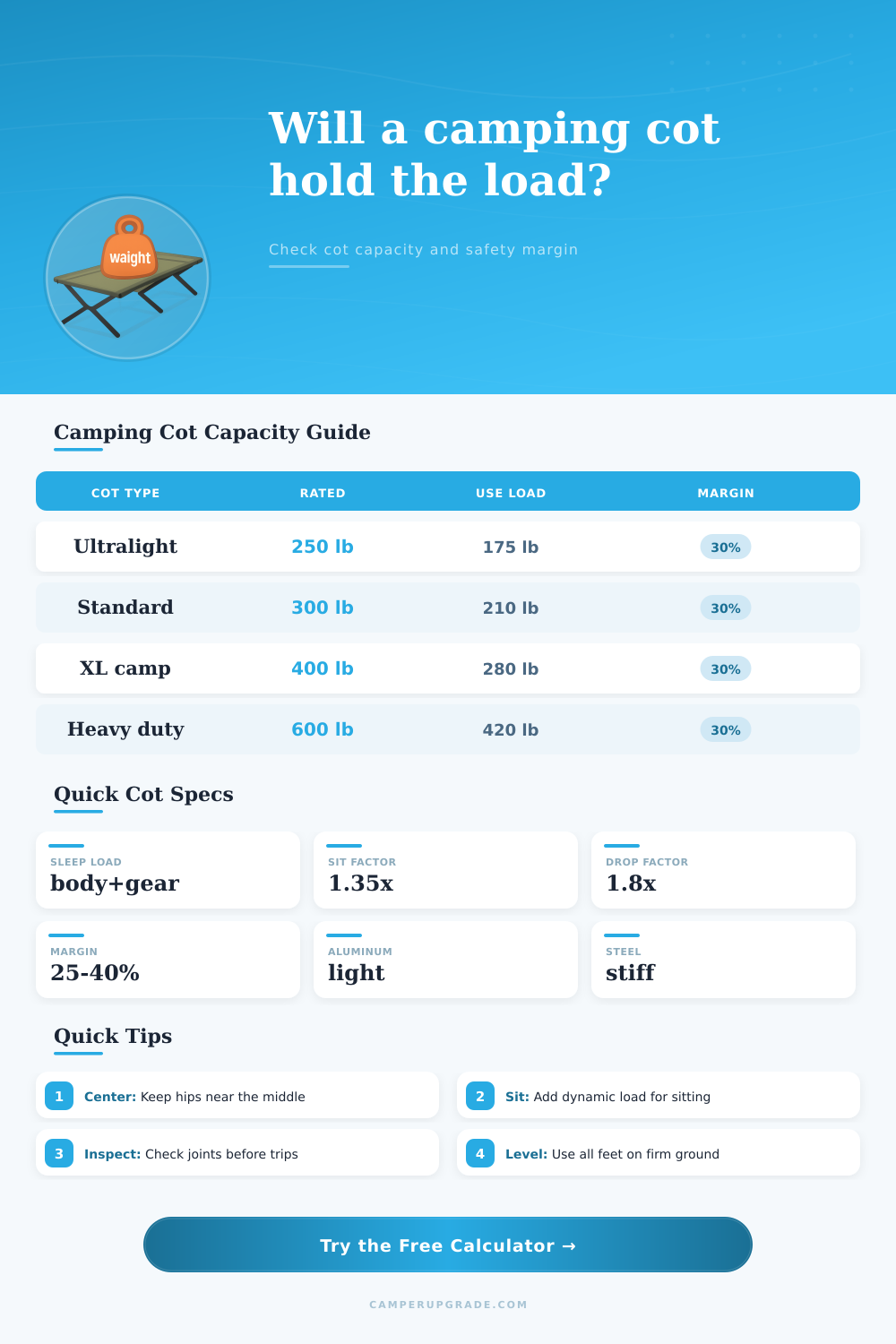
| Cot Class | Typical Rating | 25% Usable | Best Match |
|---|---|---|---|
| Ultralight | 220-275 lb | 165-206 lb | Backpacking |
| Standard | 280-325 lb | 210-244 lb | Car camp |
| XL camp | 350-450 lb | 263-338 lb | Tall sleepers |
| Heavy duty | 500-600 lb | 375-450 lb | Base camp |
| Activity | Factor | Example | Use When |
|---|---|---|---|
| Still sleep | 1.05x | 210 lb | Quiet rest |
| Turning | 1.20x | 240 lb | Night shifts |
| Edge sit | 1.35x | 270 lb | Putting boots on |
| Drop load | 1.80x | 360 lb | Hard entry |
| Frame | Reserve | Watch Point | Trip Use |
|---|---|---|---|
| Aluminum | 0.96x | Dents | Packable |
| Steel | 1.00x | Rust | Car camp |
| Aircraft Al | 1.03x | Joints | Premium |
| Plastic hinge | 0.88x | Cracks | Light use |
| Leg Count | 300 lb Load | 400 lb Load | Note |
|---|---|---|---|
| 4 feet | 75 lb/ft | 100 lb/ft | Needs level |
| 6 feet | 50 lb/ft | 67 lb/ft | Common |
| 8 feet | 38 lb/ft | 50 lb/ft | Stable |
| 12 feet | 25 lb/ft | 33 lb/ft | Bunk rail |
💡Cot Capacity Tips
A camping cot have a maximum weight capacity, but a camping cot can fail if you dont understand the impact of weight on camping cot performance. Many individual believe that there weight must be less than the camping cot’s rated capacity. The manufacturer’s rated capacity is the static weight capacity of the camping cot.
This means the camping cot is measured in a perfectly still environment. In the real world, camping are not static. When you are on the sleeping cot, you move.
How Weight and Gear Affect a Camping Cot
When you are in your sleeping bag, you may roll over while sleeping. These activity apply a dynamic force to the camping cot that exceed your resting weight. This dynamic force create a momentary spike in the weight that is placed upon the frame of the sleeping cot.
This spike in the weight upon the camping cot frame can place extra load upon the camping cots joint. In addition to the weight of your body, there is the weight of your gear. When camping, a person do not lie upon a camping cot alone.
A sleeping bag and a foam pad may sit upon the camping cot as well as the persons clothing. Twenty or thirty pound of gear can add twenty or thirty pounds to the camping cot’s load. If a camping cot has a maximum weight of 200 pounds, and you and your gear weigh 190 pounds, you are close to the camping cot’s maximum load.
The weight of your camping gear can cause the camping cot to failing. To determine the total weight of the camping cot, you must add the weight of your body to the camping gear that you bring. The material of a camping cot’s frame determine how much weight it can support.
Camping cots with steel frames can support more weight then camping cots with aluminum frames. Steel is a very stiff material; aluminum frames are lighter and easier to transport but can flex under heavy use. The metal tube that make up a camping cot frame may dent from use on rocky terrain or soft sand.
When aluminum frames dent, the user will compromise their structural integrity. A dented aluminum tube cannot support as much weight as a straight aluminum tube. Camping cot frames’ manufacturing material impact the total weight that a camping cot can support.
The terrain upon which you place your camping cot can also impact its stability. If you place your camping cot upon a flat and hard surface, the weight will be distributed evenly upon the leg of the cot. However, if camping on rocky terrain or soft sand, the legs of the camping cot will not be level with one another.
If a camping cot leg sink into sand or rests upon a rock, the weight is not distributed evenly upon the camping cot. The camping cot will be subjected to more weight upon its hinge or welds which could result in the camping cot failing. Finally, when choosing a camping cot, allow for a safety margin.
A camping cot may have a weight limit of 200 pounds. This does not mean that a person should only ever sleep on a camping cot that weigh 200 pounds or less. The safety margin allow for dynamic load calculations, the weight of camping gear, the natural wear and tear of the cots fabric, and its metal frame.
When a camping cot has a safety margin built into its weight capacity, it will be able to support the sleeping person and their gear even when sleep upon the camping cot.