Camping Cooler Dry Ice Calculator
Estimate dry ice pounds, frozen hold time, carbon dioxide release, and cooler space for frozen food, meat, fish, and remote camp resupply planning.
🏕Dry Ice Camping Presets
⚙Dry Ice And Cooler Inputs
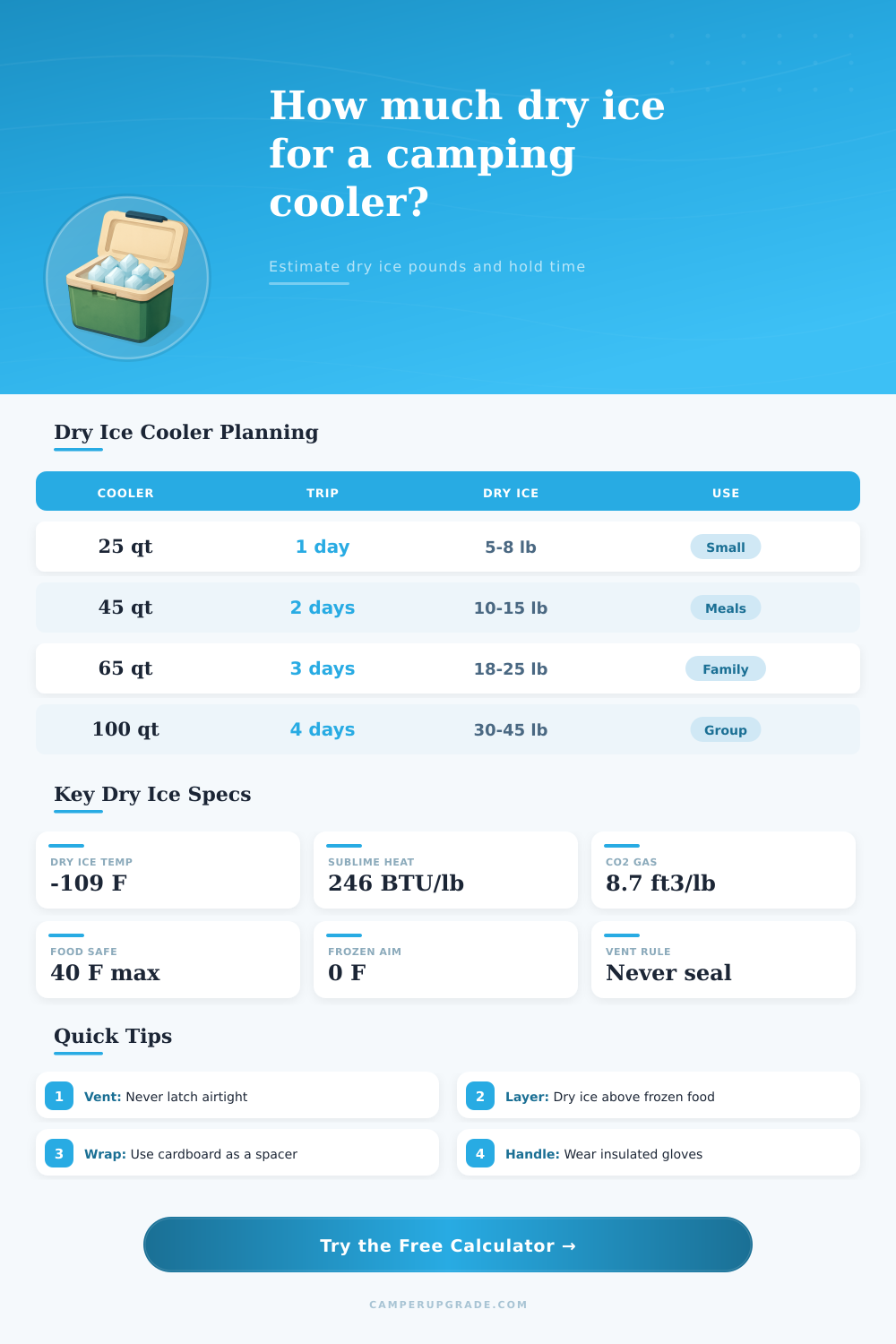
Dry ice is frozen carbon dioxide at -109.3°F. This model uses about 246 BTU per pound of sublimation energy, estimated cooler heat gain, warm-load cooling, venting losses, and packed dry ice density. Use ventilation and insulated gloves.
🧊Dry Ice And Cooler Spec Comparison
📊Dry Ice Sublimation And Cooler Reference Tables
| Cooler Size | 1 Day | 2 Days | 3 Days |
|---|---|---|---|
| 20 to 30 qt | 5 to 8 lb | 8 to 12 lb | 12 to 18 lb |
| 40 to 55 qt | 8 to 12 lb | 12 to 20 lb | 20 to 30 lb |
| 60 to 75 qt | 12 to 18 lb | 18 to 28 lb | 28 to 42 lb |
| 90 to 110 qt | 18 to 28 lb | 30 to 45 lb | 45 to 65 lb |
| 120 qt plus | 25 to 40 lb | 45 to 70 lb | 70 to 100 lb |
| Dry Ice Format | Bulk Density | Sublimation | Best Cooler Use |
|---|---|---|---|
| Large slab | 1.6 lb/qt | Slowest | Top layer freezer hold |
| Wrapped block | 1.5 lb/qt | Slow | Meat and fish transport |
| Thin slices | 1.3 lb/qt | Medium | Between cartons |
| Pellets | 1.0 lb/qt | Fast | Fast chill, short use |
| Block plus pellets | 1.35 lb/qt | Balanced | Fill gaps around load |
| Reference Value | Imperial | Metric | Calculator Use |
|---|---|---|---|
| Dry ice temp | -109.3°F | -78.5°C | Cold source limit |
| Sublimation heat | 246 BTU/lb | 571 kJ/kg | Cooling reserve |
| CO2 gas yield | 8.7 ft³/lb | 541 L/kg | Ventilation load |
| Solid density | 97 lb/ft³ | 1.56 g/cm³ | Block reference |
| Food frozen target | 0 to 20°F | -18 to -7°C | Hold threshold |
| Cooler Class | Wall Range | Heat Gain | Dry Ice Note |
|---|---|---|---|
| Soft insulated | 0.5 to 1 in | High | Short backup only |
| Basic hard | 1 to 1.5 in | Moderate high | Add more buffer |
| Marine cooler | 1.5 to 2 in | Moderate | Good weekend use |
| Rotomolded | 2 to 3 in | Low | Best camping fit |
| Expedition | 2.5 to 3 in | Very low | Long base camp |
🧭Dry Ice Planning Tips
Dry ice are a tool that can be used to keep food frozen. Dry ice is different than regular ice in that dry ice dont melt. Regular ice melt into liquid form of water.
Dry ice, on the other hand, is frozen carbon dioxide that can turn direct into a gas. Dry ice can reach temperatures of -109 degrees Fahrenheit. Because of the cold temperature of dry ice, it can quickly freezes food.
How to Use Dry Ice to Keep Food Frozen
However, if you places dry ice directly against food, it can cause freezer burn. A buffer should be placed between food and the dry ice. Such a buffer could be cardboard or a thick towel.
The buffer will allow the dry ice to not come in contact with the food direct. The buffer will additionally prevent the food from experiencing freezer burns. The cooler that is used to transport the dry ice will have an impact on how long the dry ice lasts.
Coolers with thick walls will have more insulation then coolers with thin walls. Coolers with thick walls will be able to keep the cold air within the cooler for a longer period of times. Soft-sided coolers will have less insulation then hard-sided coolers.
Thus, dry ice will sublime more quick within a soft-sided cooler. Additionally, the placement of the dry ice within the cooler will also impact the length of time that the dry ice will last. Carbon dioxide gas are heavier than warm air.
Thus, if you places the dry ice at the bottom of the cooler, the carbon dioxide gas will sink to the bottom of the cooler. To counteract this, the dry ice should be placed on the top of the foods within the cooler. This placement will allow the carbon dioxide gas to sink down towards the food, while also creating an environment that is conducive to the efficiency of the cooling process.
In addition to the factors discussed thus far that will impact the length of time that dry ice will last, it is also necessary to consider the safety of use dry ice. Dry ice will produce carbon dioxide gas as it sublimes. If an airtight latch seals the cooler, the carbon dioxide gas will build up within the cooler.
This buildup of carbon dioxide gas can lead to the cooler or its lid popping off. To avoid such an outcome, you should not use an airtight lid for the cooler. One alternative is to use a lid that isnt airtight or to leave the drain plug of the cooler open.
Allowing the carbon dioxide gas to escape from the cooler will ensure the safety of those who is using the cooler, even though warm air will enter the cooler as a result. The other factor that can impact the length of time that dry ice will last are the number of times that the cooler is opened. Each time someone opens the coolers lid, warm air will enter the cooler, and carbon dioxide gas will exit the cooler.
The more times that the cooler’s lid is opened, the more faster that the dry ice will sublime. To prevent food from spoiling within the cooler, an extra amount of dry ice should be provided. If the cooler is exposed to warm air, the dry ice will sublime at a faster rate then expected.
To ensure that the food remains frozen throughout the trip, you should of packed more dry ice than is necessary into the cooler.