Camping Clothing Weight Calculator
Estimate packed clothing weight, worn-layer weight, trip-day efficiency, and pack share from real camping apparel items, fabrics, weather exposure, and reuse plans.
Clothing Weight Results
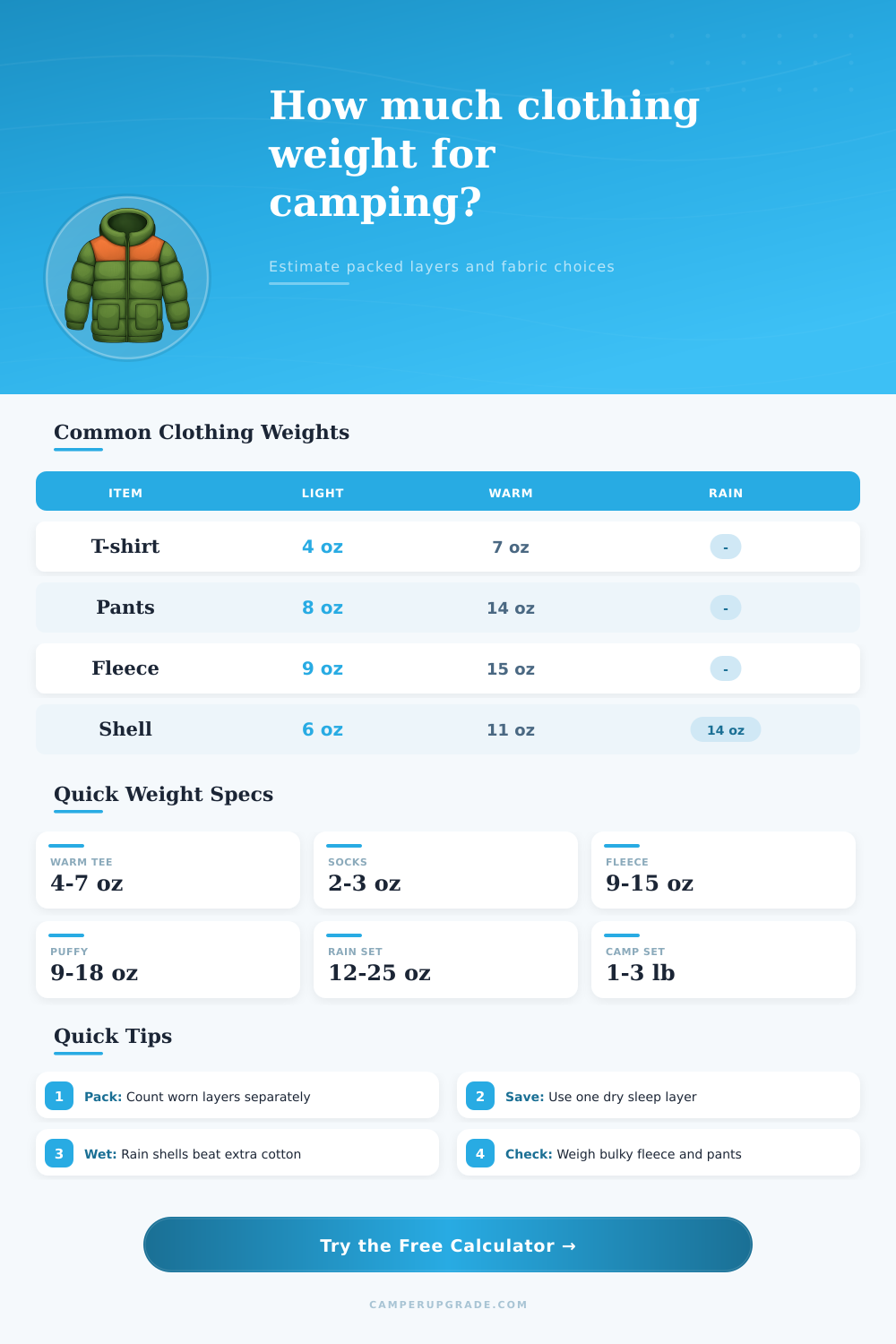
| Base or next-to-skin item | Typical light weight | Warm or merino weight | Calculator use |
|---|---|---|---|
| Short-sleeve synthetic shirt | 3.5 to 5 oz / 99 to 142 g | Merino tee 5 to 7 oz / 142 to 198 g | Main packed top count |
| Long-sleeve sun hoodie | 5 to 8 oz / 142 to 227 g | Heavier knit 8 to 10 oz / 227 to 283 g | Fabric choice: sun hoodie |
| Base-layer bottoms | 5 to 7 oz / 142 to 198 g | Warm tights 7 to 10 oz / 198 to 283 g | Sleep set or cold bottom layer |
| Underwear brief or boxer brief | 1.5 to 2.5 oz / 43 to 71 g | Merino 2 to 3 oz / 57 to 85 g | Underwear pair count |
| Hiking sock pair | 2 to 2.8 oz / 57 to 79 g | Cold sock 3 to 4.5 oz / 85 to 128 g | Sock pair count |
| Warmth layer | Lightweight range | Warmer range | Good camping use |
|---|---|---|---|
| Grid fleece or alpha midlayer | 7 to 10 oz / 198 to 283 g | 10 to 12 oz / 283 to 340 g | Cool hiking and active insulation |
| Standard fleece hoodie | 11 to 15 oz / 312 to 425 g | 16 to 22 oz / 454 to 624 g | Car camp or cold evenings |
| Ultralight puffy jacket | 8 to 12 oz / 227 to 340 g | 12 to 16 oz / 340 to 454 g | Three-season camp insulation |
| Warm puffy jacket | 16 to 22 oz / 454 to 624 g | 22 to 32 oz / 624 to 907 g | Alpine shoulder season |
| Winter parka | 32 to 48 oz / 907 to 1361 g | 48 oz+ / 1361 g+ | Stationary cold-weather camp |
| Rain, wind, and shell item | Common weight | Heavier durable weight | When it matters |
|---|---|---|---|
| Wind shirt | 2.5 to 5 oz / 71 to 142 g | 5 to 7 oz / 142 to 198 g | Dry wind, bugs, cool starts |
| Rain jacket | 6 to 10 oz / 170 to 283 g | 11 to 16 oz / 312 to 454 g | Rain, wet brush, exposed ridges |
| Rain pants or kilt | 4 to 8 oz / 113 to 227 g | 9 to 14 oz / 255 to 397 g | Cold rain or wet campsites |
| Full rain set | 10 to 18 oz / 283 to 510 g | 20 to 30 oz / 567 to 850 g | Extended wet forecasts |
| Softshell pants | 12 to 18 oz / 340 to 510 g | 19 to 28 oz / 539 to 794 g | Cold wind, climbing, snow travel |
| Trip clothing strategy | Typical packed clothing | What is usually worn | Weight check target |
|---|---|---|---|
| Summer weekend campground | 2 to 4 lb / 0.9 to 1.8 kg | Shirt, shorts or pants, socks | Comfort beats shaving every ounce |
| Three-season backpacking | 1.5 to 3.5 lb / 0.7 to 1.6 kg | Hiking shirt, pants, socks | Keep packed clothing under 15% of pack |
| Wet canoe or coast trip | 3 to 6 lb / 1.4 to 2.7 kg | Wet travel layer or rain shell | Protect one dry sleep set |
| Alpine shoulder season | 3 to 6.5 lb / 1.4 to 2.9 kg | Base top, pants, fleece | Prioritize warmth per ounce |
| Winter cabin or base camp | 6 to 12 lb / 2.7 to 5.4 kg | Warm base and insulation | Bulky fleece and spare pants add fast |
Clothing weight is one of the most important factor to consider in terms of the total weight of a persons pack. People often assume that clothing isnt as important as other aspect of a hiking or backpacking trip, but clothing can add to the total weight of a persons pack. The weight of clothing can increase if a person pack too much clothing or if the clothing gets wet during there trip.
The weight of wet clothing is more than dry clothing. Additionally, wet clothing can make the clothing take up more space within the backpack. Thus, people must plan their clothing so as to not add unnecessary weight to their backpack.
How Clothing Adds Weight to Your Backpack
The type of clothing that a person pick will dictate the weight that their clothing will add to their backpack. Synthetics is the lightest of the fabrics and dry the most quickest. Merino wool is the heavier of the two fabrics yet it manages odors more better.
Merino wool also retains its warming property even when wet. People have to choose between the low weight of synthetics and the odor resistance of merino wool. Many people dont realize this when they pack too many synthetic as they could of had one merino wool piece that would last them for several day.
People must distinguish between the clothing that they are wearing versus the clothing that they are packing. The clothing that they are wearing do not add to the total weight that they are carrying whilst wearing them. However, if they pack the clothing into the backpack, then it does add to their total weight.
A person may feel as if they are wearing light clothing such as a fleece and an rain shell. However, when they pack these item into their backpack the weight of their backpack increases. People have to consider all of the the clothing that they are wearing and packing so that they can understand the total weight of their bodys systems.
The weather and the moisture that a person encounter will play a huge role in the weight of their clothing and their body temperature. If the weather is dry, they can pack less clothing. However, if the weather is wet, they will need to pack more clothing.
Wet clothing will add more weight to a person than dry clothing. Additionally, wet clothing will remove more heat from the body. For these reason, people need to have a dedicated dry sleep layer for their body.
A dedicated dry sleep layer for the body is a set of clothing that is kept inside of the sleeping bag. Thus, the clothing will remain dry and can be used to reset the body temperature each night when they wake up. People should attempt to keep the weight of their clothing to a small percentage of the total weight of their pack.
If a person find that their clothing is contributing to twenty percent of their total weight, they are likely carrying too much clothing. People often pack a fresh outfit for each day of their trip. However, when using a reuse strategy with fabrics that do not readily pick up smell, people can reduce the total weight of their clothing and the amount of clothing that they have to pack for their trip.
Insulation for the body is another aspect of clothing that people should consider. A person uses a grid fleece for movement yet they will need a puffy jacket for the warmth when they are not moving. Down and synthetic fill will retain warmth at a low weight for the person.
An ultralight puffy will be needed instead of a heavy parka for the trip. A reference table can help people to determine the weight of each item of clothing that they is considering for their trip. Accessories for the clothing such as hats, gloves, and buffs are small in weight.
However, they are still important to the regulation of body temperature. A beanie is small in weight yet can provide warmth to the body in cold weather. These accessory should also be considered in terms of their weight.
People want to have the most warmth from their clothing with the least amount of weight. In planning out their clothing, people should use the process of subtraction. They should start with all of the clothing that they may need and then remove the clothing items that do not have a dual-purpose.
Focus on the fabric that will be used and the reuse of the clothing. If people use these strategy, the weight of their pack will be reduced. Thus, they can focus on the hiking that they will undertake rather than the weight of their pack.