Camping Carpool Cost Calculator
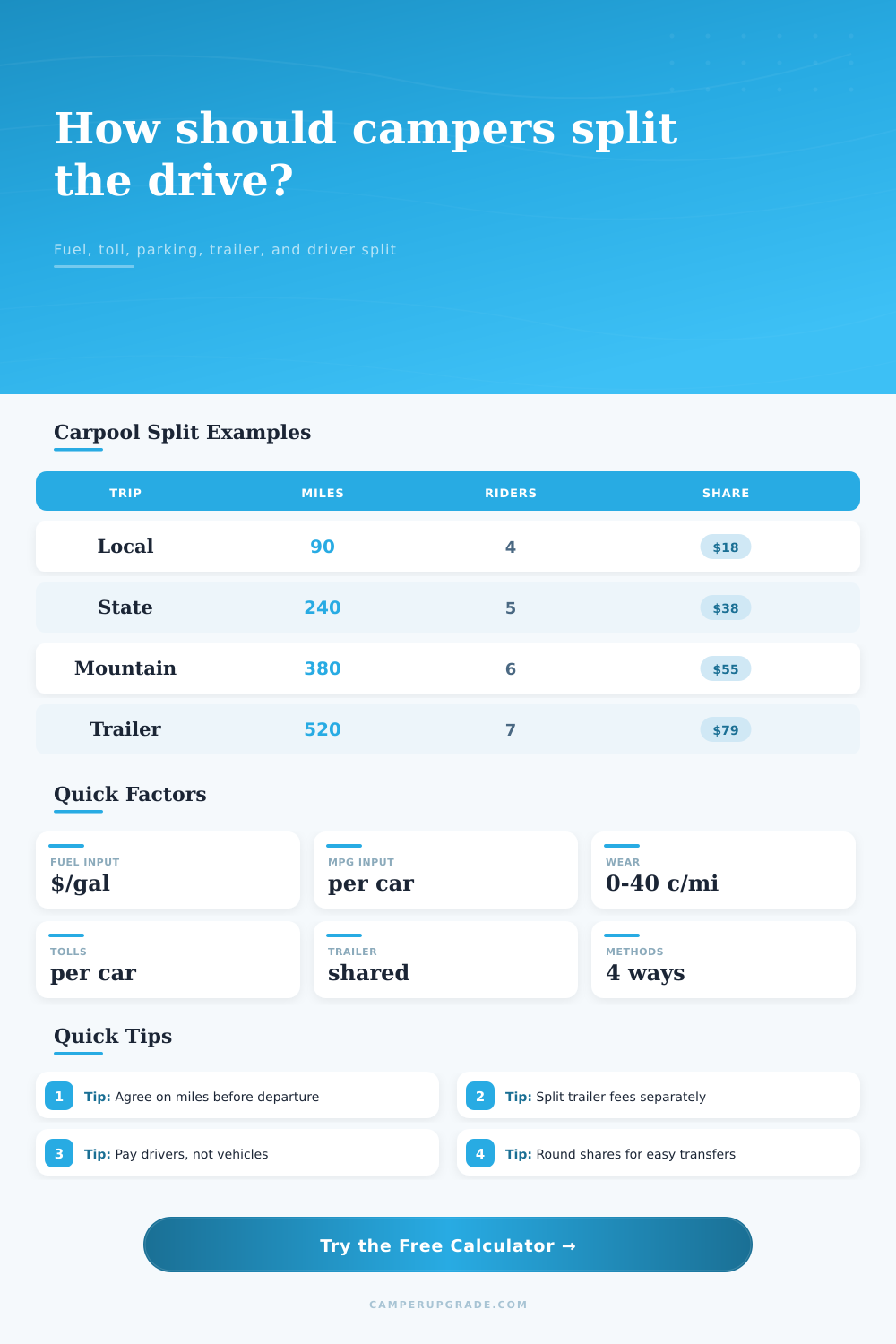
Split a campground drive by fuel, vehicle count, passengers, tolls, parking, driver wear allowance, gear trailer costs, and the reimbursement method your group agreed to use.
🚗Trip Presets
🛣Driving Inputs
💳Shared Fees And Allowances
🧮Current Split Snapshot
📊Reference Tables
| Trip type | Round-trip miles | Typical vehicles | Planning note |
|---|---|---|---|
| Nearby lake weekend | 60 to 140 miles | 1 to 2 | Parking and entry fees can outweigh tolls. |
| State park campground | 160 to 300 miles | 2 to 3 | Use loaded mpg when coolers and roof boxes are packed. |
| Mountain campground | 300 to 520 miles | 2 to 4 | Fuel use rises with grade, wind, and low-speed access roads. |
| National park or rally | 500 to 900 miles | 3 to 6 | Agree on wear allowance and driver reimbursement before departure. |
| Vehicle load | Realistic mpg adjustment | When to use | Split impact |
|---|---|---|---|
| Light carpool | Use normal highway mpg | Passengers and bags only. | Fuel stays close to map estimate. |
| Full cargo area | Reduce mpg 5% to 10% | Coolers, bins, camp chairs, and roof bag. | Fuel share rises modestly. |
| Roof box or bikes | Reduce mpg 10% to 20% | Large roof load or hitch rack in wind. | Fuel can exceed tolls on longer drives. |
| Small gear trailer | Reduce mpg 15% to 30% | Trailer plus shared group equipment. | Track trailer costs as their own pool. |
| Reimbursement method | Payers | Best fit | Watch item |
|---|---|---|---|
| Equal share across all passengers | Everyone | Friends sharing one simple trip total. | Drivers also pay their own share. |
| Riders reimburse drivers | Non-drivers | Drivers provide cars and do not chip into the pool. | Passenger count must exceed drivers. |
| Equal amount per vehicle | Vehicle teams | Each car settles internally after the group total is known. | Uneven passenger counts need a side split. |
| Equal amount per driver | Drivers | Club treasurer reimburses drivers directly. | Riders still need a collection plan. |
| Fee or allowance | Common entry | Formula role | Practical check |
|---|---|---|---|
| Fuel | Miles, mpg, price | Miles x vehicles / mpg x price. | Use round-trip distance per vehicle. |
| Tolls | Per vehicle amount | Tolls x vehicles. | Include express lanes only if agreed. |
| Parking or entry | Group total | Added once to the trip total. | Separate campsite fees from vehicle fees. |
| Driver wear | Per-mile allowance | Miles x vehicles x wear rate. | Set to zero for fuel-only carpools. |
🗺Comparison Grid
Fuel Only
LeanSplit gallons and tolls when drivers prefer a simple trip settlement with no mileage allowance.
Fuel Plus Wear
FairAdds a per-mile driver allowance for tires, maintenance, and loaded campground driving.
Trailer Pool
GearKeeps trailer rental, added fuel, or extra parking visible instead of hiding it in fuel math.
Driver Direct
CleanWorks well when an organizer collects from riders and sends equal reimbursement to each driver.
💡Carpool Split Tips
Until the person demands their cut, that’s when the ride-share backseat starts feeling more like a charity event. Two SUVs and one set of sedans stuffed with coolers, tents, and enough gear to sink a small dinghy. And it’s not just pavement; the math quickly goes rocky. That friend is pulling the kayak trailer. Yeah, they’re going to want something from this trip too. Gas prices went up closer than the shore. Toll fees increased along the drive to mountains.
Plug in your vehicles and mileage and let the Camping Carpool Cost Calculator do the math for you, because no one wants to make a wild guess at coefficients and conversions right then while everyone’s struggling to figure out how to uncross the extension cord.
How to Split Camping Costs Fairly
So, when you drive, you don’t just pay for the miles on map. You also pay for a roof box, which adds drag. And for ice chests, which add weight. And if you have a light carpool with no roof boxes and no ice chests, you get normal highway mileage. But load up those trunks, slap on that bike rack, and your gas mileage will drop by ten to twenty percent.
Why? Because gas is the largest variable. The tool adjust for this: you plug in a realistic mpg that accounts for weight that you’ll be pulling. It’s a tiny tweak, but it makes sure the guy driving isn’t unknowingly subsidizing his passengers comfort.
And what about wear and tear? That’s where things get really touchy between friends who’ve done this year after year. You can see the gas price, sure, but you don’t see oil changes or tire wear. To account for this, the calculator feature a field for a per-mile wear allowance, allowing you to place a small value on the strain the journey imposes on your chassis and engine.
Of course, you’re under no obligation to do so. Some people like to limit themselves to fuel and tolls only. If you’re driving a long distance to some far-off campsite, though, an allowance of this sort seem reasonable. It recognizes the service the driver is providing, above and beyond the act of turning the ignition.
The trailers make it even more complicated. For example, if someone is towing gear trailer for the group’s common equipment, you should of put that expense into its own pool. With this tool, you can account for trailer expenses separately from your vehicle expenses, keeping the accounts clean. Do you want to divide up the cost by everybody riding? Or just those who is using the gear? That is why every group has a different dynamic.
If you guys share a tent and cooler and everyone gets the benefit of that stuff, everyone will pay. But if it’s just the fishing team hauling it around, they’ll be the ones paying. Either way, the calculator splits it out for you. There is no arguing about it as sun goes down.
There is another sneaky catch regarding parking and admission. Many state parks are “per car” rather then “per human.” So if there are six of you and two cars, entry fees might exceed fuel on a weekend getaway. These flat rates will be included in the grand total and divided according to your preferred reimbursement plan.
You get to decide whether everyone splits the total bill evenly or whether non-driving passengers pay driving passengers back separately (the latter option works when the drivers aren’t putting money into the kitty themselves). This clears up confusion over who pays whom while keeping track of who’s paid what.
It takes some planning, but the solution is simple: Agree on the path before departing. Determine your mileage. Agree to the wear allowance. Decide how to pay it back. After that, it’s math time; the rest of the time, you can just focus on where you’re going and what song is playing next.
The goal is to arrive at the campground with friends still by your side and money still in your wallet. The calculator turns messy group spending into a simple final total, helping you do just that. It’ll keep the accounting painless so that the camping can remain fun.