🔋 Camping Battery Calculator
Calculate the battery capacity you need for your RV, camper van, or off-grid camping setup
Check each appliance you use, then adjust watts and daily hours as needed. Wh/day updates automatically.
| On | Appliance | Watts | Hours/Day | Wh/Day |
|---|---|---|---|---|
| LED Lights | — | |||
| 12V Fan | — | |||
| 12V Refrigerator | — | |||
| Phone / Tablet Charging | — | |||
| Laptop | — | |||
| TV / Monitor (12V LED) | — | |||
| CPAP Machine (no humidifier) | — | |||
| Electric Blanket / Heated Pad | — | |||
| Water Pump | — | |||
| USB Devices / Smart Chargers | — | |||
| — | ||||
| — |
Lowest upfront cost
Heavy, needs maintenance
Sealed, no maintenance
Best mid-range value
Vibration resistant
Good for rough roads
Lightweight, fast charge
Best long-term value
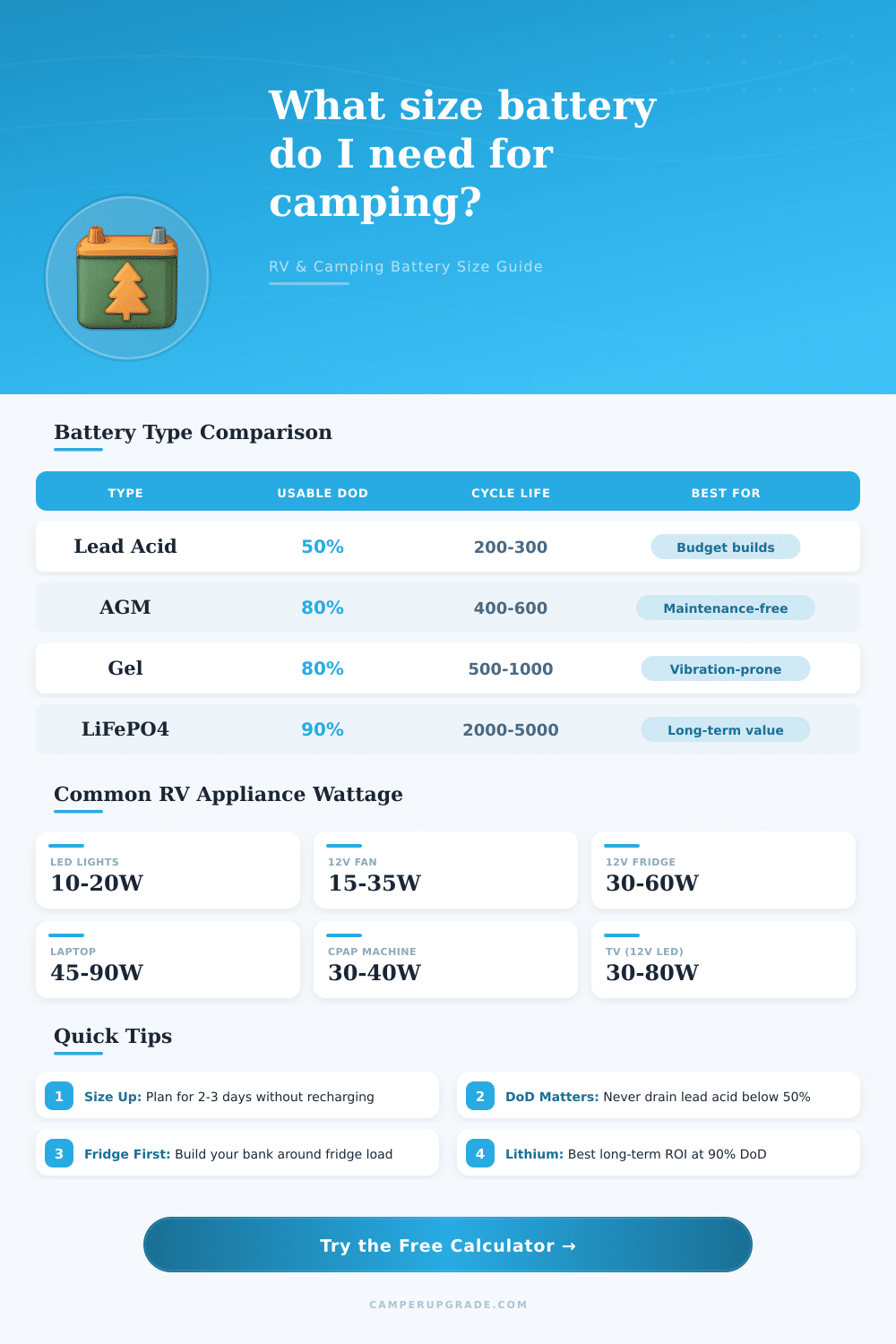
| Appliance | Typical Watts | Avg Hrs/Day | Est. Daily Wh | Notes |
|---|---|---|---|---|
| LED Lights | 10–20W | 4–6h | 50–120 Wh | Interior strip or dome lights |
| 12V Fan | 15–35W | 4–8h | 75–280 Wh | Roof vent fan or oscillating fan |
| 12V Compressor Fridge | 30–60W | 24h (cycles) | 360–720 Wh | Largest single load in most RVs |
| Phone / Tablet Charging | 10–20W | 2–3h | 20–60 Wh | Per device, varies by charger |
| Laptop | 45–90W | 3–6h | 135–540 Wh | Via 12V adapter or inverter |
| TV / LED Monitor | 30–80W | 2–4h | 60–320 Wh | 12V TVs draw much less than AC models |
| CPAP (no humidifier) | 30–40W | 7–8h | 210–320 Wh | Humidifier adds 60–100W extra |
| Electric Blanket | 45–75W | 4–6h | 180–450 Wh | 12V models draw less than AC versions |
| Water Pump | 40–80W | 0.5–1h | 20–80 Wh | Only runs while a tap is open |
| USB Hub / Smart Devices | 10–30W | 4–8h | 40–240 Wh | GPS, speakers, lights, dashcam |
| Daily Usage | 12V Raw Ah | 12V Ah (AGM 80%) | 12V Ah (Li 90%) | 24V Raw Ah |
|---|---|---|---|---|
| 200 Wh | 16.7 Ah | 20.8 Ah | 18.5 Ah | 8.3 Ah |
| 400 Wh | 33.3 Ah | 41.7 Ah | 37.0 Ah | 16.7 Ah |
| 600 Wh | 50.0 Ah | 62.5 Ah | 55.6 Ah | 25.0 Ah |
| 1,000 Wh | 83.3 Ah | 104.2 Ah | 92.6 Ah | 41.7 Ah |
| 1,500 Wh | 125.0 Ah | 156.3 Ah | 138.9 Ah | 62.5 Ah |
| 2,000 Wh | 166.7 Ah | 208.3 Ah | 185.2 Ah | 83.3 Ah |
| Bank Size | Total Wh (12V) | Usable Wh (AGM) | Usable Wh (LiFePO4) | Typical Use |
|---|---|---|---|---|
| 50 Ah | 600 Wh | 480 Wh | 540 Wh | Off-grid tent, 1 night |
| 100 Ah | 1,200 Wh | 960 Wh | 1,080 Wh | Weekend camper, basics only |
| 150 Ah | 1,800 Wh | 1,440 Wh | 1,620 Wh | Van life, 1–2 days moderate use |
| 200 Ah | 2,400 Wh | 1,920 Wh | 2,160 Wh | Full RV, 1–2 days |
| 300 Ah | 3,600 Wh | 2,880 Wh | 3,240 Wh | Off-grid extended stay |
| 400 Ah | 4,800 Wh | 3,840 Wh | 4,320 Wh | Full-time RV living |
In the heart of your camper, the battery has only one important task: it keeps everything operating. Whether you travel by van, caravan, tent or boat, that battery delivers the 12 or 24 volts that your devices require. Without a reliable source of energy you simply will stay in darkness.
The lights will not shine, the water pump will not operate, and your electronic devices will become only fancy weights.
How to Choose a Battery for Your Camper
When you choose a new battery, you have several options. Lead acid batteries are the cheapest, but they operate well only if you mostly stay in campgrounds with electrical connection. If you want something stronger, there are AGM and gel batteries that last better in difficult conditions.
And then are LiFePO4 lithium batteries; a lot of expert travellers genuinely advocate them. Lithium batteries offer more capacity in the same space, charge much more quickly and weigh almost half compared with traditional lead acid systems. This smaller weigt helps to save a bit of fuel during the journey.
Some folks favour an entirely other way: two 6-volt “deep cycle” batteries. When one binds them together to do 12 volts, one can use until 75 or 80 percent of their capacity, instead of the usual limit of 50 percent. That method is popular with owners already for almost twenty years.
The secret is to buy them as a matching pair and substitute both simultaneously, when they fail.
LiFePO4 batteries accomplish almost all needs, they are efficient, operate well with solar panels and easily fit in tight spaces. One alone lithium battery can operate a fridge, fan and all lights without any problems. Even so, there is one important detail: although lithium operates under freeze, charging it in very cold weather without protection can dammage the cells.
The most modern models already have built-in protections. Some self-heating versions require at least 800 watts of solar panels only to operate the internal heater.
Your budget certainly will affect your decision. A basic lead acid battery from a normal store, together with some used solar panels and a simple charger, will suffice for basic lights and to load your phone. But for a long time without connection, lithium batteries are better.
The prices fell considerably recently. 100Ah lithium battery can safely operate a fridge, load devices and light lights and computer during three or four days, even without use of solar panels.
When you drive, the electrical system of the car charges your batteries through that seven-pin connection. When you arrive at a modern campground, you simply connect the external energy. Newest campers already come with lithium-ready converters, so solar can rule everything without repeating the wiring.
If you plan long trips in natural places, upgrading the batteries and installing solar panels become necessary. One big battery usually operates better than two little ones in parallel, especially when you lackspace.