Campground Road Turning Width Calculator
Estimate the road width a camper, motorhome, or trailer needs through a campground curve using rig length, wheelbase, lane width, inside radius, swing allowance, road direction, and shoulder clearance.
📍Rig and Road Presets
⚙Turning Inputs
Tow vehicle or motorhome bumper-to-bumper length.
Front axle to rear axle on the steering vehicle.
Use 0 for a van, truck camper, or motorhome only.
One-way road width, or one lane on a two-way road.
Radius from the inside edge or curb of the turn.
Extra outside tail or mirror swing you want reserved.
Two-way mode keeps the turning rig inside its lane.
Buffer to ditch, curb, posts, trees, or soft edge.
Use 90 for a campsite corner, 45 for a gentle bend.
Use mirror-to-mirror width if trees or posts are close.
Required swept width
0
ftLane margin
0
ft remainingMinimum inside radius
0
ft for this laneRoad recommendation
0
total road widthTurning Width Breakdown
📊Current Setup Comparison Grid
🛣Rig Turning Width Examples
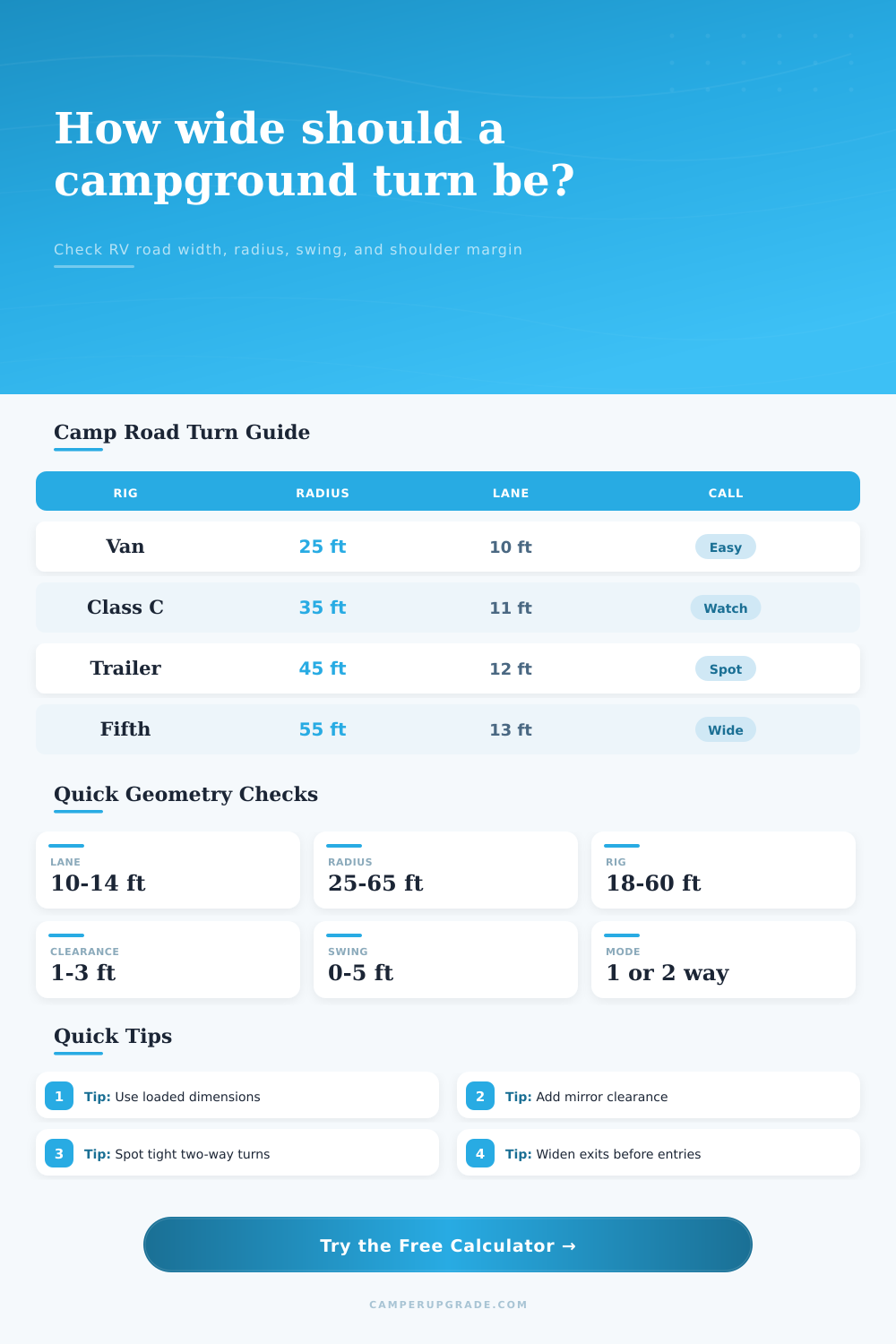
| Rig setup | Typical wheelbase | Typical trailer | Comfortable inside radius | Practical road note |
|---|---|---|---|---|
| Class B van | 12 to 15 ft | 0 ft | 25 to 32 ft | Often works on older one-way loops. |
| Class C motorhome | 14 to 19 ft | 0 ft | 35 to 45 ft | Rear overhang needs a swing buffer. |
| Mid-size travel trailer | 11 to 13 ft tow vehicle | 22 to 28 ft | 40 to 55 ft | Watch inner trailer tire tracking. |
| Long fifth wheel | 13 to 15 ft truck | 34 to 42 ft | 55 to 70 ft | Wide exits reduce shoulder drop-off risk. |
📏Inside Radius Effect
| Inside radius | Curve feel | Offtracking impact | Best fit | Campground caution |
|---|---|---|---|---|
| 20 to 30 ft | Very tight | High | Vans, small campers | Posts and rocks should be set back. |
| 31 to 45 ft | Moderate | Medium | Class C, short trailers | Spot trailers if shoulder is soft. |
| 46 to 60 ft | Comfortable | Lower | Travel trailers | Keep tree limbs outside mirror path. |
| 61 ft and up | Generous | Low | Fifth wheels, long rigs | Still check exit taper and road crown. |
⇄One-Way vs Two-Way Road Planning
| Road mode | Calculator comparison | Driver expectation | Use when | Extra buffer to consider |
|---|---|---|---|---|
| One-way loop | Full entered width is available | Can use most of road through the bend | Camp loops, dump station lanes | Add shoulder clearance near ditches. |
| Two-way road | Entered width is one lane only | Stay out of opposing lane | Park entrance roads, shared spurs | Add centerline and mirror separation. |
| Managed pinch point | Use one-way mode temporarily | Spotter controls traffic | Narrow bridge or gate turn | Post signage before the pinch point. |
| Pull-through curve | Use larger radius, same lane width | Low steering angle, low swing | Big-rig friendly sites | Check trailer tail against utilities. |
📋Lane Width and Clearance Reference
| Lane width | Best use | Shoulder condition | Typical comfort level | What to watch |
|---|---|---|---|---|
| 9 to 10 ft | Small one-way loops | Firm, clear edge | Tight | Mirrors, roots, marker posts |
| 10.5 to 11.5 ft | Standard camp lanes | Firm gravel shoulder | Moderate | Trailer tire cut-in |
| 12 to 13 ft | RV-friendly loops | Recoverable shoulder | Comfortable | Rear swing near site posts |
| 14 ft and up | Big-rig access | Wide clear zone | Generous | Exit taper and parked vehicles |
💡Practical Calculation Tips
Why? Because most accidents at campgrounds happen when driver doesn’t understand how much room is required to steer clear of a tree. I thought I was fine when I made that sharp corner and hit my side mirror, but now I am panicking because I’m inches away from crashing into a tree. Most campground mishaps happen because drivers underestimate the space needed to avoid trees rather then because of a loss of control… It’s all in the turn geometry, not necessarily driving ability.
Enter your rig’s specs and the calculator will do all the math for you. It’ll give you an idea of what size your ride takes up on the road, and how much clearance you have. One key variable is inside turning radius. You don’t drive a rig like a chunk of steel that rotates in place about its center. It tracks out to one side and then cuts back the other. This is what we call offtracking with the front end swinging far out as rear wheels cut in. This makes a long fifth wheel track a shorter arc than the cab of truck does. Think rear follows front and you’ll plow over a ditch or soft shoulder. Because it takes into account this difference between truck following and trailer tracking, the tool splits those variables and provides a swept width that’s based off physics.
How to Use the Turning Calculator
Experienced drivers understands the importance of shoulder clearance. That wide road surface doesn’t necessarily mean there’s usable space. The lane width is reduced by soft gravel, brush and drop offs. An eleven-foot lane on the map could be a three foot drop off and full of trees reducing your functional lane size to five feet. In this situation, add some extra room as a swing buffer. This will protect you when backing out of a tight spot with a trailer.
Campground roads also impose another set of limitations with two-way road. Because you have to drive within your lane, the maximum width you can use when making a corner is only half that of the gravel width. That’s why the road mode selector follows centerline boundary constraints and makes it calculate as though you’re sharing the road. A negative margin indicates the turn isn’t possible given the physical limits, which is important for collision avoidance with other vehicles.
So how does it get practical? First, you’d measure the loaded rig. Wind resistance increase with a roof-top cargo box. Spare tires mounted on the back swing wider than frame. Even a bike rack increases the effective vehicle length. Measure from the front bumper to whatever sticks out furthest in the rear (including mirrors if you wish to account for true clearance).
Enter the tightest part of that curve. Typically, the most restrictive spot is the turn’s apex. Say there is a foot of margin at the apex according to the calculator; chances are, you’ll have two feet at both entrance and exit points.
Here’s how it works: The reference table provides various rig configurations with their matching typical radius requirement: From this chart, you can see why your Class B van may only need a twenty-five foot turning circle, whereas a thirty-foot travel trailer requires almost double. It isn’t just length. Overhang plus wheelbase equals total swept path. If you have a long wheelbase, the whole thing has a greater swept path, though it doesn’t offtrack as much when making a turn. A short wheelbase allow for tighter turning radius but requires more care on the part of the driver to prevent jackknifing.
When you have your numbers you can relax. You no longer have to guess, it’s all planning now. You’ll know when it’s okay to come through that tight turn. You’ll be able to breathe. You won’t guess at any turns or bends in the road. You’ll know exactly where to put those tires on the ground and you’ll do it confidently.