Campground Electric Pedestal Load Calculator
Estimate 30A and 50A pedestal demand, diversity-adjusted kVA, simultaneous AC load, transformer size, feeder ampacity, and spare demand margin for campground electric layouts.
🏕Electric Layout Presets
⚙Pedestal And Demand Inputs
📊Calculated Spec Grid
🔌Pedestal Connected Load Reference
| Pedestal Type | Planning Voltage | Connected Amps | Connected kVA Per Site |
|---|---|---|---|
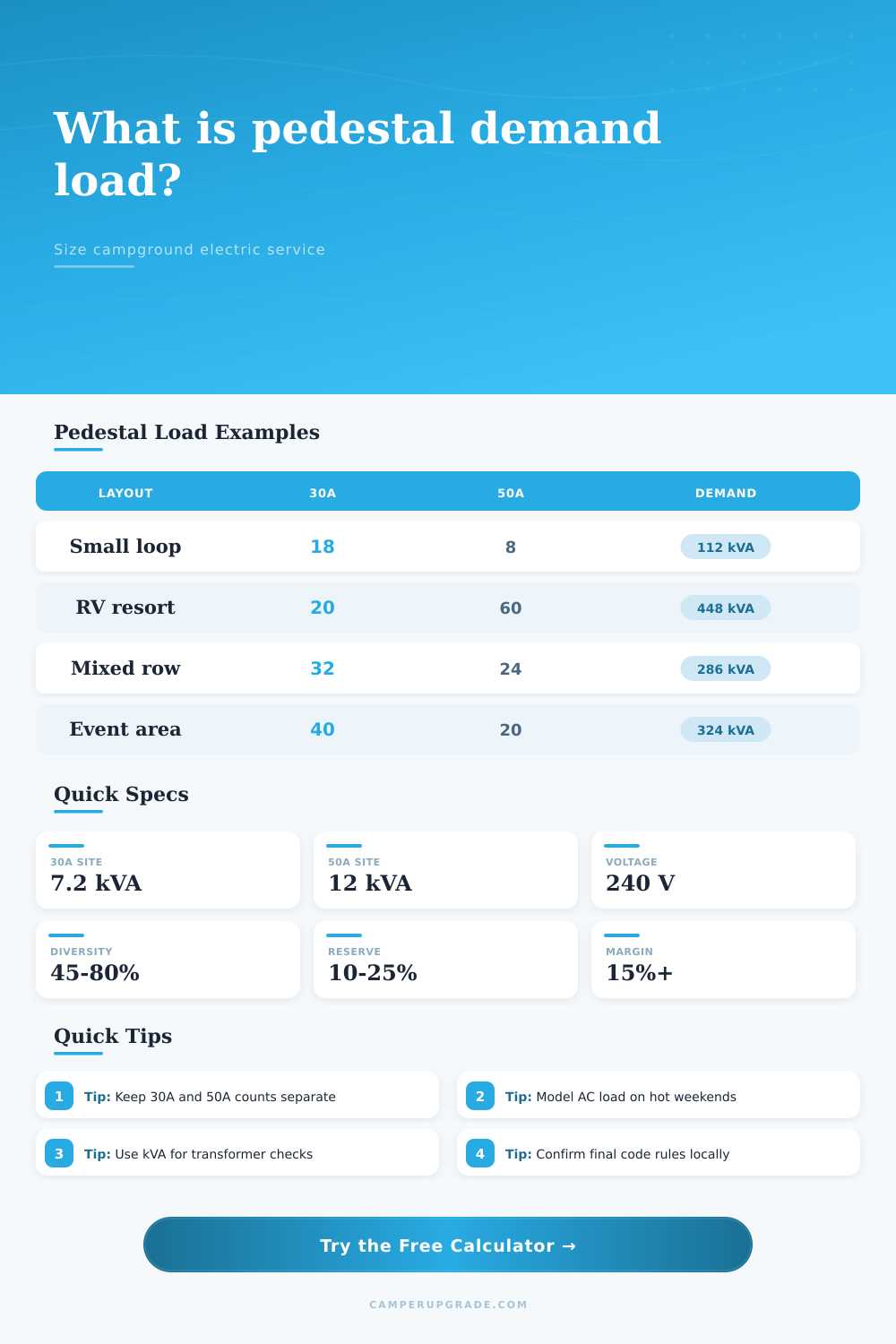
| 30A RV pedestal | 240 V | 30 A | 7.2 kVA |
| 50A RV pedestal | 240 V | 50 A | 12.0 kVA |
| 30A pedestal at 208 V | 208 V | 30 A | 6.2 kVA |
| 50A pedestal at 208 V | 208 V | 50 A | 10.4 kVA |
| Dual receptacle pedestal | Use highest served load | 30A or 50A | Do not add both unless both can be used at once |
🌡Diversity And AC Coincidence Table
| Campground Pattern | Diversity Range | AC Coincidence | Planning Note |
|---|---|---|---|
| Cool-season mixed camping | 40% to 55% | 15% to 30% of sites | Lower AC load but still check heaters and cooking overlap. |
| Normal summer weekend | 55% to 70% | 35% to 55% of sites | Typical mixed 30A and 50A park planning range. |
| Hot humid holiday | 70% to 85% | 55% to 80% of sites | Run this as the stress case for weak feeder sections. |
| Monthly or seasonal sites | 60% to 80% | 45% to 70% of sites | Long-stay campers often have more appliances operating together. |
| Premium all-50A resort | 65% to 90% | 60% to 85% of sites | Large rigs can make pedestal rating and transformer margin drive the design. |
🗂Transformer And Feeder Sizing Table
| Standard Transformer | 240V Single-Phase Amps | 208V Three-Phase Amps | Best Planning Fit |
|---|---|---|---|
| 75 kVA | 313 A | 208 A | Small loop, limited expansion, mostly 30A sites. |
| 112.5 kVA | 469 A | 312 A | Small mixed loop or retrofit section. |
| 150 kVA | 625 A | 416 A | Medium campground block with mixed pedestals. |
| 225 kVA | 938 A | 625 A | Larger mixed rows with meaningful 50A share. |
| 300 kVA | 1250 A | 833 A | High-demand loops, expansion feeders, or resort blocks. |
| 500 kVA | 2083 A | 1388 A | Large all-utility parks or multiple distribution sections. |
🏗Example Layout Demand Table
| Example Layout | 30A / 50A Sites | Assumed Diversity | Typical Demand Check |
|---|---|---|---|
| Small state park loop | 20 / 4 | 50% | 75 to 112.5 kVA transformer range. |
| Family weekend campground | 36 / 18 | 62% | 150 to 225 kVA section depending on AC load. |
| Seasonal lake park block | 48 / 32 | 68% | 225 to 300 kVA range with strong feeder margin. |
| Premium 50A row | 12 / 48 | 72% | 300 kVA or larger depending on shared loads. |
| Large rally field | 64 / 36 | 78% | Multiple feeders or large main distribution likely. |
📐Formula Notes
Connected kVA = 30A sites x voltage x 30 / 1000 + 50A sites x voltage x 50 / 1000.Design kVA = connected kVA x diversity factor + simultaneous AC kW + shared service kW.Required kVA = design kVA x (1 + reserve margin). Required amps = required kVA x 1000 / voltage, or divided by voltage x 1.732 for three-phase.
💡Pedestal Load Tips
One complaint leads to another until you realize your campground has electrical issues. The AC turns off. The microwave blows a breaker. The water heater won’t kick on. Campers pull out of full campground sites because they know it’s not working. And there you are, standing at a pedestal wondering why campers moved into sites where they shouldn’t of had to.
This is the point where good intentions regarding capacity meet the hard truth of electrical physics. A campground’s power plan is as much about anticipating people’s behaviors as it is about how many outlet there are. It isn’t sized for a calm Tuesday morning. It’s sized for the hottest day in July when everyone cranks up their air conditioners at once.
How to Plan Your Campground Electricity
After plugging-in your site numbers, the calculator do the rest. No more guesswork with conversions or coefficients. Before we can do that, however, you have to know the difference between demand load and connected load. The latter is like saying how many guests could use a space heater and run their A/C at the same time while also cooking dinner. It doesn’t happen, ever!
The former is demand load: what’s hitting the feeder. There is a gap between connected load and demand load. That’s where diversity comes into play. In other words, it’s the statistical likelihood that not everybody is using everything simultaneousy. If you’re located in a cool climate your diversity factor will likely hover in the neighborhood of forty percent. For a resort town in a hot, humid location, you want that diversity bumped up to about eighty percent.
Here’s where most folks go wrong: they’ll size based on the typical week and get hosed during the peak hour. Modeling this load is best done in your park by separating out your fifty-amp and thirty-amp sites. Larger rigs will draw more power and is typically assigned to the fifty-amp sites. They frequently run multiple electric heating systems or air conditioning unit. This hides the impact on individual feeder sections when treated as a blended average. You can tweak this split to match your actual guest demographic mix. If all your guests are small teardrop campers, your loop will look much different than a row for big fifth-wheel trailers.
Another factor is voltage. In most parks today, there’s split phase two hundred and forty volts. Commercial districts or older parks may still be using three-phase two hundred and eight volts. This voltage change have a huge impact on the current draw. This is a tiny detail, but it impacts voltage drop and conductor sizing.
The primary variable is air conditioning. That’s what tears up transformers. Model your total AC load based on the worst case realistic combination. If you’re in Arizona, assume almost everything is running. If you’re in the Pacific Northwest, take a bit more of a cautious approach. The calculator lets you enter the number of simultaneous compressors and their average wattage. This separates out the big motor load from the pedestal base load.
Office lighting, water pumps, bath houses, they all add up fast. They are continuous loads. Unlike RV plugs, which vary in how they are used, these shared service loads don’t see those benefits. They run at night too. Add them on top of the diversified RV plug load for your true design demand.
Theory meets hardware when it comes to transformers. No, you can’t purchase a transformer exactly matched to the load calculations. There’s no such thing. You pick the next available standard size. That forces you to include some sort of reserve margin. For new builds, the standard is a fifteen percent reserve. This provides you some breathing room for unexpected load spikes or just allows for growth potential down the road. If you’re retrofitting an existing park, maybe go with ten percent. But remember: you are gambling at that reduced level.
Ideally, you want to stay below eighty percent use on the transformer during peak hours. This will ensure the transformer stays cool and lasts longer. Electrical equipment is no different than any other piece of equipment; heat kills it. This breaks down the insulation and cause it to fail early.
It is the same with feeder ampacity. You need enough copper or aluminum wire to carry the current without excessive voltage drop. Too long a run from the main building out to a loop, more wire is necessary compared to a short run. This is where the calculator really shows you the relationship of the size of the transformer you choose and how many amps you’ll need in your feeder wiring.
If the number you get for your demand calculation exceeds what your feeders are capable of handling, you got a problem. You can either increase the wire, which is expensive, or limit the maximum use during peak hours. Alternatively, you can stagger AC start times, but this creates a bad guest experience. Increasing the wire is a budget problem. Limiting demand causes a bad guest experience. It’s all about risk management.
On one hand, you don’t want to be undersized and blow out your fuses during the busy season with brownouts. On the other hand, you don’t want to oversize everything to such an extent that you’re wasting money on equipment which is simply sitting there idle. Modeling accurately strikes the balance. Apply realistic diversity factors. Consider the heat. Honor the AC load at the same time. Include a margin for error.
Get this right, and the electricity simply works. Guests will never notice. That is the whole point.