Campground Electric Bill Estimator Calculator
Estimate a metered RV electric bill from appliance kWh, air conditioner duty cycle, seasonal usage, hookup amperage, campground rate, fixed fees, taxes, and stay length.
Detailed bill and load breakdown
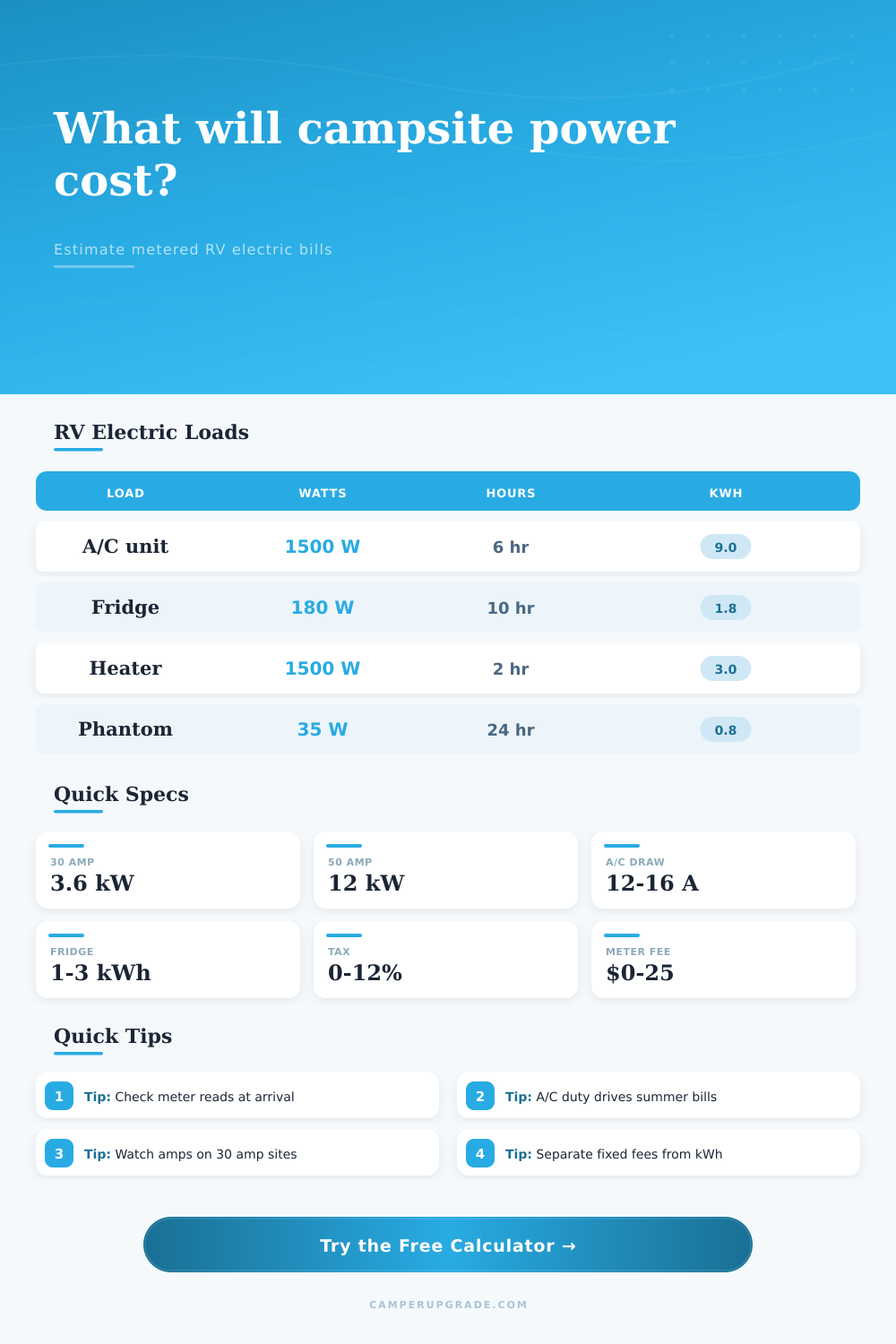
| Appliance or load | Typical watts | Daily pattern | Typical kWh/day |
|---|---|---|---|
| 13.5k to 15k BTU rooftop A/C | 1,300 to 1,800 W running | Cycles by thermostat and sun exposure | 4 to 30 kWh |
| RV electric water heater element | 1,000 to 1,500 W | Short recovery cycles after showers or dishes | 1 to 8 kWh |
| Absorption fridge on electric | 250 to 450 W cycling | Higher in hot weather and full sun | 1.5 to 5 kWh |
| Residential fridge or compressor fridge | 80 to 250 W cycling | Varies by size and ambient temperature | 0.8 to 3 kWh |
| Microwave or induction cooktop | 900 to 1,800 W | Usually minutes, not hours | 0.2 to 2 kWh |
| Electric space heater | 750 to 1,500 W | Can dominate winter metered stays | 3 to 25 kWh |
| Converter and battery charger | 60 to 600 W | High after battery use, lower at float | 0.5 to 5 kWh |
| Internet, TV, lights, and chargers | 30 to 300 W combined | Evening and workday use | 0.5 to 4 kWh |
| Season setting | A/C multiplier | Fridge and fan multiplier | Best use |
|---|---|---|---|
| Cool spring or fall | 0.50 | 0.90 | Open-window weather with short compressor cycles. |
| Mild mixed weather | 1.00 | 1.00 | Baseline for normal three-season campground stays. |
| Humid summer | 1.20 | 1.10 | A/C runs longer for moisture control even at moderate temperatures. |
| Hot dry summer | 1.35 | 1.15 | Full sun, desert afternoons, and high interior heat gain. |
| Cold winter electric heat | 0.10 | 0.95 | A/C load drops, but electric heat is multiplied by 1.25. |
| Hookup | Approx capacity | Continuous planning load | Watch items |
|---|---|---|---|
| 20 amp 120 V | 2,400 W | About 1,900 W at 80% | One heater or one small A/C leaves little room for cooking. |
| 30 amp 120 V | 3,600 W | About 2,880 W at 80% | One A/C plus water heater or microwave can trip the pedestal. |
| 50 amp RV service | 12,000 W total | About 9,600 W at 80% | Two A/C units, dryer, heater, and cooking can still stack up. |
| Shared or weak pedestal | Varies by voltage drop | Keep a larger margin | Low voltage raises current draw and stresses A/C compressors. |
| Billing item | How it appears | Calculator field | Why it matters |
|---|---|---|---|
| Metered kWh | Beginning read minus ending read | Rate per kWh and stay length | Directly scales with A/C, heat, water heater, and appliance use. |
| Daily utility fee | Small daily meter, utility, or resort fee | Daily meter or utility fee | Can be noticeable on long stays even when kWh use is low. |
| One-time read fee | Meter read, admin, deposit handling, or hookup fee | One-time read, admin, or hookup fee | Hits short stays harder than monthly stays. |
| Tax or surcharge | Local tax, utility tax, or energy surcharge | Tax or utility surcharge | Applied after the campground's stated taxable subtotal. |
A/C kWh/day = A/C units x running watts x thermostat hours x duty cycle x seasonal A/C multiplier / 1000.Total bill = total kWh x rate per kWh + daily fee x nights + one-time fee + tax or surcharge on that subtotal.Likely running amps = simultaneous running watts / service voltage; 50 amp RV service is treated as 12,000 W total capacity.
While you expect to be charged a reasonable amount to keep lights on and fridge cool, the final bill resembles something like running an industrial compressor overnight. The reason for this disconnect is most RVers don’t understand how metered campground power realy operates. You’re being billed for every kilowatt hour that moves past the meter. There are also usually additional fees added that isn’t related to your actual consumption. The key to avoiding sticker shock when you check out is understanding what you’re paying versus what you’re using.
It’s also the air conditioner, but here’s the nuance: That air conditioner doesn’t run all night long, day in and day out. No rooftop unit do. It runs, chills down your room, then stops. What you’re looking for isn’t the total runtime (on/off/on/off), but rather the run time percentage, the percentage of time compressor was actively running, rather than idling.
How to Lower Your RV Electric Bill
Duty cycle vary greatly depending on the amount of sunlight falling on your site. Thirty percent? That’s one shady location, maybe in July. Seventy percent? That’s a scorched-earth zone baking under a cloudless sky. The calculator up top will do the math for you; it’ll translate those vague percentages to concrete dollars so you can actualy understand how much more that additional sunshine is costing you.
Besides the cooling aspect, many folks are surprised by how much other silent energy hogs there is. In hot weather, for example, your electric fridge must work extra hard to keep cool; it pulls more juice to do so. Ditto with your water heater’s element. Most campers don’t think about turning it off while running their propane (or just never turn it back on again, which use several kilowatt hours each day yet doesn’t make anyone any cooler). And then there are those phantom loads: that Wi-Fi router, that TV kept going via inverter, that house battery charger/converter we use to top off our batteries at night. They don’t seem like much individually. But as a group over the course of two weeks, well, that’s another good-sized bite from electric meter. It is small stuff, but it adds up.
Finally, be aware of what infrastructure you’re hooking up to. There’s a limit to how many amps a particular site can handle. You can’t pull into a 30-amp site and expect to use the AC, turn on the microwave, and heat water all at once without tripping the breaker. That’s both a comfort issue and a safety one. The page has a handy table that breaks down wattage capacity for typical RV pedestals. That allows you to visualize the tradeoff. Perhaps you want to run everything, but maybe the pedestal don’t provide enough amperage. In that case, planning when you do your heaviest draws (so you don’t stack high draw appliances) becomes as important than planning how much you’ll spend overall each month.
And don’t forget about fixed fees and taxes that might be included in your estimate. A lot of campgrounds will include a once-per-stay meter read fee (or even a daily one) which is independent of usage. As a percentage of overall cost, this fee are a lower part of it when you’re there longer. But if you’re just there for a weekend, then this fee can throw off the estimated cost per kilowatt hour pretty badley. Also make sure to ask about taxes, did the rate quoted include them? Do they tack them on at checkout?
Finally Knowing your meter reading gives you awareness: when you get there, snap a photo of the meter readout. Remember that baseline before you do anything. Keep track of the big hitters (the water heater, the A/C). Treat your energy usage in your RV as a utility bill instead of an invisible cost and you’ll take back control. Adjust the heat, turn off the air conditioning, or simply understand your usage numbers so you know how they is calculated. That will allow you to enjoy the camping not the counting, and that’s one less thing you should of worried about.