Campfire Wood Needed Calculator
Estimate how many bundles, cubic feet, cord fraction, burn hours, and carrying weight to plan from fire duration, fire size, wood species, log diameter, moisture, wind, group size, use, and reserve.
Campfire wood estimate
| Wood species | Dry lb per cord | Volume factor | Campfire note |
|---|---|---|---|
| Hickory | 4,100 lb | 0.90 | Dense, long coals, strong warmth |
| White oak | 3,850 lb | 0.95 | Slow burn and steady coal bed |
| Red oak | 3,650 lb | 0.98 | Good campfire hardwood when seasoned |
| Hard maple | 3,500 lb | 1.00 | Balanced heat and flame |
| Ash | 3,250 lb | 1.05 | Moderate hardwood, easy to handle |
| Birch | 3,000 lb | 1.10 | Bright flame, medium burn time |
| Cherry | 2,900 lb | 1.12 | Medium heat and pleasant cooking coals |
| Douglas fir | 2,650 lb | 1.18 | Softwood, lively flame, shorter burn |
| Pine | 2,250 lb | 1.28 | Fast flame, plan more volume |
| Cedar | 1,950 lb | 1.35 | Very fast flame, better for kindling |
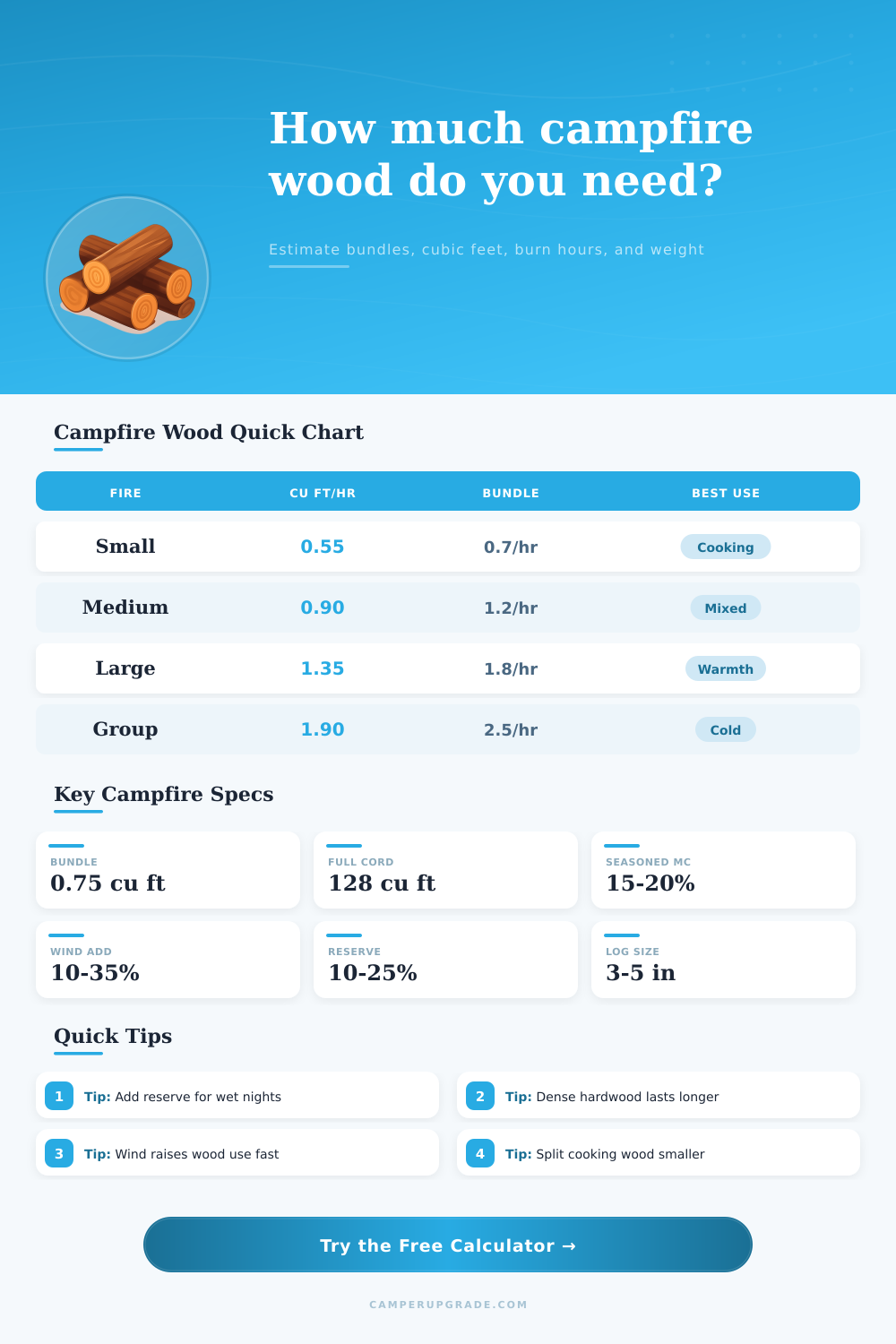
| Fire size | Base cu ft per hour | Typical group | Best use |
|---|---|---|---|
| Small cooking coal fire | 0.42 cu ft/hr | 1-3 people | Coffee, pans, low flame, short meal |
| Small social fire | 0.55 cu ft/hr | 2-4 people | Mild evening and controlled flame |
| Medium campfire ring | 0.90 cu ft/hr | 4-6 people | Mixed cooking, light warmth, conversation |
| Large warmth fire | 1.35 cu ft/hr | 6-10 people | Cool weather and stronger radiant heat |
| Group fire ring | 1.90 cu ft/hr | 10-16 people | Wide ring, frequent feeding, cold camp |
| Condition | Planning adjustment | What changes | Calculator input |
|---|---|---|---|
| Dry seasoned wood | 0-5% less | Lights easily and burns predictably | Use 15-18% moisture |
| Typical seasoned wood | Baseline | Good split campfire wood | Use 20% moisture |
| Damp or partly seasoned | 10-25% more | More energy leaves as steam | Use 25-35% moisture |
| Breezy open campsite | 15% more | Faster flame and more oxygen | Select breezy open site |
| Windy exposed campsite | 35% more | Very frequent feeding needed | Select windy exposed site |
| Wood amount | Stacked cubic feet | Full cord fraction | Common burn plan |
|---|---|---|---|
| 1 camp bundle | 0.75 cu ft | 0.006 cord | Short cooking fire or starter wood |
| 2 camp bundles | 1.5 cu ft | 0.012 cord | Small 2-hour social fire |
| 4 camp bundles | 3.0 cu ft | 0.023 cord | Medium evening in fair weather |
| 6 camp bundles | 4.5 cu ft | 0.035 cord | Large or breezy evening fire |
| 8 camp bundles | 6.0 cu ft | 0.047 cord | Group fire or cold night reserve |
| One tenth cord | 12.8 cu ft | 0.100 cord | Multi-night base camp planning |
| Campfire plan | Duration | Fire profile | Starting estimate |
|---|---|---|---|
| Quick cooking fire | 1.5 hr | Small coals, hardwood, calm | About 1 bundle |
| 2-person evening | 3 hr | Small social fire, light wind | About 3 bundles |
| Family s'mores | 2.5 hr | Medium mixed-use fire | About 4 bundles |
| Breezy lake site | 3 hr | Medium fire, breezy exposure | About 5 bundles |
| Group fire ring | 4 hr | Large ring, 10 people | About 10 bundles |
| Cold night reserve | 5 hr | Large warmth fire, reserve | About 11 bundles |
Planning a campfire require that you determine the amounts of wood that you must bring to the campsite prior to start the fire. The amount of wood that you will need for your campfire isnt determined by the length of times that you would like to enjoy your campfire. Instead, the amount of wood that you will need is dependent upon the type of fire that you would like to create, the type of wood that you will burn, and the environmental condition that will impact the burning of that fire.
The type of fire that you would like to build will impact the amount of wood that you need to start and fuel that fire. For instance, you will require less wood for starting a fire that will produce only coal, as those coals can help maintain heat with less wood. However, you will require more wood for a large fire that will produce many flame, as the fire will burn the wood more quick.
How Much Wood to Bring for a Campfire
The species of wood that you use will impact the amount of wood that you need for your campfire. Hardwoods, like oak or hickory, contain more energy per piece of wood then softwoods, like pine or cedar. Thus, you can burn less wood if its hardwood; hardwoods take more time to ignite.
However, softwoods ignite much more quickly and burn much faster then hardwoods. The moisture content of the wood will impact the amount of fire that burns. If the wood contain 20% moisture, that wood will have enough water to absorb the heat of the fire.
If the wood is too wet, the fire will use its energy to evaporate the water in the wood, preventing it from producing heat. Thus, if the wood is too moist, you will need to bring more wood than if you used dry wood. Additionally, if the area where you plan to start the campfire will experience wind, the campfire will consume wood at a fast rate.
Thus, you will need to bring more wood if the campfire will experience high wind. The size of the group that you will have at the campsite will impact the amount of wood that you need. If there are more individual at the campsite, you will need to burn more wood to keep everyone warm.
Additionally, more individuals will require that you feed the fire more frequently to maintain that heat for the individuals. Thus, the calculator account for the size of the group at the campsite. It is always a good idea to include some wood as a reserve fire for the campfire.
This additional wood will be required in case that the conversation at the campfire will last longer then you had estimated, or that the temperature at the campsite will drop. Additionally, if the weather is predicted to include wind or rainfall at the campsite, it is a good idea to bring more reserve wood. The calculator will indicate the amount of reserve wood that you should bring in the results of the calculation.
The diameter of the logs of wood will impact the amount of time that it will take to start the fire, as well as the length of time that the fire will last. If you use small pieces of wood, they will ignite quickly and be useful in the campfire; however, small pieces of wood will burn very quick. Large pieces of wood will take longer to start burning, but will retain their heat for longer period of time once they are burning.
The calculator will account for the diameter of the logs. The calculator will provide output for the number of bundles of wood that you need to bring, the total volume of the wood in cubic feet, the fraction of a cord of wood that the volume represents, the number of planned hours that the fire will burn (including reserve wood), and the weight of the wood that will help you to plan how to transport the fire wood to the campsite. To ensure that your campfire wood calculation is accurate, you should run the calculator twice.
Your first calculation should use the weather condition that you expect at the campsite. The second calculation should include increasing the settings for moisture content or wind at the campsite. The comparison of these two calculation will allow you to determine if you will need to bring additional wood as insurance for the fire.
Once you calculate the total amount of wood that is required for the campfire, you will know how much space the wood will take up at the campsite, as well as the total weight of the wood that you will need to carry to start the campfire.