Campfire Wood Per Hour Calculator
Estimate wood burn rate, total log count, bundle count, firewood weight, reserve wood, and remaining burn time from ring diameter, fire style, log size, moisture, wind, temperature, hours, and group plan.
🔥Campfire Wood Presets
⚙Fire Ring, Log Size, Moisture, Hours, and Reserve Inputs
⚙Campfire Wood Spec Grid
📋Campfire Wood Reference Tables
| Fire style | Rate multiplier | Good for | Planning note |
|---|---|---|---|
| Low cooking coals | 0.62x | Skillet, kettle, coffee | Smaller flames, steady coal bed. |
| Small tidy flame | 0.82x | Two people or short stop | Feeds slowly and conserves bundles. |
| Steady social campfire | 1.00x | Most family camps | Balanced light, warmth, and coals. |
| Large group flame | 1.34x | Group ring or scout circle | Needs wider ring and frequent feeding. |
| Cold-weather warming fire | 1.58x | Cold evenings | Higher heat target plus reserve. |
| Wood type | Density used | Burn factor | Log behavior |
|---|---|---|---|
| Pine or spruce | 30 lb/ft³ | 1.10x | Lights fast, burns quickly. |
| Douglas fir | 33 lb/ft³ | 1.04x | Good all-around camp wood. |
| Cedar or poplar | 27 lb/ft³ | 1.16x | Fast flame, shorter coal life. |
| Mixed campground wood | 38 lb/ft³ | 1.00x | Baseline for unknown bundles. |
| Maple or birch | 43 lb/ft³ | 0.94x | Stronger coals, steadier feed. |
| Oak or ash | 47 lb/ft³ | 0.88x | Dense hardwood, long coals. |
| Hickory or locust | 52 lb/ft³ | 0.84x | Heavy, long-burning fuel. |
| Ring diameter | Burn area | Typical use | Base effect |
|---|---|---|---|
| 20 to 24 in | 2.2 to 3.1 ft² | Small cooking fire | Low hourly feed. |
| 28 to 30 in | 4.3 to 4.9 ft² | Family camp ring | Normal bundle planning. |
| 34 to 36 in | 6.3 to 7.1 ft² | Group fire ring | Feed rate climbs quickly. |
| 40 to 42 in | 8.7 to 9.6 ft² | Large social circle | Reserve becomes important. |
| 48 in | 12.6 ft² | Big fixed ring | Use a smaller active bed if needed. |
| Formula item | Calculation | Why it matters | Typical range |
|---|---|---|---|
| Burn area | pi x radius² | Ring size drives base rate. | 2 to 13 ft² |
| Log volume | length x split face | Converts weight to log count. | 0.08 to 0.35 ft³ |
| Moisture factor | 1 + wet add | Wet wood wastes heat steaming water. | 1.00 to 1.45x |
| Wind factor | 1 + mph add | Draft increases burn speed. | 1.00 to 1.30x |
| Reserve wood | total x reserve | Protects the last hour of the plan. | 10% to 35% |
💡Campfire Wood Tips
To plan a campfire, you must determine how much wood you need to bringing to the campsite. It is very difficult to determine the amount of wood that will be required for the campsite due to the various variable that can affect the rate at which the wood burns. You must consider the length for which you would like the fire to burn and the number of individual that will be sitting around the campfire.
However, these two variable alone dont provide a complete calculation of the amount of wood that will be required. If you do not bring enough wood, your fire will go out due to the drop in the temperature of the campfire. Conversely, if you bring too much wood, you will be carrying more wood than it is required for your campfire.
How Much Wood to Bring for a Campfire
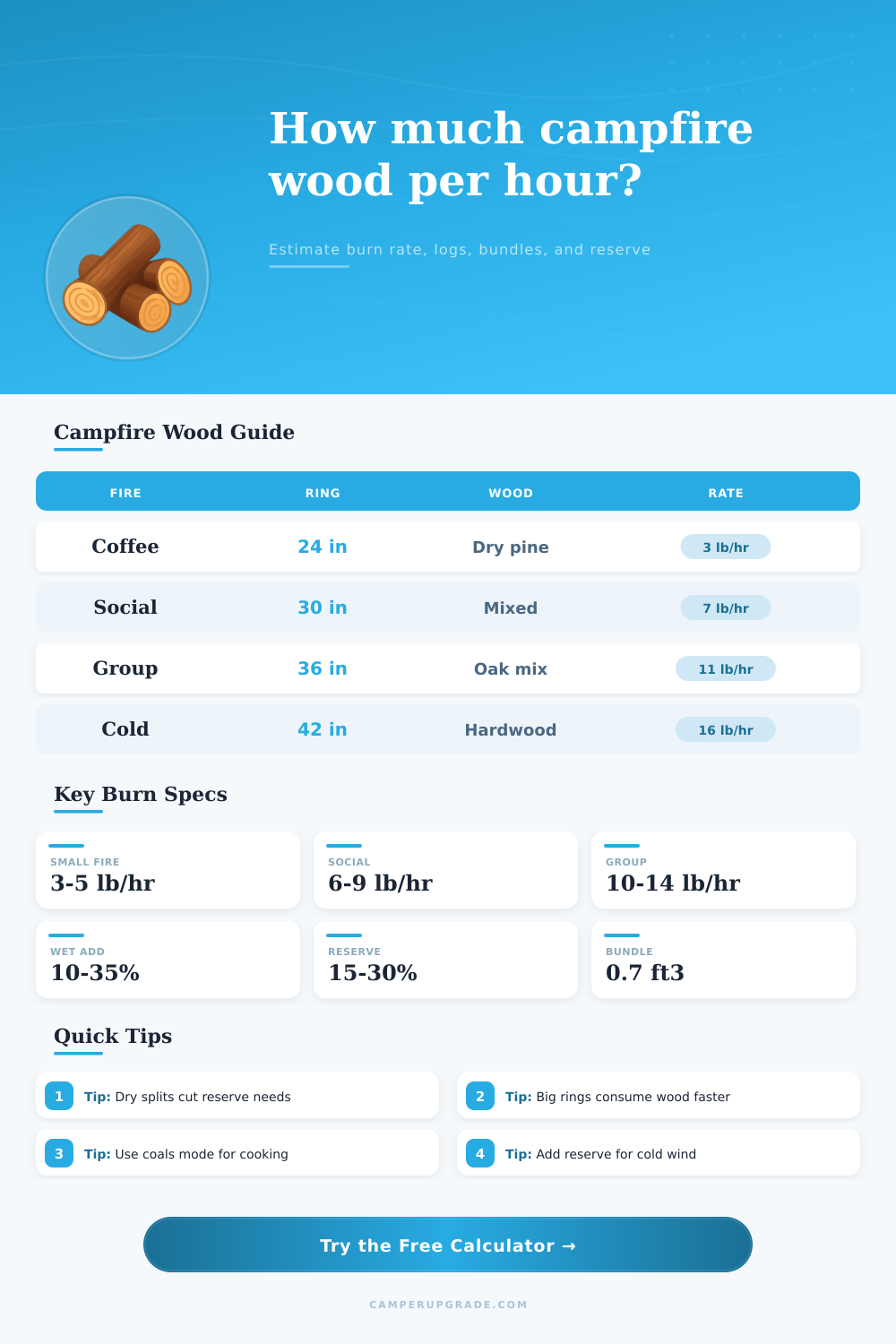
The amount of wood that the campfire consumes is mostly dependent upon the size of the area that is burning, which is determined by the inside diameter of the fire ring. The larger the diameter of the fire ring, the more wood that the campfire will consume each hour. Fire calculator can establish this initial calculation of the amount of wood that will be consumed by using the inside diameter of the fire ring.
After establishing this baseline measurement of the wood that will be consumed by the campfire, additional factor such as the moisture content of the wood and the speed of the wind at the campsite can be used to either increase or decrease the calculated amount of wood that will be consumed by the campfire each hour. One of the factors that can impact the amount of wood that is required for the campfire is the moisture that is contained in the wood. While the exterior of the wood may appear to be dry, the interior of the wood may contain some moisture.
In this case, the campfire will need to use some of its heat to evaporate the moisture from the wood. As a result, the campfire will not be utilizing some of its heat to create a flame. This results in the wood burning more fast than it would if the wood were dry.
As a result, more wood will be required for the campfire than the original calculation. Additionally, wind will increase the rate of consumption of the wood, as well. The wind will move the oxygen into the campfire, and the lifting of the flames will increase the rate at which the flames consume the wood.
The size of the logs that are to be burned can also impact the campfire. For instance, logs that are short and thick will take longer to ignite than logs that are long and thin. However, once the short and thick logs are burning, they will retain their heat more better than the long and thin logs.
The long and thin logs will light easily, but their flames will consume the logs quickly. You can use the fire calculator to test various size of logs. By using the calculator, you can determine how the size of the logs will impact the total weight of the logs that you will need to bring to the campsite.
An additional factor that you should consider is the inclusion of reserve wood. Reserve wood will serve to protect your campfire in the event of some unexpected change. At the campsite, for instance, an unexpected change may be an arrival of additional individual, or the wood may become damp while at the campsite.
Additionally, additional wood may be required to reach the desired temperature of the campfire in colder temperature. Thus, you should of brought some percentage of reserve wood before you leave the campsite to build your campfire. The calculator will show the amount of reserve wood in logs and in bundles that will be required for your campsite.
This will allow you to see the amount of reserve wood that is required for your campsite. Lastly, the number of variables regarding campfires indicates that the number of logs that might actualy be burned at the campsite will likely differ from those calculation with the calculator. Each individual has the potential to make various change to the campfire.
For instance, an individual might add an extra log of wood to increase the flame of the fire, or move some of the wood closer to the coals to dry the wood. Each one of these changes will impact the length of time that the fire burns. Thus, rather than providing the number of logs that should be burned, the calculator will provide a range of logs.
This range will help to indicate the number of logs that will be burned, but it will not replace your individual judgement regarding that number. One of the most useful habit that you can develop in relation to the fire calculator is to use it to calculate the amount of wood that will be consumed when the fire ring is of your typical size and the wood that you typically use for your campfires. Additionally, you can use the calculator to adjust for any change in the size of the logs that will be used for the campfire.
By using the calculator regularly, the range of logs that will be consumed will become more familiar to you, and you can ensure that you have enough wood to last the entire evening at the campsite. Additionally, you will avoid the need to search for more wood after dark.