Campfire Tripod Height Calculator
Size tripod leg length, apex height, chain drop, pot clearance, and fire-zone fit from your cookware, leg spread, terrain, hook hardware, and cooking heat target.
🏕Tripod Cooking Presets
⚙Tripod, Pot, Fire, and Clearance Inputs
The calculator models a three-leg tripod as a cone: apex height equals the square root of leg length squared minus foot radius squared. It then compares available hook height against fire height, clearance, pot body height, bail rise, hardware drop, and reserve.
🔧Tripod Material and Spec Comparison
Steel camp tripod
40-60 lbReliable for Dutch ovens and kettles when hinges and chain are rated.
Forged iron tripod
60-90 lbHeavy and stable, best for large pots over steady coal beds.
Aluminum tripod
10-20 lbLightweight for kettles; keep legs away from direct flame.
Green hardwood poles
20-35 lbField-built option with lashings; inspect knots and scorching often.
📏Useful Tripod Reference Values
📋Tripod, Chain, and Heat-Zone Tables
| Leg Length | Spread | Apex Height | Best Use |
|---|---|---|---|
| 42 in | 26 in | 36 in | Coffee pot |
| 54 in | 34 in | 47 in | Small stew |
| 72 in | 44 in | 64 in | Dutch oven |
| 84 in | 54 in | 74 in | Stockpot |
| 96 in | 62 in | 84 in | Group cook |
| Heat Zone | Pot Gap | Fire Type | Use Case |
|---|---|---|---|
| Low simmer | 18-24 in | Coals | Beans, stew |
| Steady cook | 12-18 in | Low flame | Soup, rice |
| Fast boil | 8-14 in | Active fire | Water, pasta |
| Sear heat | 6-10 in | Hot coals | Pan frying |
| Hold warm | 24-30 in | Edge heat | Coffee, sauce |
| Chain Drop | Link Step | Adjustment | Cookware |
|---|---|---|---|
| 6-10 in | 1 in | Fine heat | Small kettle |
| 10-18 in | 1-2 in | Normal range | 3-6 qt pot |
| 18-30 in | 2 in | Wide range | Dutch oven |
| 30-42 in | 2-3 in | High tripod | Stockpot |
| 42+ in | 3 in | Long hang | Large kettle |
| Pot Size | Loaded Wt | Min Tripod | Clearance |
|---|---|---|---|
| 1-2 qt | 4-8 lb | 40 in | 8-14 in |
| 3-4 qt | 10-18 lb | 50 in | 10-16 in |
| 6 qt oven | 18-28 lb | 64 in | 12-20 in |
| 8 qt kettle | 25-38 lb | 72 in | 14-22 in |
| 12 qt pot | 40-65 lb | 84 in | 16-24 in |
💡Tripod Height Tips
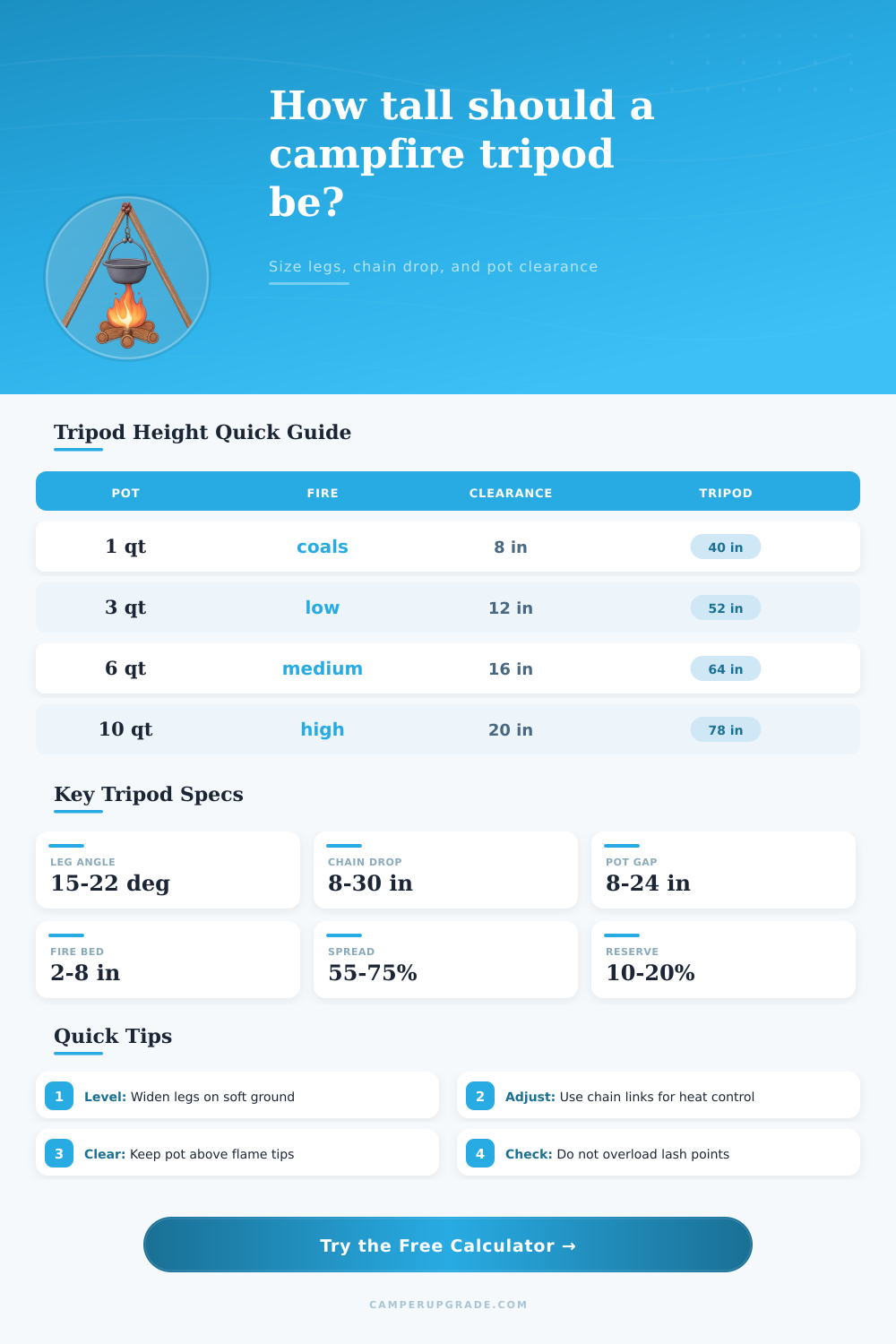
To effectively cook on a tripod, an understanding of the geometry of the tripod are necessary. The tripod will have three leg that come together at a single point: the apex. The height of the apex and the distance between the legs will determine the height of the cooking pot.
If the legs of the tripod is too close together, it will be unstably and may fall over when the cook attempt to stir the pots. Alternatively, if the legs of the tripod are too far apart, the apex height will be too low for the pot to be placed above the cooking logs. The spread of the legs should be between 55 and 75% of the total length of the legs for stability.
How to Set Up a Cooking Tripod
Another critical component are the distance between the heat source and the cooking pot, called an clearance zone. This zone will control the temperature of the pot’s contents. If the clearance zone is too small, the pot will be too close to the flame and the food will burn.
If the zone is too large, the food will not cook quick enough. The ideal distance is between 12 and 18 inches between the cooking fire and the pot. This range of distances will allow for the formation of a convection current that wraps around the pot to cook the food even.
The chain that is used to suspend the cooking pot from the tripod legs is the primary tool for controlling the heat of the pot. Using a long chain allow the cook to move the pot up and down to control the temperature of the pot. If the cook uses a short chain, they may be limited to one cooking temperature.
Calculating the height that the cook want the pot to reach must account for both the bail handle on the pot and the cooking tripod hardware. The bail handle is the handle that rises above the cooking pot. The hardware such as S-hook, carabiners, and swivels adds to the length of the chain.
This cooking hardware can add three to four inches of total drop in the length of the chain. If the cook dont account for this drop in height, the pot will be positioned too low on the tripod. Depending on the material from which the tripod is construct, the cooking tripods will exhibit different performances.
Iron is a very stable material that can hold heavy pot. However, the cook will find the tripod difficult to carry. Aluminum is a light material that is easy to carry.
However, if the tripod is made from aluminum, it can warp if it is too close to the cook fire. If wooden pole are used to make the tripod, care must be taken to ensure that the poles do not scorch. Additionally, the lashings holding the poles together may stretch out under the heat of the fire.
In this case, a height reserve buffer should of be provide. This provides for a margin of error in case the tripod’s legs is not level with each other. When cooking on a tripod, there are several measurement that must be accounted for.
For instance, the apex and leg spread must be accounted for, as must the length of the hanging chain. The leg spread must be stable and the chain must be long enough to permit temperature adjustment. By calculating the tripod’s cooking measurements correctly, a cook will be able to control the heat.
If the cook can control the heat from the fire, they will be able to cook the food to the more correct temperature.