Campfire Ring Size Calculator
Size a camping fire ring from inside firebox diameter, stone width, wall height, course layout, air gaps, gravel base, and seating clearance.
🏕Campfire Ring Presets
⚙Ring Diameter, Stone, and Firebox Inputs
This sizing tool estimates geometry only. Follow campground rules, burn bans, manufacturer limits, and local fire code before building or lighting any campfire ring.
🧱Ring Material and Spec Comparison
Concrete retaining block
Easy arcsPredictable face length, fast dry fit, best with a steel insert or fire-rated inner liner.
Fire brick liner
High heatBest thermal face near flame. Usually paired with an outer stone or block shell.
Steel insert ring
Clean fireboxControls ember contact and gives a known inner diameter for stone surround sizing.
Fieldstone wall
Natural lookNeeds larger overage because face lengths vary and courses rarely stack evenly.
📏Calculated Ring Geometry Snapshot
📋Campfire Ring Reference Tables
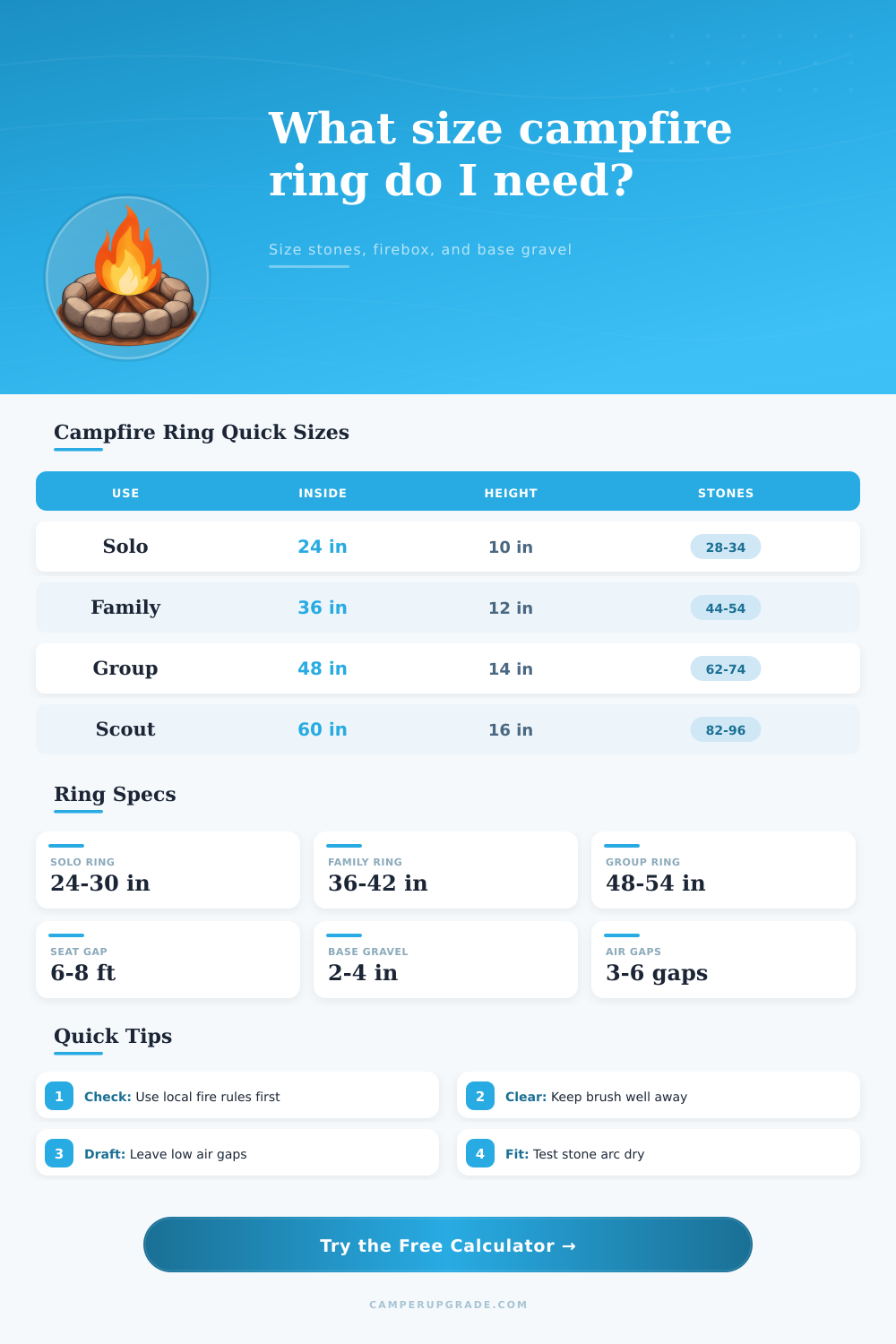
| Camp Use | Inside Dia. | Wall Height | Best For |
|---|---|---|---|
| Solo or canoe camp | 24 to 30 in | 8 to 10 in | Small twig fires |
| Couple weekend | 30 to 34 in | 10 to 12 in | Short evening fire |
| Family campsite | 36 to 42 in | 12 to 14 in | 4 to 6 chairs |
| Group camp | 48 to 54 in | 14 to 16 in | Cooking tripod |
| Large lodge circle | 54 to 60 in | 16 to 18 in | Wide seating ring |
| Inside Dia. | Circumference | Firebox Area | 36 in Insert? |
|---|---|---|---|
| 24 in | 75 in | 3.1 sq ft | No |
| 30 in | 94 in | 4.9 sq ft | No |
| 36 in | 113 in | 7.1 sq ft | Tight |
| 42 in | 132 in | 9.6 sq ft | Yes |
| 48 in | 151 in | 12.6 sq ft | Yes |
| Stone Face | 30 in Ring | 36 in Ring | 48 in Ring |
|---|---|---|---|
| 6 in brick | 16/course | 19/course | 26/course |
| 8 in block | 12/course | 14/course | 19/course |
| 10 in block | 10/course | 12/course | 15/course |
| 12 in paver | 8/course | 10/course | 13/course |
| 16 in stone | 6/course | 8/course | 10/course |
| Base Depth | 36 in Ring | 48 in Ring | 60 in Ring |
|---|---|---|---|
| 2 in | 1.6 cu ft | 2.8 cu ft | 4.4 cu ft |
| 3 in | 2.4 cu ft | 4.2 cu ft | 6.5 cu ft |
| 4 in | 3.1 cu ft | 5.6 cu ft | 8.7 cu ft |
| 6 in | 4.7 cu ft | 8.4 cu ft | 13.1 cu ft |
| 8 in | 6.3 cu ft | 11.2 cu ft | 17.5 cu ft |
🔥Fire Ring Material Reference
| Material | Typical Face | Thermal Note | Overage |
|---|---|---|---|
| Fire brick | 9 x 4.5 in | Best liner | 5% to 10% |
| Concrete block | 10 to 12 in | Use insert | 10% |
| Fieldstone | 8 to 18 in | Variable gaps | 15% to 25% |
| Steel insert | Fixed ring | Protects wall | 0% to 5% |
| Lava rock wall | 6 to 10 in | Heat tolerant | 15% |
| Base Fill | Approx. Density | Use | Drainage |
|---|---|---|---|
| Pea gravel | 95 lb/cu ft | Drain layer | Good |
| Crushed stone | 100 lb/cu ft | Firm base | Good |
| Lava rock | 45 lb/cu ft | Heat layer | Excellent |
| Coarse sand | 90 lb/cu ft | Leveling bed | Fair |
| Stone and lava | 75 lb/cu ft | Hybrid bed | Very good |
💡Campfire Ring Sizing Tips
When building a fire ring, you must plan the dimension of the fire ring and the material of the fire ring to ensure that the fire ring will function correct. A fire ring is a structure on which fire are built, and fire rings have specific measurement to allow for the log that will be burned within the fire ring. If the inner diameter of the fire ring is too small for the logs that will be burned, you will have to break those logs into smaller piece.
If the inner diameter of the fire ring is too large, then the fire that will be create will be too big to manage, and the wood will be consumed too quick. These measurements are for the inner diameter of the fire ring, not the outer footprint that the fire ring will make on the ground. Another important factor to consider when building a fire ring is the thickness of the material that will be use to build the fire ring.
How to Build a Safe Fire Ring
If thick stones or thick concrete blocks is used, the outer diameter of the fire ring will be larger than the inner diameter where the fire will burn. If the fire ring is too wide, the seating area will be further from the fire ring. People may also feel more further away from the fire when they are seated in these areas.
Fire ring dimension can help with planning the diameter of the fire ring and the number of stone that will be needed to build the fire ring. The material that you choose for the fire ring will determine how long the fire ring will last. Fire rings are often made of stone for they’re appearance.
However, stone crack when they are exposed to high heat. To avoid crack in the stones, firebricks or steel insert can be placed into the fire ring. These will act as a thermal shield to protect the outer stones from the heat of the fire.
Airflow are required for the fire to burn correctly and for the fire to have proper airflow to prevent smoke within the fire. If the fire ring is too seal, the fire may smolder and produce smoke. By leaving gap in the bottom layer of stones within the fire ring, the airflow will be allowed to reach the base of the fire.
These gaps will allow for better airflow within the fire ring, which will make the fire burn good. A proper foundation is necessary for the fire ring. The stones should not be placed directly on the grass or dirt that may become mud.
Instead, crushed stone or pea gravel should be used to create an foundation for the fire ring. Using crushed stones or pea gravel will create a level platform for the fire ring and will allow for drainage within the fire ring. Without drainage, the fire ring will become a puddle of rainwater.
Safety should of the primary concern when building a fire ring. One of the most important safety concern is the distance between the people and the heat of the fire. The fire has a radius of heat that spread beyond the fire rings stone wall.
The seating area should be created to account for the inner edge of the firebox rather than the outer edge of the fire ring. Placing the seating area for the firebox will allow the people to be at a safe and comfortable distance from the heat of the fire. By planning the dimensions and the materials of the fire ring, you can create a fire ring that will last a long time and be easy to maintain when it is burn.